Total Pageviews

Showing posts with label seed starting soil blocks. Show all posts

Sunday, May 15, 2011

Tomato Seedlings

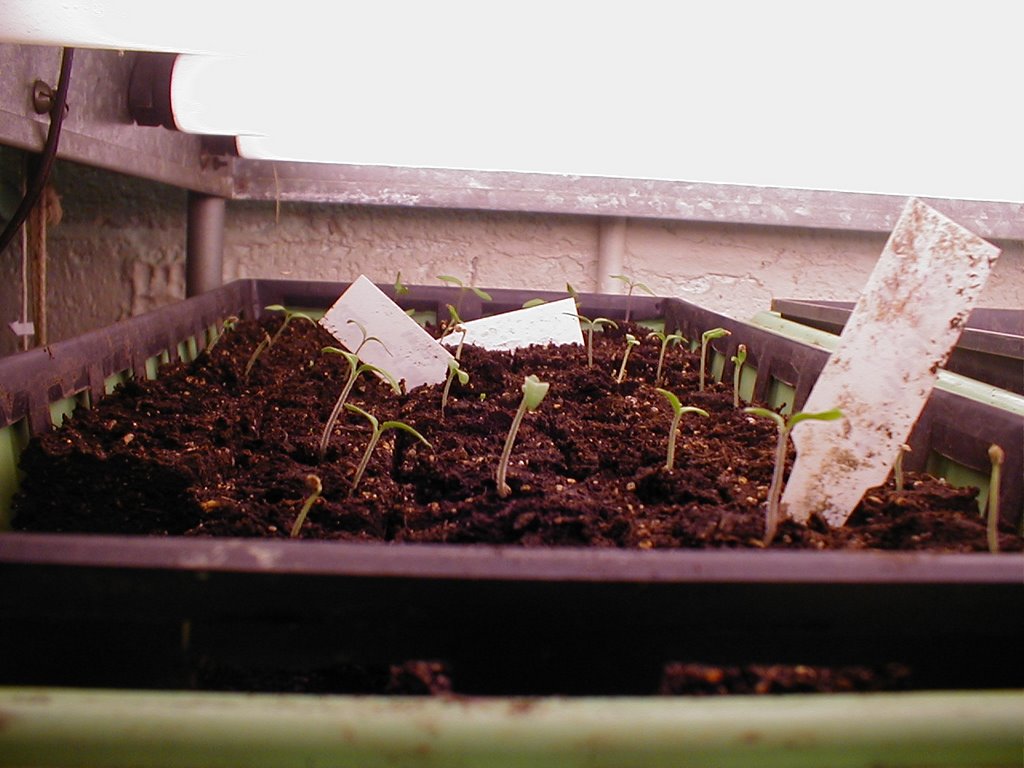
 The seedlings under lights.

Amish pasted tomato seedlings in small soil blocks. they are ready to go into 2" soil blocks where they will grow for 4 weeks and than be transplanted

A close up of the newly germinated maters (I believe they are 2 days old)


Tomato cotyledon leaves ready to lose the seed covering

Tomatoes under 24 hours old

Thursday, April 07, 2011

Starting the Peppers

We use soil blocks to start and grow our seedlings here at Boulder Belt Eco-Farm. We use the Eliot Coleman soil mix (with a few substitutions) to make our small and large soil block mixes.

below are some pictures of small soil blocks used for starting 300+ pepper seeds.


A tray of small blocks all ready to go. To the right is the metal pan (a full sized hotel pan I got back in my food service days, i believe from Sigma Alpha Mu because they used it for some extra-curricular activity, bent a corner and tossed it in the trash where I retrieved it and brought it home to start it's new life as a farm tool). The red thing is the block maker and the black stuff is left over moistened soil mix

The tray is filling up. Here I have completed the Revolution pepper seed

Almost done, I still had the Valencia (sweet orange peppers) and Jalapenos to go. The green thing is a hand seeder that I use. It makes the job much easier and faster over using one's fingers or tweezers.

the next step after getting all the seeds onto mini blocks is to water lightly with the sprayer and than cover the entire tray with black plastic and into a warm place. the seeds get watered about every day. We don't want the blocks to dry out but we also don't want the seeds to stay dripping wet either so they are checked morning and evening for dampness as well as for any signs of germination.

Once they start to germinate we make large soil blocks and put the little blocks and seedling into the square hole in the top of each large block and they are done until they need to be transplanted which should happen the end of May.

Saturday, December 25, 2010

My Christmas Present

Eugene asked me a few days ago if I wanted to know what he was working on for my Christmas present and I said no, I wanted to wait until Christmas to see the surprise that should have been built years ago (and I must say when he said it was something that he should have made years ago that did get my curiosity up).

So yesterday (Christmas Eve) we were in the barn and Eugene told me to follow him into the seed room. I had kind of forgotten about the Christmas surprise he had been building and thought he wanted to show me the onion progress (as we had just been talking about the onions). So I followed him into the room and lo and behold there was the big Surprise-A heat table so we can start more seedlings and get better and quicker germination. I am so stoked!


The heat/seed starting table. You can see it is a table with sides and has sand in it. The sand is a wonderful medium to grab heat and spread it out (i.e. an insulator). Plus it will absorb any water that gets on it. There are a couple of layers of plastic (which are 6 mil greenhouse film remnants). the flat with soil cones is there just to check temperatures ranges, there are no seeds in that soil

The Thermostat. I believe there is now a thermometer involved which is important as these heat tables can cook seeds and seedlings if not properly monitored.

A heat cable under sand and plastic

Friday, April 02, 2010

Saved Heirloom Seed to the Rescue

Yesterday was the day to start 700+ eggplant and pepper seeds. we like these seedlings to be about 7 to 9 weeks old when we transplant them out and since we transplant such warm loving crops out at the end of May/early June, April 1st seemed like the perfect time to start them (plus our biodynamic calendar, The Stella Natura sez it was a fruit time which is a great time to start fruiting plants).

In order to start seed you need to know a couple of things. How much space has been allotted in the market garden and how many varieties will be planted. I knew that there was a total of 40 50'x 4' beds reserved for all the night shades (tomato, potato, peppers, eggplant) and out of that 2 beds were reserved for eggplant and 16 for peppers. The next step was to go get the seed packets and see what we had to plant.

The eggplant was easy-we had a total of 12 different packets of seed. 6 of the packets were 6+ years old and so assumed dead so I tossed those seeds out (by tossing out I mean putting the seeds in the compost and saving the packets for other uses such as seed saving). This left me with 6 varieties-Dancer, Nadia, Casper, Galine, Rosita and Oriental Express. Since Galine was bought to replace Nadia and Rosita to replace Dancer (probably because these varieties come from Peto Seed which is a part of Semenis which is Owned by Monsanto, but I would have to look this up to be sure) and both those seeds are 3+ years old, they were not planted.

The peppers were also easy because most of the seed we are using this year we bought this year. So it was a matter of going through the pepper seeds and picking out all the brand new clean, unopened seed packets and putting them aside. I chose 7 varieties, Valencia, an orange pepper we have done for years and years because it is a great pepper, Islander, a purple pepper, Revolution, the best red bell pepper out there as far as I am concerned, Lipstick, a red pimento pepper that is new to us this year, Flavor burst, a yellow Italian type reputed to have great flavor (this is also a new variety for us this year), Jalapeno and Cayenne because, while we do not sell a lot of hot peppers, these two are pretty essential to have around for personal use.

I also used this time to figure out what tomatoes will be planted this year but that is another blog post for another time...

After I figured out just what varieties I would plant I than figured out just how many seeds needed to be started to cover our asses. There is a bit of an art to this. You do not want to run short and find you don't have enough plants to fill beds and you do not want so many that after you are all done you have many flats of seedlings sitting around that Eugene refuses to kill for months on end, getting bigger and bigger. You may ask why we don't sell these plants? We don't because by the time we know what could be sold (the leftovers after transplanting) it is so late in the home garden planting season that it is hard to sell vegetable seedlings, so we make a very feeble attempt at doing so. And we are not at all set up to do seedlings for sale. We need a lot more seed starting space and a proper greenhouse that can be heated and that takes $$$.

When I figure out how many seeds to start I take into account the germination will not be 100%, more like 80% for new seed and for seed that is 3+ years old much lower rates of germination. And at least 20% will die for some reason before transplanting. Our first year here we have had 90% die off due to mice decapitating most of the pepper seedlings. So I like to start around 50% more seed than is needed as it is always better to have it and not need them than to need them and not have them. And because we do a lot of heirloom and specialty hybrids it is not as if we can trot off to the local TSC or Wal-Mart and pick up packets of the varieties we need (actually when K-mart had the Martha Stewart seed collection I found for several things like Chioggia beets and Costata Romanesque zucchini were in stock). For most things we have to order through the mail which takes extra time (as I will not pay $50+ for over night delivery for a mofo $10 packet of seed).

Okay, so with all this information I went out to the barn and made 700+ tiny soil blocks, took a break and than came back with Eugene in tow to get all these seeds started as well as finding/making tags so we know what's what. This is simple and yet amazingly important step-all pepper and eggplant seedlings look a like, never ever think you can tell one from the other. And when it comes time to prick the seedlings into 2" soil blocks there will be trouble. There will be even more trouble when it comes time to transplanting the mystery seedlings as one would have no idea what goes where. The problems get even larger when harvest time rolls around 90 days after planting the seeds.

So we started sowing seed and find we did not order enough seed for many of the peppers. This is in large part because both Fedco and Johnny's have gone nuts on using very confusing and changeable units of measurement for their seed sales. Some seeds are measured using English units (oz, pounds, etc..) some use metric (grams, Kilograms, etc..) and some are sold by the thousand. So this means you have to have the ability to convert from measurement to another and it seems we are not great this ability (nor are many market growers, judging by the bitch fest about this topic on the market farming email list in Jan and Feb). Also Eugene's eyes are weakening and the boy is too vain to wear glasses (I am talking cheaters, not prescription) so he missed a couple of crucial decimal points and thus instead of ordering 400 Revolution pepper seeds (4 grams) he ordered 40 (.4 grams) - but we got lucky and Fedco sent 65, about 1/3 the amount we need.

This pisses me off because 2 years ago he did exactly the same thing (but that was the year of the terrible pepper season for western Ohio so it really did not matter in the end, we would have lost them no matter what). The good news is I can still order this variety through Fedco because after years of resistance they have on-line ordering and now will take seed orders until September, instead of shutting down the orders in early spring and I see they have Revolution seed in stock. So I have just ordered a whole gram of seed (Woo Hoo!!!).


Any Hoo, we found, in the end, we were short on a lot of pepper seed variety (due to the confusion of changeable metrics) and thus ended up with not enough potential plants to fill the space allotted. So I looked to see what we had in saved seeds from years past and found Chinese Giant in red and yellow. So I planted enough of those to fill up all the small blocks. these are older seed so they may not germinate well, if at all. And these are not my first choice as the fruit tends to come on late and the peppers tend to not ripen without getting hit with something, so low yields of usable fruit, generally. Still we did have these heirlooms on hand and they did save the day.

But now that additional Revolution seed has been ordered and should arrive in less than a week we should be all right for red bell peppers and probably won't need many of the Chinese Giant.

Tuesday, February 16, 2010

The Poor Man's Fertilizer

Like most of the USA we have been inundated by snow. I believe we have had around 21" fall this month and we still have a couple of weeks and at least one more snow storm to get through.

A hoop house covered in snow

So far we have not lost any hoop houses but it is not easy to get into any of them. The one you can walk to fairly easily has its' entrance covered with a 4' deep drift that extends about 10' out from the house. the other houses have no drifts in front of them but you have to slog through about 1/4 mile of beautiful powder in drifts up to 3.5' deep (and an average depth of 2'). So no one has been in them since I harvested greens for a customer and Eugene hoed beds the 4th of February. I suspect things are growing in the houses as the days are certainly longer and we have had several sunny days which means the hoop houses got above freezing (likely well above freezing).

Deep snow means you can't do a whole lot around the farm. We have started kale and lettuce seeds to go along with the onion, leek and shallot seedlings but other than putting the kale and lettuce germinants into 2" soil blocks as they germinate and watering everyone about every other day (over watering kills more innocent baby plants than anything else) takes maybe 4 hours a week. Fruit trees and brambles need to be pruned but at the moment that is an impossible task. We have to wait until the snow quits accumulating and starts melting.

The packing shed in winter

The snow melt is likely gonna be problematic. We have over 10" on the ground and there are a lot of piles and drifts that are much deeper all over SW Ohio. If we are lucky we will get warmish dry conditions and the snow will slowly and safely sublimate away. But what is much more likely to happen is rain which will clear away the snow in a matter of hours instead of a matter of weeks but this will also cause flooding. I am rooting for the quick fix and possible floods, otherwise we will not be able to prune, work the ground or transplant early crops until well into March and than we will be facing an overwhelming task of getting a lot done in a very short amount of time without a lot of help.


Betty in her element

The good news about the snow is Betty LOVES it. To her snow is the best thing since sliced bread. Little does she know that soon it will all be gone. of course when it goes away her bones and other toys will reappear and vole hunting will likely be easier. And there is likely to be a very healthy vole (and other small rodent) population this spring as deep snow is the perfect thing for small prey animals. iIt hides them from predators and it keeps them insulated from extreme cold and wind.


Chicken tractors just about covered by drifts. It's a good thing we don't have any right now, they would be miserable

The other good thing about the deep snow is it is keeping all our over wintered crops like the garlic and asparagus nice and cold. one problem with bare soil in winter is when if freezes and thaws you get frost heave which will heave bulbs and plants all the way out of the soil where they will die. A nice layer of snow stops this sort of thing from happening. Plus the snow will leave behind things like phosphates in the soil which are always welcome. Old time farmers call snow the poor man's fertilizer

Friday, November 21, 2008

Boulder Belt in Winter

Winter is here-it is cold, snowy and most everything that is not we covered is dead. This means things have slowed way down for us (yay!) It is nice to be able to kick back for a month or so before the 80 hour a week grinds starts again.

People want to know what we farmers do in the off season. For us, we spend a lot of November cleaning up stuff like the store, the garden beds, popcorn, catnip, onions. Crunching numbers on the various produce items we grow so we have an idea as to what is selling and what is not selling so we know what seeds to plant for the coming season. Eugene does not do much on the computer so it is me who keeps the blog and website updated and that can be time consuming, especially this year since it looks like Boulder Belt is back in the CSA biz and that means at some point I need to design an informative CSA page for the Boulder Belt Website.

December is too often spent removing snow from hoop houses and driveways. It is also the time we put in our main seed order with Johnny's Selected Seeds (our favorite seed house). In the past we have waited until after Christmas to put in our order but there are rumors that there will be seed shortages this year so I believe I will get at least part of the order in in early Dec. or even late November. December is usually the Month that we start the onions and leeks indoors, though this year I believe the onions will be started today or tomorrow (that would be mid November). The reason for moving up the date is due to the fact we have quite a few Copra onion seeds left over from last year and We decided that those should be planted to see if they have strong germination. If they do than we do not need to order more seed. If they do not than we will know by Dec 1st if the seeds are working or not and can get an order into Johnny's early enough to avoid the dreaded back order that can set one back several months.

If December, January and February are mild (which is the NOAA prediction for us this winter, but I will believe that when I see it) than the crops in the hoop houses will continue to produce pretty much all winter and someone has to go and harvest and package the crops periodically (weekly-as growth slows way down in the winter even if it is relatively warm and sunny). We than sell the greens, leeks, etc., at the Oxford Monthly Winter market and this year the CSA gets their share as well. We also sell through the store via email appointment and occasionally to a restaurant or Miami University.

If the winter months are cold with a lot of precip, than most things quit growing until Late Feb and cannot be harvested, the exception to this are the leeks and scallions. Than we sit around twiddling our thumbs waiting on the greens to come back to life. Okay, we don't spend much time thumb twiddling (but we do start craving greens in a big way and are delighted when things are harvestable again). If it is a snowy winter than we are spending lots of time removing snow from the hoop houses, otherwise they get flattened and are unuseable and have to be repaired or replaced. this has happened a couple of times to us and incredibly the crops under all the snow and plastic are generally unharmed and producing very well when we finally get to them

What we are doing by Feb is starting seriously seeds indoors. This starts out slowly with around 15 pots of onions and leeks planted in Dec/Jan. Those are followed by the brassicas-kale, broccoli, cabbages, etc., and lettuces in mid to late Feb. Those crops are repeatedly seeded indoors through April/May so we have a continual harvest April through June/July. By late March we are also starting early tomatoes, peppers, zucchini and melons to be planted in mid April in hoop houses. In April the main crops of tomatoes, peppers, eggplant, celery, celeriac, parsley, flowers, etc., are started which fills up the grow room along with cold frames and hoop houses with thousands of seedlings.

Once the seeds are started we are tied to the farm. The seeds need daily tending-watering, fertilizing, pricking (this means to re pot into a larger container), making soil (we make our own soil mix for seed starting as we have a hard time finding soiless mixes that don't contain petroleum products or chemical fertilizers. Add to that, we start seeds in soil blocks and we make our own soil blocks so the soiless mix has to be just so for it to work for us. Making our own soil blocks means we use very little plastic when starting our seedlings. It probably saves us around a thousand bucks a year as well (of course it increases our work load by at least 100 hours as we have to make a lot of soil and a lot of soil blocks.)

So you can see that we small sustainable farmers really don't have much down time at all. Some day, perhaps, we will quit this idea of winter growing and marketing and will shut the farm down in November and go to the Caribbean for 4 months.

Saturday, April 12, 2008

Getting Things Done

It rained early yesterday and we ended up with 1.5 inches which filled the market garden with water. So we got a day off from planting things in the garden. Instead I pricked 200 pepper seedlings (out of about 450 seeds planted-fairly bad germination) into 2" soil blocks and Eugene planted French and galia melons along with replanting zucchinis because the first bunch I planted had terrible germination due to me using old seeds. I got 6 seeds out of 100 (maybe more) to germinate.

Later we investigated the new to us Coke and Pepsi fridges and decided they needed professional help so I called up Lowman's in Eaton and made an appointment to have their commercial refrigeration guy come out early Monday morning to see what's wrong with them. This visit will likely be expensive but we need to get the fridges up and running before we open the store April 23rd, that's just 11 days away.

We also did thinking about our signage. We have a couple of big signs we bought from a Dunkard who used to sell/repair Howard Miller Clocks. He sold them to us many years ago for $50 IIRC. They have been sitting around posing as tables for several years and now we are finally able to deal with them. So now we have to come up with a design and find someone who will either put a vinyl design on them of someone who will paint a design on them. I am leaning strongly towards hiring a sign painter rather than someone who uses computer aided design to create signs. Not to mention, I feel vinyl is more toxic than paint (I am probably very wrong on this, I should ask my brother who knows his paints and toxins). As a person who was raised by real artists and has more than her share of art talent (which means you would think I could design and paint the damn signs myself but I keep running into creative blocks so the task keeps not getting done) I would be more comfortable using an artist and not a technologist to do the signs. the down side is there are not many sign painters left in the world-this craft is being destroyed by the vinyl sign industry which is sad.

Saturday, March 29, 2008

Seedlings!

Broccoli seedlings that are now out in a cold frame getting ready for transplanting in the next week out in the market garden.

One of our light stands with kale, lettuce and a few flats of empty soil blocks on the bottom shelf. This light stand is a homemade job. Eugene took 2x4's laying around the farm and built this in a couple of hours. the lights are shop lights/fluorescent bulbs hung from light weight dog chains. You can see on the bottom shelf that one side of the lights are higher than the other side.

The other light stand that had broccoli, kale, lettuce, onions, and a few other things. Most everything that was on this stand when the picture was taken is now out in cold frames hardening off. This light stand is a commercial unit we picked up at an auction about 10 years ago. We paid $50 IIRC and it lists new for around $1200. We have had to replace all bulbs many times (annually is optimal and we replace bulbs about every other season). We have had to replace the ballasts 2 or 3 times for each shelf. To increase use we have hung additional light fixtures from the bottom of the unit as well as from the ceiling.

Thursday, March 13, 2008

Seedling Madness

Yesterday was spent dealing with seedlings, lots and lots of seedlings.

The first round of lettuces went out to a hoop house where they will be transplanted in the next couple of days. The first round of onions and leeks went into a cold frame because they grow better in such conditions than under lights in a too warm and humid for them grow room.

I was good to see all those flats and pots of seedlings going outside because the second round of lettuces germinated and had to be put into 4 flats of 2" soil blocks (49 per flat). This round of lettuce includes two of my favorites-lollo rosa and cracoviensis, both heirlooms. Also did with 3 flats of kale-winterbor, Holona (aka Dinosaur kale) and Russian white. the winterbor we have been growing for years and the other two are new to us.

I still have to do up another 3 or flats of large soil blocks for the celery and celeriac that is just beginning to germinate. Hopefully, I will get to that today after harvesting the leeks for the farmers market this Saturday in Oxford. otherwise they will wait until Saturday afternoon or Sunday morning.

I also did another round of onions yesterday as the Stella Natura indicated it was a good day to plant root seeds. We thought we had enough planted with the first go round but two pots of red onion seed failed to germinate (well one had a whopping 2% germination rate, the other zero) leaving us with 6 pots of onions. So I prepared 6 additional pots and planted more Ailsa Craig, Boulder belt Sweets and some older Copra seed which had fairly poor germination but needed to be used up or thrown out so I sowed them very heavily in hopes of getting 2 full pots of seedlings. I also did a pot of some red onion seed Eugene saved last year that has been doing well for us.

While I was doing that Eugene made soil mix, trimmed the blackberry canes, carried lettuces up to the hoop house, tried to dog proof the fence only to find while he was fixing one part, Nate was wiggling out of a new hole he had created further down the fence line so he could run across 127 to see the dogs on the other side of the road. Damn Dogs.

And it is still early in the season. I have not gotten into the thousands of tomatoes, peppers, eggplant, basil, etc., seedlings that will be started in the next couple of weeks. Or all the seedlings that need transplanting or all the perennials that need mulching or the fruit trees that need pruning. We have a lot on our plates but it will all get done as it does every year.

Friday, March 07, 2008

Soil Block Redux

It's seed starting time so I though I would post a link to a nice soil block post I did earlier in this blog's life
Soil Blocks

Saturday, March 01, 2008

Things Are Picking Up

Things are beginning to pick up here at Boulder Belt Eco-Farm. We have several crops started under lights in the germination chamber (which is a room in the barn that has heat so we put all the seed starting equipment in there). We have broccoli, leeks, onions and lettuces growing at the moment.

The onions are germinating very slowly which has me a bit worried but I think the problem is the growing medium has not been getting enough moisture and has been allowed to dry out on top (these seeds are in rather deep pots so I am pretty sure there is water in the soiless mix just not where the seeds are). I noticed yesterday evening that the Copra onions are germinating fairly well as are both kinds of leeks but the rest of the onions are pretty hit and miss. But all the alliums seemed to respond to getting the soiless medium they are in very wet. I have not checked on them yet today (it is not even dawn yet). I am curious to see if they are growing better with more moisture. Or if I over did it and have started a mold problem.

The broccoli was started 4 days ago and within 48 hours had germinated. I am hoping that using the Stella Natura and planting the broccoli on a flower day will mean big heads this spring. last year we had a huge failure with the broccoli and in reading the How to use section in the Stella Natura I think I found out why. We planted the broccoli on a leaf day which means few broccoli heads and a lot of leaves, which is what we got. I did check to see when we planted the broccoli last year and sure enough it was on a leaf day. We also planted cauliflower on the same day and got spectacular (for us) cauliflower. It was the first time cauliflower actually worked for us and made beautiful heads and everything. It was a horrible seller (because the heads were not nearly as big as the chemically induced heads one sees at the grocery) so it will not be grown by us this year.

The Lettuce was started 10 days ago and is about 15 days away from being big enough to be transplanted into a hoop house. The plan was to do 200 heads of 6 kinds of lettuce, Simpson, (green leaf) Amish Deer Tongue (heirloom, green), red sails (red leaf), Marvel of Four Seasons (red bibb, heirloom), Lollo Rosa (red and green frilly lollo type, heirloom) and Cracoviensis (green and purple asparagus lettuce, ancient heirloom and one of the best tasting lettuces we have ever grown).

When we start most seeds we use tiny soil blocks. A seed or two is placed onto each mini block. When the seed germinates it is moved to a 2" soil block that has a square hole that is the same size as the mini block. Basically, I take the mini block and drop it into the hole in the larger block and I am done. Repeat the action several hundred more times. The large block is big enough to hold the seedling for 4 to 8 weeks which is about all the time that is needed before it is transplanted.

Squash is an exception, with squash we have no more than 3 weeks to get them transplanted. They grow big quickly. So starting early zucchinis can be tricky if the weather does not cooperate. This happened last year. We got squash started in March so it could go into a hoop house in early April and we got the Easter Freeze which made it way too cold for the zukes to go into a hoop house so we ended up tossing the plants into the compost, having no early zukes for the first time in about 5 years and starting over. hopefully we will be able to do early zucchini this year, that the weather Gods and Goddesses will smile upon us and allow a fabulous crop of specialty zucchini to come early to Boulder Belt and the Oxford Farmers Market and the SW Ohio Locavores.

Now that we have some crops started the next step is preparing a couple of hoop houses to receive the crops and than hardening off the seedlings and transplanting. Lettuce will be the first to go, than broccoli and than all the onions and leeks (which history tells us will take the two of us several weeks of transplanting to get everything in, unless we get some help). And of course, in that time we will be starting more seedlings in the germination chamber. Soon things will get a bit complicated, though nothing out of the ordinary.

Wednesday, February 27, 2008

Winter Inertia

It is the end of Feburary (close enuff) and therefore we are close to the end of the most boring, mind numbing time of the year for us farmers.

the seed orders are all in and most of the seeds and plants have been delivered to the farm. We still are getting seed catalogs every time we visit the PO Box. I guess these folks don't realize that if we have not order from them yet the chances of that still happening are quite small. But Since the chance is not zero they still have hope we will send them some money.

We have started some seedlings but not enough to keep us both busy for more than 45 minutes a day. So far we have onions, leeks, lettuces and broccoli started. The alliums and lettuces are germinating and the broccoli will follow suit in a few days as it was just planted yesterday. At this point we have somthing like 10 perma-nest trays full of seeds and seedlings and 12 nursery pots full of onion and leek seeds that are beginning to wake up.

It is still too icy/snowy to do much up in the garden. I suppose we could be clearing out hoop houses that have dead crops in them so we have room for the lettuces and other cold weather crops. But the inertia of mid winter seems to be preventing the two of us from doing much in the hoop houses.

Eugene is in the midsts of doing the state and federal taxes for 2007. I believe he is about 75% of the way through the taxes, maybe more. They seem to be going quite well, very little swearing this year, so far.

We have ordered 6 tons of compost from Fresh Aire Farms but don't know when that will arrive. Dan Young makes some very nice compost. We make compost too but ever since we got out of the laying hen bidniss we never seem to have enough material to make enough compost for the farm. And out compost is not nearly as clean and nice as Dan Young's so we for the second year in a row buy his to supplement what we make. And the bought compost is a tax write off of which which we are finding we need a lot more.

Soon enough the seasons will change and spring will be here and the work can start in earnest and I won't be so bloody bored

Friday, April 20, 2007

Harvest Day

Tomorrow we have a farmers market so today I spent harvesting, cleaning and packaging greens, radishes and chives. I got started later than I wanted to due to life interference. Let's see, I got a call from L saying she could not come out to help today (due to life interference). The dogs had to be fed and that means someone has to stand between Danny and Arlo so Danny doesn't chase Arlo off and than eat Arlo's food, while they eat (Arlo is too wimpy to stand up to Danny even though he is a lot bigger and has all his teeth). I put in laundry when I got up at 6:30 and figured it would better to hang it on the clothes line before I started work rather than hanging it up in the afternoon or completely forgetting about it and letting it get moldy and rewashing it all.

Finally at 8:45am I got up to the gardens with bins, towels to cover the greens so they do not get flaccid and a sharp pocket knife for cutting. I walked around removing row covers from beds that had havestable things for about 15 minutes and than started in on cutting spinach than moved on to cilantro, than spring mix, than mustard, than lettuce and I was done around 10:45am.

The next step was to wash everything which meant getting the wash tub (a 30 gallon Rubbermaid tub), The giant salad spinner and salt and white vinegar which I add to the wash water to kill slugs, rehydrate greens and kill any pathogens. Since we put in a new water line last fall I can now set up my wash station behind the store under the apple trees instead of behind the barn which means I do not have to go up any steps to get produce into the 3 door commercial fridge in the upper level of the barn (which should be moved into the store this Sunday-yay!).

Anyhoo I got the equipment together and the hose where I needed it and filled the tub and spent the next 2 hours cleaning up leafy greens and dumping them into the water to cool, rehydrate and get any dirt off. Than I would put them into the salad spinner to remove excess moisture than dump them into a towel lined bin and put that into the fridge so the produce could cool off for a couple of hours. I was done with that around 1pm.

Next was lunch (chicken sandwich and yogurt and bananas) and a needed break. Than I decided to transplant some germinating pepper and eggplant seeds from tiny soil blocks to larger soil blocks while I waited on the produce to get cold and than I made some labels for the bags and finally I was almost ready to bag up what I had harvested and cleaned.

So I started putting spinach labels on produce bags and than brought out the two bins full of fresh, sweet, crisp spinach and bagged up 10 1/2 pound bags. I repeated this with the spring mix, Mustard greens, lettuce and cilantro and put the d'avignon radishes and chives into bunches secured with rubber bands and put everything back into the fridge.

Tomorrow morning we will put everything into coolers and haul it to Oxford for market. If all goes as planned we will sell everything and not feel so poor (the weeks before the regular season starts-May 5th-are the nadir of the year financially for us).

I figure for every hour we spend at market selling we spend 8 hours growing the food and getting prepared

Monday, March 26, 2007

A Busy Monday

A busy Monday.

We had a woman named Lauren come out and helped us weed out the raspberry patch this morning/early afternoon. I met Lauren at the march Winter market in Oxford. She had just moved to town and needed a place to play in the dirt and asked if she could help us out. I said yes. And she works for food. She was an interesting person, secular and politically left of center and because she teaches Medieval Lit at a college in PA she is fluent in middle and old English. I think that's way cool. She's here to be with her SIO while on sabbatical. And she seems to be a careful gardener which is good. We have lots of work for her to do this spring.

When she arrived I was folier feeding garlic, spinach and the strawberry plants in a hoophouse (that are already in flower!). Eugene and I had already made 2" soil blocks and transferred some basil and pac choy to those and he was getting ready to plant more seed. he stopped his seed planting and worked with Lauren weeding out the raspberries for about an hour and when I was finished feeding fish emulsion to plants I got in on the action.

I noticed the raspberries are beginning to leaf out. This is early for them but considering we have had temperatures about 25 degrees above normal who can blame them. They probably think that it is far later in the spring than it is. They are hardy plants as long as they are not producing flowers and fruit so if they leaf out and the weather decides to go to 25 degrees below normal next week they should be alright.

Lauren had to leave around 2pm. She got a nice big bag of lettuce and a couple of garlic bulbs and a bag of dried basil. It's like having a CSA again only this time the member is engaged with the farm and I do not write a newsletter. Of course no money is changing hands, but that is okay with me. Right now we can use help more than cash.

After she left I read email and than ordered the first of the planned 600 meat birds. I ordered a straight run of 50 rock cornish cross day old chicks to be picked up this coming Sunday and a second batch of 100 cornish hen chicks to be picked up Easter Sunday. It sure will be fun to have baby chicks again. They are entertaining and a good source of meat, manure and income for us. Hopefully Danny boy and Nate will not think of them as snacks. Last year Nate was quite bad about wanting to kill the chicks but we managed to keep most alive other than the first day we stupidly put them on pasture and than left the farm to do a farmers market and also left the dogs out to "guard" the chicks. When we got home, Nate had pushed their fence down and had killed a couple of the chicks and was mouthing a couple of others when we arrived. We had to punish Nate and gather up about 25 peeps that had run into tall grass and weeds to hide from the huge predator and put their fence back together all before unpacking from the market. It was a bad scene, one that will not be repeated.

As I write this blog entry I am making a chicken and vegetable soup for dinner. I have been having cooking problems for the past week, ever since the element in the oven burned up. I find I am oven dependant and not having one has taken me out of my cooking comfort zone. Granted, I know how to make literally hundreds of dishes on the stove top but complete meals here often include baked squash, biscuits, a cake, roasted potatoes, roasted chicken, etc.. And at the moment I cannot embellish meals not make dessert from scratch (which is a good thing health-wise but a bad thing enjoyment-wise)

Wednesday, March 21, 2007

Happy Spring

We are enjoying our first full day of spring. it is 70˚F right now, mostly sunny with a stiff 15mph breeze.

Despite the warmth, it is not really the best condition to get done certain garden tasks such as thinning out and transplanting spinach plants so they can grow big (but we can do this during rainy days which it sounds like we will be getting several in a row starting tomorrow afternoon).

It is a good day to plant seeds and hoe beds and a little of both has been done today. We got most of the beds that will be planted with onions hoed up as well as beds for the second pea planting. I made soil blocks and planted 4 kinds of zucchinis-Costata Romanesque, green tint Patty pan, Sunburst Patty pan and Zephyr which is our best selling zuke (it's 1/2 green and 1/2 yellow).

This morning went to see the oral surgeon so he could check out the implant he put in my jaw 2 weeks ago. He said everything looked excellent and if I keep healing the way I have been I should be ready for the fake tooth in 3 months. My next appointment is June 20th.

Went to the Streit's to pick up our milk after getting my jaw checked out. They had just weaned a calf off of one of their milk cows and he was pitifully mooing for mom. Weaning is not a pleasant thing but a fact of life on any farm that breeds animals and pretty essential in the dairy biz. We saw Joe and talked a bit about the fact the ODA has dropped its suit against the Schmittmeiers who were told to cease and desist from selling raw milk about a year ago. I guess the new ODA head is not as adamant about prohibiting the sale of raw milk in Ohio as Fred Daily was . This is great news.

now it is time to fix dinner. tonight we are having sloppy Joes made with locally grown hormone/antibiotic free beef, Sloppy joe sauce I made last fall that was supposed to be homemade catsup, some onions and garlic we grew last year and peppers from the freezer. for a vegetable I will either cook up the chard we picked for market last Saturday that I kept back or I will go get some lettuce from the hoophouse and make a salad with the marked down organic maters I found at the Eaton Kroger's. I'm leaning towards the salad. I picked lettuce last night and it was really really good. And the bed does need some thinning so the rest of the lettuce plants get big.

Saturday, March 17, 2007

Seed Starting

Onion seedlings beginning to poke out of the soil

Late winter is when we start the first of our seedlings. Right now we have a lot of onion and leek seeds on the light tables. We also have been doing lettuce on a regular basis. next week the early zucchinis and cucumber seedlings will be started along with cabbages and broccoli.

Eugene watering the seedlings on a light table

Eugene is thinking about changing how we do the cabbages and broccoli. For the past 12+ years we have started them inside under lights using soil blocks. last summer Eugene direct seeded the last planting of cabbages and they were about the best cabbages we have ever grown. likely because direct seeded plants are always stronger and healthier than transplanted seedlings because the direct seeded plants do not undergo transplant shock which really weaken plants but its something you do not notice if all you do is grow seedlings inside for a particular crop. what he is thinking of doing is planting the broccoli in a raised bed built last year for spring mix. While we will have to transplant the seedlings they will be grown outside which should make them a lot heartier than indoor grown starts. And if some don't get transplanted they can grow in the raised bed as there do not seem to be any other plans for the thing.

Tuesday, May 02, 2006

Farmers' Market Starts and Other Issues


Today is our first market of the season. I feel like I should be a bit nervous and running around getting things together but other than harvesting crops, I think we are pretty much ready to go. And I should be out harvesting as it is dawn but we are having a thundershower so I will wait until the rain passes.

Picked up my new digital camera yesterday and of course I cannot use it because I am not running a new enough version of mac OS X. I have 10.2 and I need at least 10.3 to use the software that came with the camera so I can download the images to my hardrive via a USB cable. Not a huge problem as I have a 1 gig memory card on order form Amazon that should arrive in a couple of days and I will go to a local electronics box store to see if they have a card reader that is affordable (I suspect it will cost much less than buying the upgrade to Mac OS 10.3 which is around $100 US.). Despite the hardware/software incompatibility problems the camera is way cool and can do so much more than the old one.

After getting the camera and spending a couple of hours figuring out I cannot download pix to my Mac I went and started our tomato crop for the year. We are doing 11 different kinds of tomatoes: Glick's Pride, Big Beef, Pink Brandywine, Yellow Pear, Red Pear, Sungold, Yellow Taxi, Dr. Wyche's Yellow, Green Grape, Opalka and a Opalka cross we have been growing out for 3 years now trying to get one of the mutations to stablize out. We are going for the stripe genetics in hopes of creating a new striped sauce tomato. Should know something in maybe the next 4 to 7 years.

I started the tomatoes in small soil blocks and as soon as they germinate I will make 10 to 12 trays of 2" soil blocks and will move them into those. They are slated to be transplanted around June first and I do not want huge plants because they are quite hard to put into cloth mulches so that is why I started them so late in the season.

Tuesday, April 18, 2006

Good Days


Heirloom garlics on a beautiful mid April Morning

It's been an good past couple of days.

Got a worker lined up for June this morning. She’s the younger sister of this year's market manager for the Oxford Farmers' Market Uptown.

Saturday went to the Talawanda Alumni FFA auction to see if we could score a produce washer. We got out bid on that but did buy a couple of peach trees that were put in that afternoon. We also went to the last Winter market of the year as customers, not vendors. that was interesting, everyone wanted to know where we were and why we were not selling (had very little to sell). It was a beautiful morning and lots of people showed up to buy things. It probably helped that earlier in the week I emailed into a call in show on WMUB about cooking telling about the last winter market. Several people said they had heard my comment read on the radio. Nothing like a bit of free advertising. I bought eggs, a loaf of bread, a bag of chard (I have been craving chard) and picked up the milk order.

We got storms Friday and Saturday nights and 1.5 inches of rain so Sunday not a lot got done, it was just too wet. Monday I made many trays of soil blocks, pricked broccoli and cauliflower into larger blocks along with some mystery peppers I found in a bucket of discarded small soil blocks (we recycle the soil blocks and sometimes they have seeds that were not germinating when they were in trays but will once they get covered by soil in a bucket). I was happy to find all these pepper seedlings. I need to replace the ones that the mouse/chipmunk critter ate. I just wish I knew what kind were. And I started 17 different kinds of flowers to be put here and there around the farm and Eugene put in about half of the onions we started in pots and cut up (chitted) the potatoes for the first planting of the year.

Today Eugene put the plastic over the 3rd hoophouse and is preparing ground for leeks and planting the 2nd succession of peas. Later on today we plan on putting in kale, cabbage and broccoli seedlings as well as the last of the onions in pots.

Right now I am waiting on the last rise of a loaf of maple wheat bread than into the over for it. So I blog.

Monday, April 17, 2006

$%%@#@^&**^ Mice Redux


Peppers seedlings on a light table about 7 days ago before being beheaded by a small critter


Living and working on an organic farm may seem to many to be the ultimate way to live one's life free of stress and full of beauty. These would be the folks who have bought into the romantic ideals of farming. In reality farming is one of the more stressful jobs you can have. You are at the mercy of the elements and wild animals both big and small. And either can destroy a lot of work in a very short amount of time. We have, in the past, had wind take out hoophouses, floods kill crops in the fields, odd/early cold snaps do great damage to cold sensitive plants, birds and dogs take chickens. These are things farmers stress about

We recently have been getting a lot of mouse or chipmunk damage to our pepper seedlings. Some critter gets on the light tables and eats the heads off of the baby plants. This is real nice to find first thing in the morning after you have spent half a day, the day before, making soil blocks and moving germinating seeds to bigger blocks. So we have been doing many superfluous things to stop the critter and few have worked.

One night we put cardboard guards around all the legs and cords thinking this might stop the critters from climbing onto the stands. No dice, they breached our system easily and beheaded more seedlings. We have traps and about once a week one gets a mouse and on Friday put out more traps in the grow room. Took down the plastic sheet that was dividing the room in half making it easier to heat the area where the seeds are germinating. And than we moved all the stands away from the walls (thinking mice can climb rough brick walls easily) on Saturday with the help of an old friend, Scott, who showed up to volunteer his time on our farm (he helped put in 2 peach trees and start the trellis for the grape arbor as well). We also moved a lot of the seedlings out to cold frames since no critters are eating the seedlings in the cold frames. But because a cold front came through last (Sunday) night it is now too cold to keep things like peppers and eggplant in the cold frames so back to the warm grow room they went. It's a damned if you do damned if you don't situation. Leave the peppers outside and they will get cold damage. Take them inside and they may get killed (but at least if they do not get beheaded they will produce later in the summer, the cold damage seedlings will not, been there, done that)

Yesterday evening Navin the senior cat had killed a mouse outside the grow room door.

Maybe, just maybe, all these things together will stop the pepper seedling carnage. There was no damage Sunday to what was left of the seedlings so perhaps we have made it too difficult for the mice to get at the seedlings (we also have removed all germinating melon seeds from the barn altogether as these seem to be prized fare for the critters and a huge attractant). I have not checked things out this morning. But I am hoping that I will not go in once again to see all my work destroyed.

Today the plan is to replant the peppers and if these get killed than I will have to either buy pepper seedlings (very expensive), plant again and hope it is not too late in the year to get a crop (it takes about 8 to 10 weeks to get peppers ready for transplanting than it is another 80 to 110 to get ripe peppers and if these things get planted past mid June there is not enough time left in our growing season for this to happen) or just give up altogether and have no peppers at all (not acceptable, we make decent money off of this crop plus I use a lot of peppers in my cooking).

I hope, at this point, the critters have found the room not as hospitable and better things growing outside now and will leave the seedlings alone.

Tuesday, April 11, 2006

Another Busy Spring Day

A shot from the Friday storms. The grass is a lot greener now than it was than. the boxes in the foreground are coldframes that were empty than but now full of brassicas and tomato seedlings.


It's been a busy spring day. It got up past 70˚F and was nice and dry. So Eugene and I finished prepping the plowed beds for the tiller. This meant squatting and heaving large chunks of sod back into the beds that the plow had placed in the aisle ways. It was a good aerobic work out but hard on my sciatic back. After a bit of dirt heaving Eugene got to tilling the beds we had just worked on and I worked on making mix for soil blocks and making soil blocks until I ran out of permanest trays.

At that point I got to inspecting the seedlings and noticed more mouse damage. The little F***s have now eaten several melon seeds, about half of the fat n sassy peppers seedlings (I hope there was enuff toxicity in the seedlings to at least give the rodent a good belly ache) and also has dug into the soil blocks displacing seedlings. I moved the melon flats to a shelf that so far the mouse/mice have not been able to get to and put a lot of things into the cold frames where they should be safe from marauding mice.

After lunch we set out to put in 4 flats of heirloom lettuce (marvel of four seasons, lollo rossa, nancy and rouge d'hiver. Okay, nancy is a hybrid bibb lettuce but the rest are all heirlooms and tasty). Eugene looked at the bed where we wanted to put the lettuce and decided 2 passes with the tiller was not enough and did a third. After he finished with that bed he did all the other beds that needed a 3rd pass (about 12) while I got the things together for the lettuce planting. To do the job right you need to have the plants, a bucket of compost, wire hoops for the row cover, row cover, rocks or bricks to weigh down the row cover, a rake to rake the bed and a trowel. So while he tilled I got everything together and brought it all to the work site.

Together we put down compost and than soil blocks with a lettuce plant in each and than started putting them in the soil. After planting the lettuces I watered them, put up the hoops and pulled the row cover over the hoops. Et voilĆ  we were done with our second lettuce planting.

So the next thing to do was to check in on the newly planted cukes and zukes in the hoophouse. Not good. A vole or mouse had spent the afternoon while we were planting and tilling munching cuke and zuke plants along with some light arugula grazing. So we pulled the row covers off of the plants and thought about pulling the black landscape fabric off the ground because the little $#@@# like to hide and nest under mulch but than decided the weeds would over come the cukes and zukes so we left the stuff down. I think we need barn and field cats to control the rodents before they eat us out of house and home. All we have is Navin, a good hunter but the boy is going on 15 years of age and Trina who is clawless and does not know about hunting (we did not declaw her she came to us with her fingers already amputated). I sure wish we still had shiva around, he was a great mouser and voler. The dogs are into killing voles but they tend to dig after them and do more damage to the plants than the voles.

Now the sun is setting and it is time to do something about dinner