Total Pageviews

Showing posts with label Thanksgiving. Show all posts

Saturday, December 05, 2009

The Day After Thanksgiving

We had a lot of people come to the farm for Thanksgiving. My Cousin Jack Showed up with his niece (and my 2nd cousin probably once removed), her baby and her SO, Jeremy on Wednesday from the greater Detroit metroplex. On Thursday My Brother, Scott arrived (from the exact same place as Jack) and soon after my Niece Carrie and her SO, Ivan and her BFF Katrina showed up from Bloomington, IN. Than my Brother in law Dave arrived with the cranberry sauce and later Doreen and her SO, Thad, showed up with yams and Mac and Cheese. Hours later our friend Wyatt showed up with bread that no one wanted because we were all too stuffed on turkey, taters, mac and cheese, salad and wine. Wyatt left us several loaves and they were quite tasty.


These pictures are of the morning after thanksgiving after everyone but my brother had left. We took a walk around the farm and had a small bon fire in order to burn the last of the blighted tomato plants and a bunch of sisal bailing twine used to support the blighted maters.

Eugene and Scott looking at the pond


Nate running towards me


Still looking at the pond


Milkweed


Golden Rod on the 40' pitch


Frosty Kale. Scott thought this would be a great shot. I think the idea was better than the shot

After Scott left for Detroit we went to Trenton to pick up 6 gallons of raw milk at Double J farm and I took this shot of the dairy cows through the barn. Notice the pasture is very green for the end of November and that has translated into a lot of yellow cream on the milk, something I have never seen in the many years I have used raw milk. Usually this time of year the cream is thin and white, barely any different from the milk. But because November has been warm and sunny the pasture has continued to grow

Wednesday, November 26, 2008

Brining Birdzilla

Happy thanksgiving. Tonight I write the obligatory what am I cooking for Thanksgiving blog entry. I am hosting 8 of my relatives tomorrow and we will be feasting on predominately locally sourced food. I am supplying the Turkey which is a 22 pound pastured raised certified organic bird raised here in Preble County by Dale Filbrun. I am brining the bird as I write this in a solution of 3 gallons of water, 2.5 cup of table salt and 2.5 cups of sugar. He will sit in that bath until 5 am or so, than be removed, rinsed and allowed to dry for a couple of hours before going into the oven to cook for 5 hours (basting every 30 minutes or so after the 2nd hour).

I am also making dressing/stuffing that will use organic bread cubes (which I already made this afternoon), organic celery from Kroger's (our celery got nuked several weeks ago by frost), our celeriac, our onions, our leeks, our apples, our pears, walnuts, the turkey stock I am making right now, parsley, sage , rosemary and thyme from our farm, mashed potatoes from our taters, Spring mix we grew, steamed chard we grew, biscuits and Eugene is making 2 pies-strawberry rhubarb and apple all with home grown fruit. My brother Scott is bringing a pumpkin pie from the Motor City, otherwise Eugene would have made a squash pie.

My sister in law, Doreen, is bringing Mac and cheese and sweet potato casserole with the marshmallows.

I have the silver polished up. It is my grandmother silver and I am also planning on using the chine she bequeathed to me. It is referred to as "The Spode". I seem to have 7 complete place settings and 8 big plates so will have a bit of mix and match in the table setting dept. Same with the silverware. There should be 12 settings but a lot of salad forks are missing along with a couple of dinner forks. Hmmmm...

So there will be a mix of really fancy silver and not so fancy silver. And a lot of great food plus various libations such as home pressed apple cider, home brewed beer, other beer, Oban scotch, water, wine

So you might be wondering about the title, Brining Birdzilla. Birdzilla came into being back in the late 1980's/early 90's. A friend of mine named Amy bought a turkey for Thanksgiving. Amy was (is) a person when food buying tended to go overboard. So for a party of 6 i believe she bought this huge turkey, maybe 30 pounds and put it in a mutual friend, Bitt's, fridge because it had nothing else in it and Birdzilla fit in his fridge. I did not partake in that first birdzilla feast as I had family obligations that year. But after that whenever I got a huge turkey (anything over 20 pounds) I have referred to it as Birdzilla. The biggest birdzilla was over 30 pounds. It barely fit in the oven.

This year Birdzilla is 22 pounds. Dale told me when I went to pick up the turkey at his farm (where I watched the flock of Christmas turkeys roam around with 3 chickens) that because of the long Indian summer the turkeys grew a lot bigger than expected so instead of getting a 15 pound bird I got a 22 pounder. He said I could have gotten a 40 pounder if I wanted (no thanks been there, done that). Birdzilla is brining for the next 10 or so hours and by this time tomorrow he will be history, and a tasty one at that.

Thursday, November 22, 2007

Thanksgiving Brew

It's thanksgiving and we at Boulder Belt are not eating a turkey dinner (mainly because I did not hop to it and order a pastured turkey from the Filbruns a month ago and when I asked 2 weeks ago if they had any left they said no, they were sold out) this year. nor are we going to anyone's home to feast upon their turkey and trimmings.

No, we are staying in and the plan is to brew beer all afternoon. We shall consume the first of this beer on New Years Day. So truly a holiday brew.

Our friend Wyatt says he is coming over with home made bread and a wort chiller. Eugene made a green tomato chutney yesterday so I am thinking making a vegetarian curry for dinner. We have a lot of greens left over from last Saturday's Winter market that need using as well as peppers, onions, snow peas and leeks. I could also throw together a salad (we have a lot of salad greens too).

This is the first Thanksgiving I have not celebrated in my life. Usually I am cooking at least one meal. Some years when I was working in food service by Thanksgiving day I had cooked over 10 different Turkey day feasts. This year nothing and I gotta say it is nice not to be responsible for dinner for many.

My sister quit celebrating years ago (20 years?) when her infant daughter suddenly died of meningitis the day before Thanksgiving (nothing thankful about that!). Go forward about 16 years and the Owsleys are in Detroit dealing with our mother dying of a stroke. She died 2 days after Thanksgiving that year. The T-day dinner that year was leg of lamb, a big salad and lots of wine and beer. Not very joyous but we made the best of it. At least we were all together (except Mom who was dying in a hospital) for the first time in decades for a Thanksgiving.

So today will be about watching Parades on the TeeVee, drinking home brews and craft beers while making beer and curry.

Tomorrow will be all about Buy Nothing Day

Thursday, November 15, 2007

Pastured Turkey Tips

Okay so you have decide this is gonna be your first locavore Thanksgiving. You have ordered your locally raised pastured heritage turkey. You will go to the farmers market this weekend to buy the trimmings such as butternut squash celery, parsnips, rutabagas, carrots, rosemary, sage, garlic, onions, taters, apples, leeks, peppers, salad greens, kale, etc.. You will spend much of next week cutting and chopping your local bounty in preparation for your feast.

Congratulations. You are getting closer and closer to having one of the best meals you have ever cooked. it is almost impossible to mess up a meal made from exquisite ingredients but it can be done so a few tips about using whole foods.

Storage- Things like squashes, garlic, onions do not need to go in your fridge (this will give you more room for things that do need cold storage). they do need a cool spot to rest but that can be on the floor of your kitchen or out in the garage. Greens, fruits, herbs do need to go into the fridge.
Give yourself time. Start a few days early. I have been watching Martha Stewart this week and she sez she has been working on Thanksgiving for the past 2 weeks. I think that is going too far but than I am not Ms Stewart and I am not cooking at all this year (which really bums me out. I love doing Thanksgiving). Still, starting this weekend would be a good thing.

The Turkey. If you did not get a fresh turkey, start thawing the frozen bird at least 3 days in advance of cooking. It takes a 20 pound bird over 56 to thaw in a fridge. It would be totally irresponsible of me to suggest taking that clean locally raised and butchered bird and thawing it out in warm water in a cooler the day before you need to cook it. But that is what I would do. I would never ever do this with a factory farmed bird. Do not attempt to cook a frozen or partially frozen bird at 450F. This was been done in my family back in the 1960's. The results, while inedible, were hilarious. One day I will write about the Black and Serve™ rolls and the blackened and raw turkey dinner.

Okay, you got the bird thawed and it is sitting on the kitchen table. Now What? I suggest putting it in a roasting pan. All the grocery stores have aluminum pans to roast a big bird, though I find these to be quite dangerous. They are floppy affairs and can drop hot grease on your legs/feet. OUCH!. But in a pinch they are better than nothing. A proper roasting pan is best. If you do not own one go get one. Now, not next Thursday.

once you have the proper equipment and you have ascertained the bird will fit in your oven (I have been known to buy birdzillas that only fit in my oven with some creative finagling. One year we got a 42 pounder (it was local, organic, pastured and cheap-1/2 off. I could not resist) you are ready to cook the thing. I have found brining the turkey is a great way to go. Simply fill a cooler (that you have sanitized) with 5+ gallons of water (enough to mostly cover the bird). A cup of sugar and a 1/2 cup Kosher or sea salt (if you you table salt cut to 1/4 cup). Place the raw and thawed turkey into the brine and let sit refrigerated for 5 to 8 hours. If it is below 45F outside use the great outdoors as your fridge. Otherwise, add some ice to the brine to keep things cold. I can guarantee you that you will not have fridge space for this unless you have some commercial fridges at your house. Once the bird is brined, remove from the solution, pat dry and let the turkey sit for about 2 hours before roasting. Brining will guarantee a moist tasty bird

If you do not want to brine than one thing you can do is simply rub the bird inside and out with a mix of kosher salt, rubbed sage, chopped rosemary and garlic powder than roast./

I preheat the oven to 450F and place the covered prepared bird in the hot oven. After 30 minutes I turn the oven down to 350F and let it cook. For cooking I time I use the general 15 minutes a pound rule (20 minutes for a stuffed bird). Around 2 hours into cooking I will remove the cover and start basting

Now here is the biggest tip I can give you, o' eater of pastured turkey. Pastured turkeys have been allowed to roam around and that means they are full of nutritious collagen, this is a good thing. But collagen tends to make meats tough if not cooked to a high enough temp. I find pastured poultry needs to be cooked to at least 180 (190 to 200 is even better) in order to cook that collagen down to tenderness. I use a cooking thermometer to check but you can also use a wing or drumstick. If the wing/drum stick falls off or nearly falls off when wiggled your pastured bird is ready to be taken out of the over, placed on the serving platter (remove the stuffing if you stuffed the bird) and allowed to rest for 20 minutes or so before it is carved.

Bon apitite

Wednesday, November 22, 2006

Turkey Brining

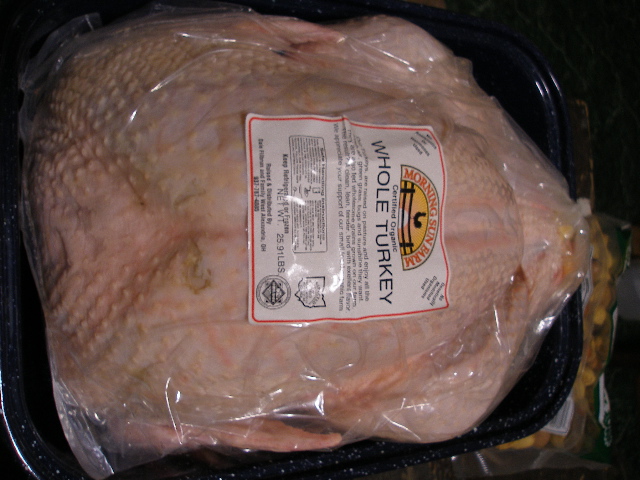
The Turkey at 4:30am before going into the brine

‘Tis the day before Thanksgiving and I am up at 4:30am in order to brine the 25.9LB organic, pastured, hormone and antibiotic free, locally raised (by Dale Filbrun) turkey. So far I have gotten the turkey out of the fridge in the barn and have bleached out a cooler. Now I am Googling a brine recipe because it has been over a year since I have brined a bird of any kind.

Brining is simple, it is a salt and sugar and water solution that you put a chicken, duck, turkey or any meat into to soak for 4 to 24 hours. I will be doing a 6 hour brine so I can get the turkey into the oven by around 2pm today so I am not up all night with the bird. Brining tenderizes the meat by removing all the blood and replacing that with a salty sweet solution via osmosis. This also means the bird will roast more evenly and all the meat will be moist. In other words brining prepares the bird to roast up in the most foolproof perfect way there is.

The Bird is it's briny bath, You can already see the blood being released from the carcass

It is now 5:50am and the turkey is in a cooler full of a salt and sugar solution (2 cups kosher salt and 1/4 cup sugar per 2 gallons of water repeated 4 times to almost cover the turkey in the cooler (he's a big boy but not quite a birdzilla). Upon reading full brining instructions I find I am supposed to brine a turkey 12 to 24 hours. This one will get 7 to 8 hours and that will have to be enough time to remove the blood and replace it with a sweet salty solution (this tastes a lot better than it sounds, really). otherwise I will be getting up at around 5am tomorrow to get the bird in the oven and have it done by 11am so we can eat around noon or 1pm on Thursday. I don't want to do this because I will need the oven for things like the garlic cheddar biscuits and dressing I am making and a couple of pies Eugene will be making.

Thursday, November 16, 2006

Buy and Eat Local This Thanksgiving

Give Thanks with the Right Food
November 2006
(from The Union of Concerned Scientists)

In the hubbub of planning and preparing a Thanksgiving feast for
friends and family, it can be easy to forget the environmental impact
of our food choices. Growing, harvesting, and transporting the
ingredients for a typical Thanksgiving meal consumes a significant
amount of water and energy and contributes to air and water pollution,
habitat degradation, and global warming.

Fortunately, you can make a holiday meal that is not only delicious but
also kinder to the environment and your family's health. Here's
how:

Look for food produced in your region. Food travels an average of 1,500
miles or more from the farm to the supermarket, consuming fossil fuels
and emitting air pollutants and heat-trapping carbon dioxide.
Regionally grown meat and produce not only travel a shorter distance to
your table and arrive fresher, but may also come from smaller farms
that often follow more environmentally friendly practices.

Choose organic. Organic standards prohibit the use of synthetic
fertilizers, toxic pesticides, and antibiotics (today's
industrialized animal production relies heavily on antibiotics to
accelerate growth and prevent diseases that stem from overcrowding).
Overuse of these substances generates air and water pollution and makes
it more difficult to treat human diseases and ward off agricultural
pests. If organic turkey is not available in your supermarket, choose
turkey that has been raised without antibiotics. Also look for organic
apples, celery, potatoes, and green beans because these holiday
favorites are among the fruits and vegetables that typically carry the
highest pesticide residues.

Support genetic diversity. Today's large-scale farms focus on only a
select few varieties of livestock and crops; for example, of the more
than 250 million turkeys sold in the United States each year, 99
percent are the Broad-Breasted White variety. And of the thousands of
potato varieties available, a small number now account for the majority
of commercial production. As our agriculture system becomes more
homogeneous, so does the risk of catastrophic losses if a disease
spreads rapidly throughout a plant or animal population upon which our
food supply depends. Choosing heirloom (or "heritage") varieties
such as American Bronze turkeys and fingerling potatoes helps support
biodiversity and ensures a reliable food supply for future generations.

Go meatless. Meat production can deplete environmental resources more
than other food production, so consider a meatless main dish.

At Boulder Belt we will be feasting on locally raised, pastured, organic turkey along with salad, sweet potatoes, apple and squash pie from our farm.

Check out Local Harvest for locating local food in your area

Saturday, November 11, 2006

Candy Roaster (squash) Pie


This past Thursday we had friends over to help us make some pear wine (which looks like this is going to take a couple of weeks of work before the juice gets to the point of becoming wine and can be bottled and than aged for about a year). Because of the visit and because we have a lot of this rare heirloom squash called Candy Roaster we decided to make a pie. And boy was it easy to do.

I have never made a squash pie from scratch. I had heard horror stories about way too wet filling and insipid flavors so the few times I have made a pumpkin pie I used canned "pumpkin" which in reality is butternut squash. But as I said, we have this rare heirloom squash that is really pretty. It looks like a lumpy pink and blue pumpkin. It has a rich buttery flavor and a moist flesh. And it is not selling because no one including us knows what this squash is all about. And the pie project was partially about finding out what the Candy Roaster is all about.

Like I said this was easy to make. First of all we found a medium sized squash (about 3 pounds). Cut it open, took out the seeds (which are good roasted) and put the squash cut side down on a cookie sheet and into a 350 degree oven for about 45 minutes (cook until it is softy and there is liquid on the bottom of the pan). When the squash is cooked take out of the oven, flip them over so the flesh side is facing towards the ceiling so it will cool faster (like about 5x faster). While the squash is cooling you can make a pie crust. Eugene is the crust maker around here. He does a much better job than I do (I tend to over work pie dough making it tough). The secrets to his excellent crusts are the following. He uses lard rendered from the fat of pasture raised organic pigs. This lard is clean and contains nothing but fat from stress free healthy hogs, no BHT, no nothing. And he also makes sure all ingredients are cold by placing everything in the freezer before assembling the dough and than the dough goes into the freezer for about 15 to 30 minutes before it is rolled out. He uses the recipe in The Joy of Cooking.

For this filling what I did was take the cooked squash and removed the flesh and mashed it into a puree (use a fork, a potato masher or a food processor to get the flesh smooth. If the squash seems watery put the puree into a strainer and let the water drip out foe a couple of minutes, you can facilitate this by gently pushing on the pulp in the strainer. I found with Candy Roaster I did not need to do this as about 2 cups of water were released during baking making the flesh dry enough.

After the flesh is prepped the rest goes quickly. You will need:

1 can of condensed Milk (use no more sugar, this already has lots)
or
1.5 cups of heavy cream (add additional sugar) This is what I used for my pie
2 cups of squash puree
4 eggs, beaten
1/2 cup white sugar (use with cream only)
1/4 cup brown sugar (use with cream only)
1 tsp ground cinnamon
1/8 tsp ground cloves
1/8 tsp ground allspice

Add everything together and mix well. Pour into prepared raw pie crust and put into a preheated 450 degree oven and set a timer for 15 minutes. When the timer goes off set the oven temp to 350 degrees and bake for another 45 minutes or so, until the edges of the pie are browning and the center is solid. Remove the pie from oven and cool for about 30 to 45 minutes

This was pretty much the best "pumpkin" pie I have ever eaten. It was sweet, light and the candy Roaster squash imparted a wonderful smooth buttery taste to the pie. Much better than any can of butternut (AKA Pumpkin) squash will ever make.

The next squash pie will be made with one of our butternut squashes which are a lot better than the B-nuts you buy at the store. That lively soil makes a big difference in flavor. Than after the B-nut may try a buttercup squash which has a sweet dry flesh and ought to make a great pie.