Happy thanksgiving. Tonight I write the obligatory what am I cooking for Thanksgiving blog entry. I am hosting 8 of my relatives tomorrow and we will be feasting on predominately locally sourced food. I am supplying the Turkey which is a 22 pound pastured raised certified organic bird raised here in Preble County by Dale Filbrun. I am brining the bird as I write this in a solution of 3 gallons of water, 2.5 cup of table salt and 2.5 cups of sugar. He will sit in that bath until 5 am or so, than be removed, rinsed and allowed to dry for a couple of hours before going into the oven to cook for 5 hours (basting every 30 minutes or so after the 2nd hour).
I am also making dressing/stuffing that will use organic bread cubes (which I already made this afternoon), organic celery from Kroger's (our celery got nuked several weeks ago by frost), our celeriac, our onions, our leeks, our apples, our pears, walnuts, the turkey stock I am making right now, parsley, sage , rosemary and thyme from our farm, mashed potatoes from our taters, Spring mix we grew, steamed chard we grew, biscuits and Eugene is making 2 pies-strawberry rhubarb and apple all with home grown fruit. My brother Scott is bringing a pumpkin pie from the Motor City, otherwise Eugene would have made a squash pie.
My sister in law, Doreen, is bringing Mac and cheese and sweet potato casserole with the marshmallows.
I have the silver polished up. It is my grandmother silver and I am also planning on using the chine she bequeathed to me. It is referred to as "The Spode". I seem to have 7 complete place settings and 8 big plates so will have a bit of mix and match in the table setting dept. Same with the silverware. There should be 12 settings but a lot of salad forks are missing along with a couple of dinner forks. Hmmmm...
So there will be a mix of really fancy silver and not so fancy silver. And a lot of great food plus various libations such as home pressed apple cider, home brewed beer, other beer, Oban scotch, water, wine
So you might be wondering about the title, Brining Birdzilla. Birdzilla came into being back in the late 1980's/early 90's. A friend of mine named Amy bought a turkey for Thanksgiving. Amy was (is) a person when food buying tended to go overboard. So for a party of 6 i believe she bought this huge turkey, maybe 30 pounds and put it in a mutual friend, Bitt's, fridge because it had nothing else in it and Birdzilla fit in his fridge. I did not partake in that first birdzilla feast as I had family obligations that year. But after that whenever I got a huge turkey (anything over 20 pounds) I have referred to it as Birdzilla. The biggest birdzilla was over 30 pounds. It barely fit in the oven.
This year Birdzilla is 22 pounds. Dale told me when I went to pick up the turkey at his farm (where I watched the flock of Christmas turkeys roam around with 3 chickens) that because of the long Indian summer the turkeys grew a lot bigger than expected so instead of getting a 15 pound bird I got a 22 pounder. He said I could have gotten a 40 pounder if I wanted (no thanks been there, done that). Birdzilla is brining for the next 10 or so hours and by this time tomorrow he will be history, and a tasty one at that.
Showing posts with label Turkey. Show all posts
Showing posts with label Turkey. Show all posts
Wednesday, November 26, 2008


Thursday, November 22, 2007
Thanksgiving Brew
It's thanksgiving and we at Boulder Belt are not eating a turkey dinner (mainly because I did not hop to it and order a pastured turkey from the Filbruns a month ago and when I asked 2 weeks ago if they had any left they said no, they were sold out) this year. nor are we going to anyone's home to feast upon their turkey and trimmings.
No, we are staying in and the plan is to brew beer all afternoon. We shall consume the first of this beer on New Years Day. So truly a holiday brew.
Our friend Wyatt says he is coming over with home made bread and a wort chiller. Eugene made a green tomato chutney yesterday so I am thinking making a vegetarian curry for dinner. We have a lot of greens left over from last Saturday's Winter market that need using as well as peppers, onions, snow peas and leeks. I could also throw together a salad (we have a lot of salad greens too).
This is the first Thanksgiving I have not celebrated in my life. Usually I am cooking at least one meal. Some years when I was working in food service by Thanksgiving day I had cooked over 10 different Turkey day feasts. This year nothing and I gotta say it is nice not to be responsible for dinner for many.
My sister quit celebrating years ago (20 years?) when her infant daughter suddenly died of meningitis the day before Thanksgiving (nothing thankful about that!). Go forward about 16 years and the Owsleys are in Detroit dealing with our mother dying of a stroke. She died 2 days after Thanksgiving that year. The T-day dinner that year was leg of lamb, a big salad and lots of wine and beer. Not very joyous but we made the best of it. At least we were all together (except Mom who was dying in a hospital) for the first time in decades for a Thanksgiving.
So today will be about watching Parades on the TeeVee, drinking home brews and craft beers while making beer and curry.
Tomorrow will be all about Buy Nothing Day
No, we are staying in and the plan is to brew beer all afternoon. We shall consume the first of this beer on New Years Day. So truly a holiday brew.
Our friend Wyatt says he is coming over with home made bread and a wort chiller. Eugene made a green tomato chutney yesterday so I am thinking making a vegetarian curry for dinner. We have a lot of greens left over from last Saturday's Winter market that need using as well as peppers, onions, snow peas and leeks. I could also throw together a salad (we have a lot of salad greens too).
This is the first Thanksgiving I have not celebrated in my life. Usually I am cooking at least one meal. Some years when I was working in food service by Thanksgiving day I had cooked over 10 different Turkey day feasts. This year nothing and I gotta say it is nice not to be responsible for dinner for many.
My sister quit celebrating years ago (20 years?) when her infant daughter suddenly died of meningitis the day before Thanksgiving (nothing thankful about that!). Go forward about 16 years and the Owsleys are in Detroit dealing with our mother dying of a stroke. She died 2 days after Thanksgiving that year. The T-day dinner that year was leg of lamb, a big salad and lots of wine and beer. Not very joyous but we made the best of it. At least we were all together (except Mom who was dying in a hospital) for the first time in decades for a Thanksgiving.
So today will be about watching Parades on the TeeVee, drinking home brews and craft beers while making beer and curry.
Tomorrow will be all about Buy Nothing Day
Thursday, November 15, 2007
Pastured Turkey Tips
Okay so you have decide this is gonna be your first locavore Thanksgiving. You have ordered your locally raised pastured heritage turkey. You will go to the farmers market this weekend to buy the trimmings such as butternut squash celery, parsnips, rutabagas, carrots, rosemary, sage, garlic, onions, taters, apples, leeks, peppers, salad greens, kale, etc.. You will spend much of next week cutting and chopping your local bounty in preparation for your feast.
Congratulations. You are getting closer and closer to having one of the best meals you have ever cooked. it is almost impossible to mess up a meal made from exquisite ingredients but it can be done so a few tips about using whole foods.
Storage- Things like squashes, garlic, onions do not need to go in your fridge (this will give you more room for things that do need cold storage). they do need a cool spot to rest but that can be on the floor of your kitchen or out in the garage. Greens, fruits, herbs do need to go into the fridge.
Give yourself time. Start a few days early. I have been watching Martha Stewart this week and she sez she has been working on Thanksgiving for the past 2 weeks. I think that is going too far but than I am not Ms Stewart and I am not cooking at all this year (which really bums me out. I love doing Thanksgiving). Still, starting this weekend would be a good thing.
The Turkey. If you did not get a fresh turkey, start thawing the frozen bird at least 3 days in advance of cooking. It takes a 20 pound bird over 56 to thaw in a fridge. It would be totally irresponsible of me to suggest taking that clean locally raised and butchered bird and thawing it out in warm water in a cooler the day before you need to cook it. But that is what I would do. I would never ever do this with a factory farmed bird. Do not attempt to cook a frozen or partially frozen bird at 450F. This was been done in my family back in the 1960's. The results, while inedible, were hilarious. One day I will write about the Black and Serve™ rolls and the blackened and raw turkey dinner.
Okay, you got the bird thawed and it is sitting on the kitchen table. Now What? I suggest putting it in a roasting pan. All the grocery stores have aluminum pans to roast a big bird, though I find these to be quite dangerous. They are floppy affairs and can drop hot grease on your legs/feet. OUCH!. But in a pinch they are better than nothing. A proper roasting pan is best. If you do not own one go get one. Now, not next Thursday.
once you have the proper equipment and you have ascertained the bird will fit in your oven (I have been known to buy birdzillas that only fit in my oven with some creative finagling. One year we got a 42 pounder (it was local, organic, pastured and cheap-1/2 off. I could not resist) you are ready to cook the thing. I have found brining the turkey is a great way to go. Simply fill a cooler (that you have sanitized) with 5+ gallons of water (enough to mostly cover the bird). A cup of sugar and a 1/2 cup Kosher or sea salt (if you you table salt cut to 1/4 cup). Place the raw and thawed turkey into the brine and let sit refrigerated for 5 to 8 hours. If it is below 45F outside use the great outdoors as your fridge. Otherwise, add some ice to the brine to keep things cold. I can guarantee you that you will not have fridge space for this unless you have some commercial fridges at your house. Once the bird is brined, remove from the solution, pat dry and let the turkey sit for about 2 hours before roasting. Brining will guarantee a moist tasty bird
If you do not want to brine than one thing you can do is simply rub the bird inside and out with a mix of kosher salt, rubbed sage, chopped rosemary and garlic powder than roast./
I preheat the oven to 450F and place the covered prepared bird in the hot oven. After 30 minutes I turn the oven down to 350F and let it cook. For cooking I time I use the general 15 minutes a pound rule (20 minutes for a stuffed bird). Around 2 hours into cooking I will remove the cover and start basting
Now here is the biggest tip I can give you, o' eater of pastured turkey. Pastured turkeys have been allowed to roam around and that means they are full of nutritious collagen, this is a good thing. But collagen tends to make meats tough if not cooked to a high enough temp. I find pastured poultry needs to be cooked to at least 180 (190 to 200 is even better) in order to cook that collagen down to tenderness. I use a cooking thermometer to check but you can also use a wing or drumstick. If the wing/drum stick falls off or nearly falls off when wiggled your pastured bird is ready to be taken out of the over, placed on the serving platter (remove the stuffing if you stuffed the bird) and allowed to rest for 20 minutes or so before it is carved.
Bon apitite
Congratulations. You are getting closer and closer to having one of the best meals you have ever cooked. it is almost impossible to mess up a meal made from exquisite ingredients but it can be done so a few tips about using whole foods.
Storage- Things like squashes, garlic, onions do not need to go in your fridge (this will give you more room for things that do need cold storage). they do need a cool spot to rest but that can be on the floor of your kitchen or out in the garage. Greens, fruits, herbs do need to go into the fridge.
Give yourself time. Start a few days early. I have been watching Martha Stewart this week and she sez she has been working on Thanksgiving for the past 2 weeks. I think that is going too far but than I am not Ms Stewart and I am not cooking at all this year (which really bums me out. I love doing Thanksgiving). Still, starting this weekend would be a good thing.
The Turkey. If you did not get a fresh turkey, start thawing the frozen bird at least 3 days in advance of cooking. It takes a 20 pound bird over 56 to thaw in a fridge. It would be totally irresponsible of me to suggest taking that clean locally raised and butchered bird and thawing it out in warm water in a cooler the day before you need to cook it. But that is what I would do. I would never ever do this with a factory farmed bird. Do not attempt to cook a frozen or partially frozen bird at 450F. This was been done in my family back in the 1960's. The results, while inedible, were hilarious. One day I will write about the Black and Serve™ rolls and the blackened and raw turkey dinner.
Okay, you got the bird thawed and it is sitting on the kitchen table. Now What? I suggest putting it in a roasting pan. All the grocery stores have aluminum pans to roast a big bird, though I find these to be quite dangerous. They are floppy affairs and can drop hot grease on your legs/feet. OUCH!. But in a pinch they are better than nothing. A proper roasting pan is best. If you do not own one go get one. Now, not next Thursday.
once you have the proper equipment and you have ascertained the bird will fit in your oven (I have been known to buy birdzillas that only fit in my oven with some creative finagling. One year we got a 42 pounder (it was local, organic, pastured and cheap-1/2 off. I could not resist) you are ready to cook the thing. I have found brining the turkey is a great way to go. Simply fill a cooler (that you have sanitized) with 5+ gallons of water (enough to mostly cover the bird). A cup of sugar and a 1/2 cup Kosher or sea salt (if you you table salt cut to 1/4 cup). Place the raw and thawed turkey into the brine and let sit refrigerated for 5 to 8 hours. If it is below 45F outside use the great outdoors as your fridge. Otherwise, add some ice to the brine to keep things cold. I can guarantee you that you will not have fridge space for this unless you have some commercial fridges at your house. Once the bird is brined, remove from the solution, pat dry and let the turkey sit for about 2 hours before roasting. Brining will guarantee a moist tasty bird
If you do not want to brine than one thing you can do is simply rub the bird inside and out with a mix of kosher salt, rubbed sage, chopped rosemary and garlic powder than roast./
I preheat the oven to 450F and place the covered prepared bird in the hot oven. After 30 minutes I turn the oven down to 350F and let it cook. For cooking I time I use the general 15 minutes a pound rule (20 minutes for a stuffed bird). Around 2 hours into cooking I will remove the cover and start basting
Now here is the biggest tip I can give you, o' eater of pastured turkey. Pastured turkeys have been allowed to roam around and that means they are full of nutritious collagen, this is a good thing. But collagen tends to make meats tough if not cooked to a high enough temp. I find pastured poultry needs to be cooked to at least 180 (190 to 200 is even better) in order to cook that collagen down to tenderness. I use a cooking thermometer to check but you can also use a wing or drumstick. If the wing/drum stick falls off or nearly falls off when wiggled your pastured bird is ready to be taken out of the over, placed on the serving platter (remove the stuffing if you stuffed the bird) and allowed to rest for 20 minutes or so before it is carved.
Bon apitite
Wednesday, November 22, 2006
Turkey Brining
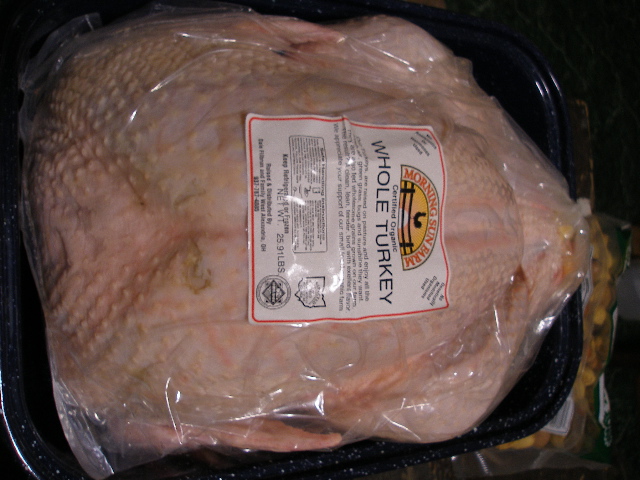 The Turkey at 4:30am before going into the brine
‘Tis the day before Thanksgiving and I am up at 4:30am in order to brine the 25.9LB organic, pastured, hormone and antibiotic free, locally raised (by Dale Filbrun) turkey. So far I have gotten the turkey out of the fridge in the barn and have bleached out a cooler. Now I am Googling a brine recipe because it has been over a year since I have brined a bird of any kind.
Brining is simple, it is a salt and sugar and water solution that you put a chicken, duck, turkey or any meat into to soak for 4 to 24 hours. I will be doing a 6 hour brine so I can get the turkey into the oven by around 2pm today so I am not up all night with the bird. Brining tenderizes the meat by removing all the blood and replacing that with a salty sweet solution via osmosis. This also means the bird will roast more evenly and all the meat will be moist. In other words brining prepares the bird to roast up in the most foolproof perfect way there is.
 The Bird is it's briny bath, You can already see the blood being released from the carcass
It is now 5:50am and the turkey is in a cooler full of a salt and sugar solution (2 cups kosher salt and 1/4 cup sugar per 2 gallons of water repeated 4 times to almost cover the turkey in the cooler (he's a big boy but not quite a birdzilla). Upon reading full brining instructions I find I am supposed to brine a turkey 12 to 24 hours. This one will get 7 to 8 hours and that will have to be enough time to remove the blood and replace it with a sweet salty solution (this tastes a lot better than it sounds, really). otherwise I will be getting up at around 5am tomorrow to get the bird in the oven and have it done by 11am so we can eat around noon or 1pm on Thursday. I don't want to do this because I will need the oven for things like the garlic cheddar biscuits and dressing I am making and a couple of pies Eugene will be making.
Sunday, November 27, 2005
Bird Flu vs Pastured Poultry

An article from AP (This reported contacted me to interview me for this story but since I do not have any birds currently I did not respond)
Free-range Farmers Dispute Whether Flocks At Risk For Bird Flu
by Carrie Spencer Ghose - Associated Press
REYNOLDSBURG, Ohio - State officials and poultry
researchers say there's little risk of bird flu coming to
Ohio, but if it does, the flocks most at risk are the ones
being raised in outdoor pastures to meet growing
consumer demand.
Farmers who specialize in free-range poultry downplay
the concerns, saying their birds are protected and their
farming methods inherently healthier.
A new strain of avian influenza that infected geese
appeared in July in Asia, and the worry is that the disease
could spread to wild birds that migrate to North America,
said Theresa Morishita, an Ohio State University
veterinarian. The disease also could be imported through
smuggling of parrots, songbirds or fighting chickens.
About 90 percent of Ohio poultry are raised in cages in
enclosed barns, according to OSU. Strict measures to
prevent germ transmission should protect them, state
Agriculture Director Fred Dailey said.
About 5 percent of Ohio's wild ducks, geese and other
waterfowl carry bird flu, but it's a weak type that doesn't
make the birds sick and does not transmit to humans. At
worst, if it infects domestic poultry, they lay fewer eggs -
but that means money to farmers.
If wild birds do bring the more virulent form of the
disease to this country, they could mix with the small
number of outdoor flocks, said Y.M. Saif, head of the
food animal health program at the OSU agriculture
research center in Wooster.
"It could be then a danger to commercial birds," Saif said.
The virus rarely transmits to humans, so the risk of that
here is extremely low. Free-range farmers said wild birds
generally don't mingle with their flocks. They said they
watch their birds constantly for health concerns, such as
not eating or drinking.
"I want to follow good science, not just emotionalism
about what's better," said Carl Bowman, co-owner of
Bowman & Landes. The 140-acre farm in western Ohio
has one of the state's largest open-pasture turkey
operations in the state, with 60,000 turkeys. The company
raises another 13,000 at a farm in north central Ohio.
Bowman & Landes raises some turkeys for a different
purpose in barns. "By far our healthiest birds have been
the ones on range," he said.
The only wild geese he's seen mingling with his birds are
so-called resident Canada geese, which don't migrate.
Still, Bowman said he might be more concerned about
bird flu next year if the disease spreads beyond Asia. All
the chicks the company hatches are tested.
Eventually, the Ohio Poultry Association would like all
commercial producers to test their birds, said Jim
Chakeres, executive vice president. The U.S. Agriculture
Department has biosecurity recommendations for smaller
flocks.
Safety starts off the farm for a larger scale indoor
operation, said Terry Wehrkamp, production manager of
Cooper Farms in Oakwood in northwest Ohio. The
company has divisions that raise feed, raise poultry and
even cook the birds for deli and grocery products.
Employees are screened for exposure to other birds, even
pet birds, and pigs. If they break biosecurity rules, such as
not showering and changing into work clothes kept only
in the barns, they're fired.
Indoor poultry growers are prepared if an outbreak were
to occur, Wehrkamp said.
"I would be very nervous if my livelihood depended on
free-range products right now," he said.
Chickens at Brunty Farms outside Akron are protected
from wild birds in 12-by-12-foot pens covered with a net
about 3 feet high, owner Ron Brunty said. The pens,
which house about 1,000 free-range chickens on two
sites, are moved through the pasture throughout the day to
give the chickens fresh grass to feed on.
"I'm not concerned about our birds catching it," Brunty
said. "I'm concerned about people flipping out about it to
the point where they don't buy."
AP International
I do not currently raise poultry but I was planning to get 50 or so pullets this coming spring and perhaps a few adult hens as well. but now I don't know. I am not so much afraid of the actual strain of avian flu taking out a flock of birds but rather what the reaction of the ODA or USDA to a positive bird in a pastured flock will be. I figure the government will over react by a factor of 10x and will try to kill off every pastured fowl in the USA or at the very least will come up with some horribly complex system of monitoring the birds that will take several hours every day for a small flock and most of the day for large flocks. This will ensure the small farmer either has to give up on pastured poultry or give up on other aspects of farming.
I really hope this is all bad paranoia on my part and this does not happen and we small farmers can go about our business unimpeded by bad logic.
As one person wrote on SANET saturday:
"The problem of Avian Flu is an opportunity for us to stop and ask some very basic questions. Firstly, why does the pathogenic virus manifest in the first place? Little importance is given to the conditions that result in the creation of the virus. A lot of attention is given to exposure avoidance and eradication once the virus manifests. As many have stated throughout history, it is not the virus that we should focus on, but rather, the condition of the birds or people that manifest the virus. What is it about these birds or humans that created a fertile environment for the virus? This question must be explored not just from an exposure avoidance perspective but from a health building perspective."
Alan Ismond, P.Eng.
Aqua-Terra Consultants
I can only hope some of these questions will be asked before any flu eradication program goes any further. But I doubt it because if such questions are asked than the way corporations raise animals for consumption will be called into question. And since these are the folks who hold the purse strings I think the conventional wisdom will be:
Pastured Poultry bad; Caged/Confined poultry good
Subscribe to:
Posts (Atom)