We have a farmers market this morning and that meant a 7 hour day harvesting and cleaning produce yesterday. I was surprised how much time it took the two of us to get things together considering all we harvested was leeks, mizuna, red mustard tat soi and spring mix.
The harvesting of greens was nice. It got sunny so the hoop houses warmed up to around 70F quickly. It got so warm I was working in a T-shirt and still pouring sweat. Kind of like working on a hot summer day (okay, a very warm spring day). We did the last major cutting of the spring mix. Eugene felt slow and puny because he is slow at greens harvesting and I am very fast. This is one of the farm, tasks where I am a lot better at it that he is and I think this bruises his ego a bit (but it strokes mine so we are all good and even.). So I ended up with two full plastic grocery bags of spring mix and he had 1/2 a bag. Together we got 15 bags of cleaned spring mix.
We also got 15 leeks from another hoop house. I believe I have mentioned how well leeks do in unheated hoop houses before. They are still doing fantastic and it was a joy to pull and clean them. They also have been very very tasty, perhaps the best leeks I have ever eaten (and I have been eating a lot the past month because we have them and they are sooo damn good). Pulling leeks is a muddy endeavour. You have to get over top of the leek in order to get a clean pull out of the ground. Otherwise, the greens want to beak off and if that happens the leek is ruined for market (but can be dug out of the ground for home use). For me to do this means having to put one foot in the bed (which is a big no no on our farm because walking in beds causes compaction, but sometimes you have to break a rule or two) so I pull straight up. Once the leek is out of the ground the dirt has to be shaken off the root ball and than the roots cut off. This means whomever is pulling leeks will get a lot of dirt on their body and I did. Normally I would not mind the dirt but I did not want to go back to the house, take off my mud covered boots and wash my hands and knife in order to go cut spring mix and not get the salad greens all muddy. But since we got such a haul from the leek hoop house (we also harvested kale, mizuna, tat soi and red mustard) we decided to take all that to the store before harvesting spring mix and that got me close enough to the house to go in and get somewhat cleaned up.
Once the greens and leeks were harvested we turned our attention to cleaning everything we had just picked plus several items that have been put up for winter such as potatoes. We store potatoes with their dirt on and clean as needed as they do not store nearly as well cleaned up. Washing the potatoes was interesting. They are stored in a couple of dead fridges in the barn and are kept naturally, almost at freezing in those fridges. So when we poured the dirty spuds into the wash water it was like pouring several pounds of ice into the water. It was stinging, numbing cold washing the spuds. Not at all fun. But soon enough the potatoes were washed and bagged and put into coolers (or should I say warmers) to keep them from freezing at market
Than there were the rutabagas we harvested a month ago into a couple of buckets and than put the 'bagas dirt, leaves in buckets into the fridge. The fridge has been smelling like rotting cabbage/rutabaga for a while so it was high time to take a good look at the rutabagas and see what's what. And what I found was a whole lot of beautiful 'bagas and few that had been damaged by cold in the field and were slowly rotting away (I believe the stinking culprits). I helped their cause by depositing them into the compost bucket so they can continue to rot and eventually help enrich the soil in which they were grown. For the rest I trimmed the roots and cleaned dirt and got them ready for today.
The final step last night was going through all the onions, garlic and winter squash and tossing out the bad ones. We lost a lot of butternut squash (we will cut them open, remove the seeds for roasting and cook up all good squash parts and freeze the puree for spring summer use) but the delicata squash seemed in excellent shape. The red onions are in sprouting mode. We are saving most to use as onions sets and for seed production (we grow several heirloom onion vareties). But we still have quite a few left. the yellow onions will be in major sprouting mode in 2 to 3 weeks it looks like. the garlic is still doing fine.
After going through everything we than started in on the second to last step before we will be ready to go. putting everything in coolers so they will not freeze at market this morning. In summer we use coolers to keep things cold and in winter we use them to keep things warm. Without them we would lose a lot of produce. So yesterday evening we filled coolers with winter squashes, onions, garlic and potatoes. this morning the carrots, radishes, turnips, chicken and greens will go into coolers. Than everything will be loaded onto the van and we will be off to market by 8:30am this morning so we can be all set up by 9:30am.
Hopefully the locavores will be out enforce and we will sell out.
Showing posts with label potatoes. Show all posts
Showing posts with label potatoes. Show all posts
Saturday, February 16, 2008


Monday, October 29, 2007
2nd to Last Saturday Market Day
This past weekend went by fast. We did two farmers markets in Oxford.
Saturday was the Uptown market that we have been going to for the past 3 years. It was one of the few gray and rainy markets we have had all year (a great thing about drought is lots and lots of sunny days. Makes doing outdoor markets easier). It was a cold one too, with a nice damp stiff breeze cutting through things. And because we are almost into November it was quite dark because the sun was still in the process of rising when we got there around 7:40am (market starts at 7:30am, we were late).
So we did not have high hopes for a good market. We were wrong, we had our second to best market ever by selling a lot of tomatoes, peppers, leeks, scallions, arugula, basil, potatoes, etc.. I believe the bulk of our sales happened in about 1.5 hours. It was intense. That's over $700 in sales in less than 2 hours. not bad. I suspect we will do better next year because the market will be better (it gets better every year and right now has the rare combination of a good manager and a good governing board and I believe Larry will be back next year to run the market and most the board members still have a year left in their reigns).
We went home via the Streits so we could pick up our raw milk for the week. Talk to Joe and Janet for about a half hour. Met a young hippie couple from Yellow Springs who were also picking up milk and other things. Eugene marveled over the fact these people drove over an hour to buy milk and other organic items. He forgot that were are doing the same thing to get raw milk (though we do live a lot closer to the Streits than the folks from YS) and if we did not raise most of our produce and poultry needs we too would drive hours to get the food we need.
Finally, got home around 2pm hungry and we still had to unload the van (which was not nearly as hard as loading at 6am because we had sold a lot of stuff and had around 15 empty crates), make lunch and get a nap. Together we unloaded the van and put food where it needed to go and than had tuna sandwiches and took a much needed nap (you would too if you had already worked a 8 hour day by 3pm). Eugene got up before me and went out to the garden to cover the few crops that were not already covered because frost was predicted for Sunday morning (and we did get a light frost, finally!). I got up as the sun was beginning to set, quite groggy from sleep. Fed the dogs because they demanded feeding and did not do a whole lot after that because Saturdays wipe me out.
Saturday was the Uptown market that we have been going to for the past 3 years. It was one of the few gray and rainy markets we have had all year (a great thing about drought is lots and lots of sunny days. Makes doing outdoor markets easier). It was a cold one too, with a nice damp stiff breeze cutting through things. And because we are almost into November it was quite dark because the sun was still in the process of rising when we got there around 7:40am (market starts at 7:30am, we were late).
So we did not have high hopes for a good market. We were wrong, we had our second to best market ever by selling a lot of tomatoes, peppers, leeks, scallions, arugula, basil, potatoes, etc.. I believe the bulk of our sales happened in about 1.5 hours. It was intense. That's over $700 in sales in less than 2 hours. not bad. I suspect we will do better next year because the market will be better (it gets better every year and right now has the rare combination of a good manager and a good governing board and I believe Larry will be back next year to run the market and most the board members still have a year left in their reigns).
We went home via the Streits so we could pick up our raw milk for the week. Talk to Joe and Janet for about a half hour. Met a young hippie couple from Yellow Springs who were also picking up milk and other things. Eugene marveled over the fact these people drove over an hour to buy milk and other organic items. He forgot that were are doing the same thing to get raw milk (though we do live a lot closer to the Streits than the folks from YS) and if we did not raise most of our produce and poultry needs we too would drive hours to get the food we need.
Finally, got home around 2pm hungry and we still had to unload the van (which was not nearly as hard as loading at 6am because we had sold a lot of stuff and had around 15 empty crates), make lunch and get a nap. Together we unloaded the van and put food where it needed to go and than had tuna sandwiches and took a much needed nap (you would too if you had already worked a 8 hour day by 3pm). Eugene got up before me and went out to the garden to cover the few crops that were not already covered because frost was predicted for Sunday morning (and we did get a light frost, finally!). I got up as the sun was beginning to set, quite groggy from sleep. Fed the dogs because they demanded feeding and did not do a whole lot after that because Saturdays wipe me out.
Sunday, September 23, 2007
Our Season So far

Despite the drought, we have had a good growing season. Not everything has grown well but most of our crops have done well for us this year. Roots have not been all that great for us. The carrots have been ravaged by carrot maggots and we have lost about 1/2 the crop. Beets have been hit and miss all summer. We have generally had a few but they have rarely been great beets. Some kinds of radishes have done exceptionally, other types have barely made roots. Onions, garlic, leeks and scallions, on the other hand, have done very well for us this summer (and will continue on into fall and winter).
Kale has been spectacular, though lately it has not been growing well. The chard was doing well until early August when it got some fungus that looks like black pepper has been sprinkled all over the leaves before the leaves turn brown and rot. The leafy cool weather greens did well in spring and we have had arugula since early August. Who knew arugula will grow well in hot dry conditions with no irrigation? Annual herbs have done especially well. We planted a lot of basil this year and all of it has produced abundantly. Parsley has also done well, though we had some major germination problems this spring so only have 12 plants. Dill has been a surprise. Eugene planted some in early summer and it got forgotten until late August so it went to seed all on its' own and has done a super job of thickly reseeding itself making for a gorgeous bed of cutting dill. Cilantro has been real hit and miss. It hates hot dry conditions so has not grown very well most of the season, that should change in a few weeks since fall has now arrived.
Winter squashes have done well but by mid summer the summer squashes had begun to give up on life. Same with the cucumbers, we had great cukes early but the main season cukes were hit and miss. Probably because we were growing several new types and did not know what we were doing with them. Melons were decent. Not terribly prolific, well, they were but so were the voles early on. The voles damaged at least 75% of the early melons. But Eugene and the dogs got on the ball and got good control of the varmints so we got many cantaloupes, Winter squashes have done well though, by mid summer the summer squashes had begun to give up on life. Same with the cucumbers, we had great cukes early but the main season cukes, charantais melons and watermelons all through August and September.
Corn was another disappointment. We rarely do good sweet corn. It is very hard to get clean well filled ears producing it organically. We do not use treated seed so we cannot plant until the soil is at least 60˚F which this year was mid May, well after they rains had left. So from the get go we had some serious issues with the sweet corn. What we ended up with was basically crappy corn. About 10% was sellable another 15% we froze for winter and the rest was composted. I don't know if we will continue to grow sweet corn. In theory, we need it for the farm stand, though our sales were not horribly impacted by not having much corn this year and I believe that we can get our customers not to expect sweet corn but to look forward to over 100 other produce items we grow at the store. For all the time and cost put into growing sweet corn it is one of our least lucrative crops. But I am positive Eugene will hanker to plant sweet corn next year and so it will be planted.
The nightshades-tomatoes, peppers, eggplant, potatoes have all done quite well. I have noticed these crops tend to do much better in dry conditions than wet. Last year we harvested, maybe, 200 peppers the entire season and most went into the freezer and were not sold. This year we have already harvested close to a thousand sweet peppers and the season is far from over. The hot peppers have loved the hot dry conditions and have been extra prolific. Tomatoes would have liked a bit more rain, I think, but overall they did well, though it seems the season was a bit short as after this week we will likely not have any tomatoes and I noticed at market this week very few other farms still have 'maters. Eggplants have done better for us in the past but this was a good year for them, no the less.
The strawberries have been a real workhorse all season. Early and mid September was not a great time for the berries but other than that they have produced high quality fruit. The raspberries have been a disappointment. Between the Easter freeze, birds and Japanese beetles we have not gotten a good harvest from either the Latham which produce one time or the heritage that produce spring and fall. The berries we have managed to harvest have been excellent, just not at all plentiful.
Now that it is autumn we will be harvesting spring mix and lettuces soon. Hopefully, we will get some rainy weather this fall, though I am not counting on it. Lettuce, especially, likes rainy conditions. Thankfully we have a drip irrigation system and we know how to use it so the leafy greens will grow well enough for us.
Monday, April 24, 2006
Taters and Onions
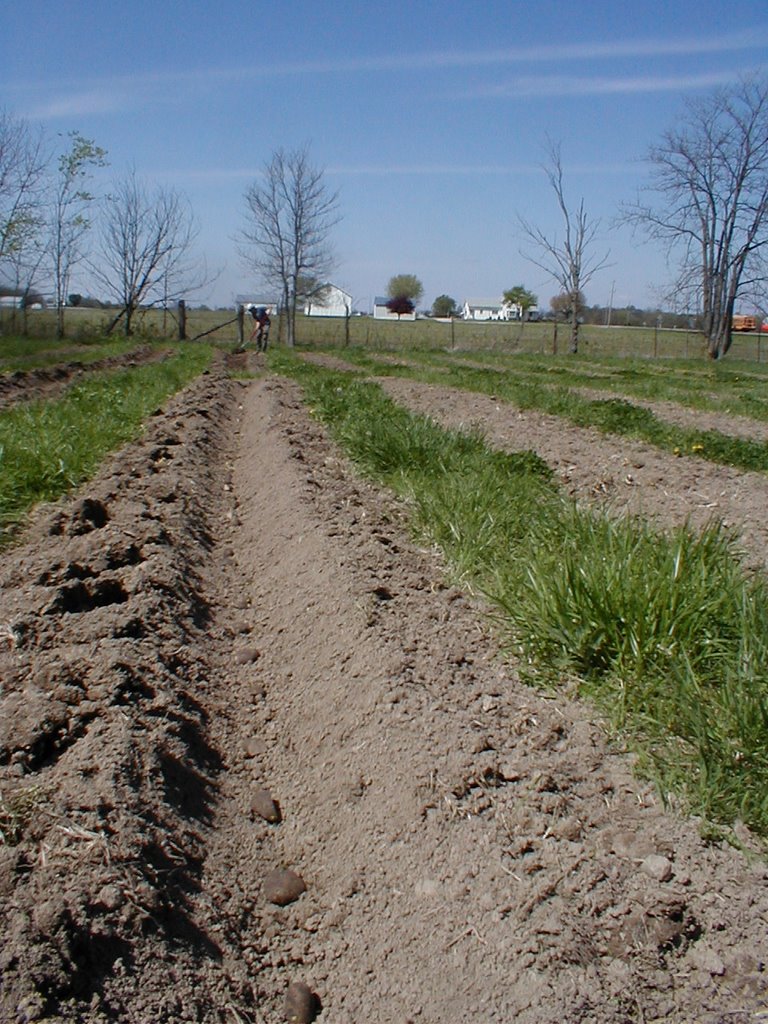
A shot of a trench with seed potatoes waiting to be covered. In the background is our neighbor's farm (the white buildings)
Eugene "chitted" (i.e. cut up) the spuds about 7 days ago after letting them sit in a well lit room for over a month to green up. In the past we chitted within 24 hours of planting, sometimes while we were out in the field planting. But I was reading some comments on the Sustainable Ag listserv by Robin Follette and she said she chitted at least a week before planting. This caused the sprouting eyes to make rootlets which is something we want, so we will be chitting earlier than later in the future.
Went up to the field with 3 bread trays of potatoes. One had french fingerling, another had early white and the third had pontiac red. Eugene decided the trenches were not deep enough so he took the potato fork and dug out more dirt and I went behind him with a rake and raked the dirt out of the trench. Did this for 6 50' beds. After that was done we started putting the potatoes in the trenches and that is when we were called away from work by a guy by the road. He sells produce at the 127/40 intersection and was checking us out and wanted to see if we wanted to sell him any produce. We said probably not and talked with him for about 20 minutes than went back to work. Got the first 2 trenches filled with taters and were starting on the 3rd and 4th trenches when out next door neighbor, whom we had not met, walked across his field to introduce himself. He was pleased that we had cleaned up most of the junk that had been sitting in the field and told us he had farmed our farm back in the early 1950's but since than it had been in pasture. We made small talk for a few minutes than we went back to work and he walked back across the field to his home. We finished up setting the potatoes and Eugene started covering them with soil.
After that took a break, drank water and than planted the onion sets. Normally we do onion from seed because you get bigger and better quality onions. And we did start several hundred onions and leeks from seed this year. But because we did not have seed for all the kinds of onions we wanted to grow we used sets as well. And since we we had a lot of tiny onions left over from last year's crop and they are the perfect size for replanting we have planted a lot of sets as well. So now we have about 3 beds on onion sets growing and looking quite good to boot. We also have a bed of onion seedlings though it is mostly sweet onions, not the yellow cooking type (aka hot onions).
Planting onion sets is pretty straight forward. Place them 6" apart and push them firmly into the ground, repeat 400 more times and you are done.
We also had a banner morning for mouse trapping. Trapped 3 of them, one in the house and two in the seed room (and with no further damage to any seedlings or seeds) plus Trina, our clawless cat, caught a mouse around 4am in our bedroom (or maybe brought it upstairs to show us, I dunno). We do not know if she was successful in killing the vermin (she has no claws after all and no one had ever taught her how to hunt until Navin came into her life just 7 months ago) but at the very least she scared it badly. It was squeaking in terror while we sleepily told Trina what a good kitty she was for catching the mouse.
Maybe this eveing we will do a bit of fishing in the pond (which is now full of black tadpoles hugging the edges trying not to become some fish's meal). I was watching several largish fish swim around that looked like the would be fun to catch. We seem to have 5 or 6 bass-like fish that are better than 15" long and many large bluegill as well.
Saturday, January 14, 2006
There's a magazine for everything
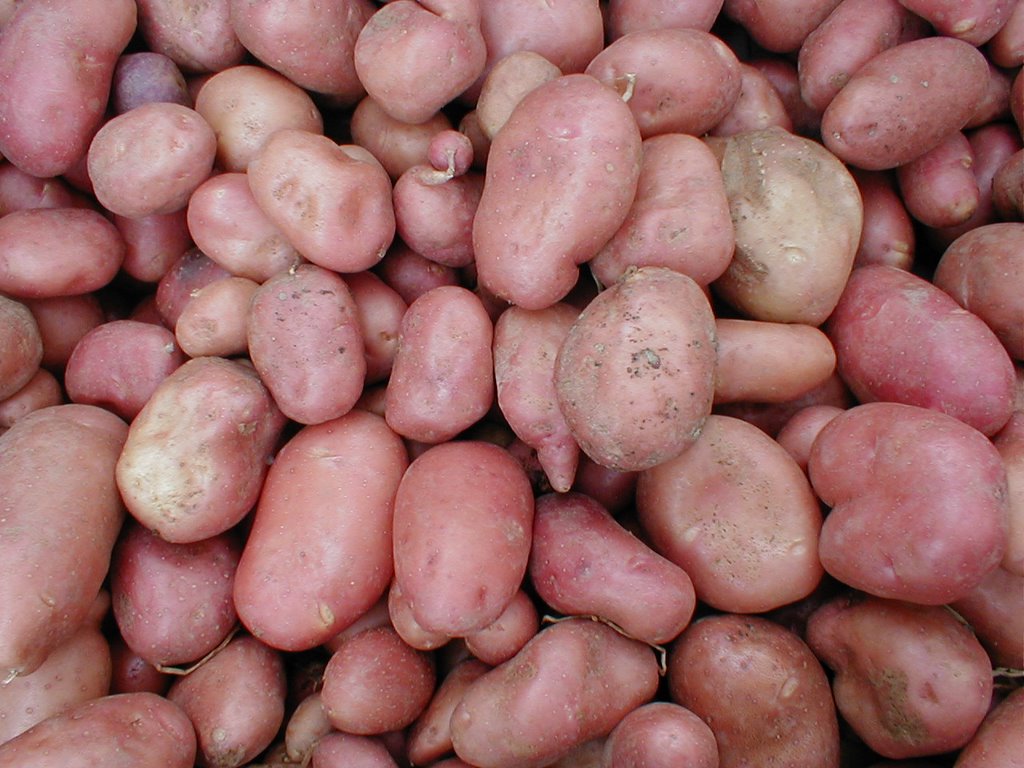
Yesterday we went into town to pick up the mail at the post office and among other things there was Spudman: The Voice of the Potato Industry, vol. 44 issue 1. A magazine devoted to the potato. And it's been around for a while, this is not their first year, no it is the 44th year. Older than me.
This issue covers potatoes in Alaska (Long days make up for short seasons), an article on the Idaho Potato Conference, articles on marketing, farm profiles, etc.. Lots to talk about in the tater world. Oh, and the potato council is attempting to make the lowly spud fun by using a Mr Potato Head™ theme for their marketing this year.
While we do grow potatoes, it is on a small scale, maybe 1000 pounds a year. This publication is geared towards farms that produce thousands ofd tons per year and grow on hundreds to thousands of acres. So I don't think I will take them up on the free subscription offer.
Subscribe to:
Posts (Atom)