Total Pageviews

Showing posts with label astronomy. Show all posts

Friday, August 31, 2007

Lunar Eclipse


A shot of the full moon at totality setting

Sunday, January 14, 2007

Bright Comet

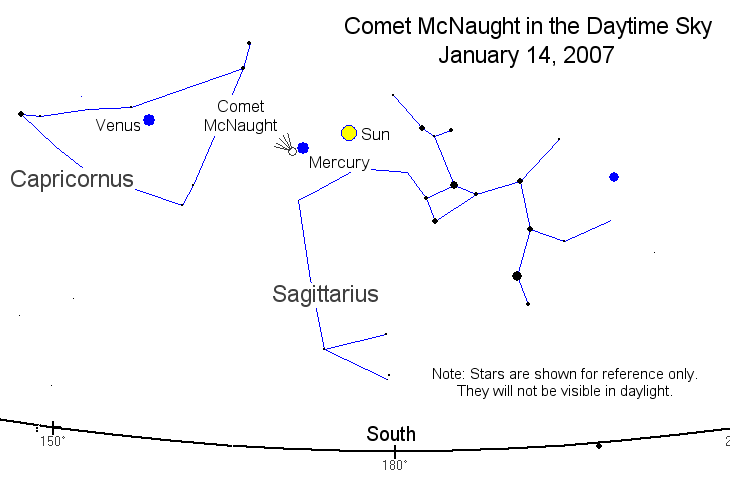
DAYTIME COMET: Comet McNaught is now visible in broad daylight. "It's fantastic," reports Wayne Winch of Bishop, California. "I put the sun behind a neighbor's house to block the glare and the comet popped right into view. You can even see the tail."

This trick is best performed around local noon: Go outside and stand in the shadow of a building. Face south. The comet lies 5 degrees to the left of the sun. (Five degrees is the width of your fist held at arm's length.)


Photo credit:
Thorsten Boeckel
of Bavaria, Germany

You may not see anything at first, but don't give up. Scan the blue sky until your eyes alight upon the comet. Once seen, you'll wonder how you could've missed it.

This weekend is a special time for Comet McNaught because it is passing close to the sun. Solar heat is causing the comet to vaporize furiously and brighten to daylight visibility. At magnitude -4 to -5, McNaught is the brightest comet since Ikeya-Seki in 1965.

Binoculars dramatically improve the view of the comet, allowing you to see structure within the tail. But please be super-careful not to look at the sun. Direct sunlight through binoculars can cause permanent eye damage.

Thursday, December 14, 2006

Geminid Fun

Got up at 3:30 am to watch the Geminids at their peak and I must say it was worth getting out of bed in the middle of the night.

Got up dressed in the dark, got downstairs and turned on a light to make coffee. Eugene got up a few minutes later and stumbled down the stairs. We got coats on and went out to see what we could see. After turning on lights it was not much for a couple of minutes. But soon enough our eyes adjusted and we started seeing shooters. I'd say the rate between 4 and 5:15am was around 100 an hour. We lost count at 25 and I'd say we ended up between the two of us seeing at least 100.

They were not the fireballs I had hope to see but did see a couple of dim twin shooters (both times coming out of Gemini, funny how that works). It was certainly no meteor storm (we got one of those about 4 years ago and it was amazing) but it was a great meteor shower.

Now I feel like I haven't had any sleep. Looks like there will be napping to be done this afternoon, if not before. I don't think there is enough coffee in the world to prevent a nap today

Wednesday, December 13, 2006

Best Meteor Shower of the year TONIGHT

"It's the Geminid meteor shower," says Bill Cooke of NASA's Meteoroid Environment Office in Huntsville, Alabama. "Start watching on Wednesday evening, Dec. 13th, around 9 p.m. local time," he advises. "The display will start small but grow in intensity as the night wears on. By Thursday morning, Dec. 14th, people in dark, rural areas could see one or two meteors every minute."

The source of the Geminids is a mysterious object named 3200 Phaethon. "No one can decide what it is," says Cooke.

The mystery, properly told, begins in the 19th century: Before the mid-1800s there were no Geminids, or at least not enough to attract attention. The first Geminids appeared suddenly in 1862, surprising onlookers who saw dozens of meteors shoot out of the constellation Gemini. (That's how the shower gets its name, the Geminids.)

Astronomers immediately began looking for a comet. Meteor showers result from debris that boils off a comet when it passes close to the Sun. When Earth passes through the debris, we see a meteor shower.

For more than a hundred years astronomers searched in vain for the parent comet. Finally, in 1983, NASA's Infra-Red Astronomy Satellite (IRAS) spotted something. It was several kilometers wide and moved in about the same orbit as the Geminid meteoroids. Scientists named it 3200 Phaethon.


Just one problem: Meteor showers are supposed to come from comets, but 3200 Phaethon seems to be an asteroid. It is rocky (not icy, like a comet) and has no obvious tail. Officially, 3200 Phaethon is catalogued as a "PHA"—a potentially hazardous asteroid whose path misses Earth's orbit by only 2 million miles.

If 3200 Phaethon is truly an asteroid, with no tail, how did it produce the Geminids? "Maybe it bumped up against another asteroid," offers Cooke. "A collision could have created a cloud of dust and rock that follows Phaethon around in its orbit."

This jibes with studies of Geminid fireballs. Some astronomers have studied the brightest Geminid meteors and concluded that the underlying debris must be rocky. Density estimates range from 1 to 3 g/cm3. That's much denser than flakes of comet dust (0.3 g/cm3), but close to the density of rock (3 g/cm3).

So, are the Geminids an "asteroid shower"?

Cooke isn't convinced. 3200 Phaethon might be a comet after all--"an extinct comet," he says. The object's orbit carries it even closer to the Sun than Mercury. Extreme solar heat could've boiled away all of Phaethon's ice long ago, leaving behind this rocky skeleton "that merely looks like an asteroid."

In short, no one knows. It's a mystery to savor under the stars—the shooting stars—this Thursday morning.