Total Pageviews

Showing posts with label wildlife. Show all posts

Wednesday, March 11, 2009

Raccoon in the Pond

Early this morning I got up and let Nate out as I do most mornings. Usually Nate runs around for about an hour than wants back in. This morning I heard him barking furiously at something in the distance. I went to the back door to see what he was barking at but is was still dark. All I could do was hear him off in the distance very excited about something. When it got light about an hour later he was still barking at that something. I looked out the window and saw what Nate was all excited about.

It was not a fish and it was too big to be a muskrat (which we do not have at this pond, though we may in the future). So I grab a pair of binoculars and see that Nate has cornered a rather large raccoon in the pond and it is not at all happy.


I grabbed the camera and walked out in 40 degree windy conditions in my robe and got some pictures of the poor thing.

My presence distracted Nate, who very wet and tired. This allowed the coon to try and get out of the situation by hiding in some cattail reeds. I took some pictures and went back in the house and let Danny out to help Nate bark at the raccoon. Than I got thinking that if the raccoon cannot get out of the pond soon it will die in the pond and than someone has to extract a bloated, fetid coon carcass from the pond at some point in the future and decided to call the dogs back in the house for a few minutes. this allowed the poor animal to get out of the pond and the last I saw it it was sitting in a half dead tree on the west edge of the property drying itself .


I have mixed feelings about letting the raccoon live. When we have chickens coons are a real pest. they will damage a coop to get at hens of young chicks and kill more than they eat. But I felt the raccoon had been harassed enough and likely will not come back onto this property if it thinks there is any chance a dog might be out (and there is an excellent chance at any time of day this will be the case).

Years ago Arlo almost killed a large raccoon trying to get some free chicken babies for lunch. We called Arlo off before he did too much damage and that coon crawled across the street and cried like a human infant for about an hour than disappeared. We saw it a couple of days later crossing the field across the street from us. It paused and took a long whiff of chicken. Than it started walking towards the chicken coop (it was about 1/4 mile away). It took about 3 steps than stopped and you could see it was thinking about Arlo and the fact Arlo will kill a raccoon. The coon decided it was not worth trying to get some chicken and ambled on and never stepped foot on that farm again, though we did see him many times but always at a very safe distance from the dog.

This is why I suspect this animal will not come by this farm ever again-just too risky. Raccoons are not stupid

Wednesday, April 09, 2008

Dogs and Peepers

It finally got warm enough for the spring peepers and toads to start their mating wail.

This new noise has got the dogs all upset. They stand on the deck with ears cocked trying to figure out from which direction the noise is coming. Than they leap off the deck and go bark at it.

They have been doing this all night. In a day or two they will get used to the noise and not be bothered by it.

Sunday, March 25, 2007

Toad Song

Last night the toads were in full voice. I could pick up 4 different notes, most seemed to minor keys except for the middle A. Their singing was driving the dogs nutz.

Toad song is sure sign of spring (as are the 20 degree above average/normal temps we have been enjoying)

Saturday, February 24, 2007

Coyotes

Went out side after dinner for a smoke and to let the dog take a pee. The other dogs in the area were barking up a storm and Nate was quite alert and seemed a bit nervous.

Than we herd the howl of a single coyote and it sounded like it was just below the pitch. Than another howl a bit to the west and suddenly ti woods to our west erupted in a cacophony of howls and yips as a rather large sounding pack of coyotes took down something. maybe a rabbit, maybe a deer.

I dunno. it send shivers down my spine and raised the hackles on my neck.

All the howling got our dogs wanting to run into the fray and defend their property. We had to call them back as it sounded like there were a lot more of them than there were of us. And it sounded like they might be on our side of the fence even. Where Nate probably would have put up a good fight and maybe even survived, Danny would have been a hors d'oeuvre for the wild canines. Arlo, being old and stodgy these days stayed on the deck (I get the feeling Arlo still is not considering this farm his territory or real home and likely never will).

As suddenly as the howling started it ceased but all the dogs in a mile radius were barking up a storm.

We went back inside and a while later Nate was growling towards the back door so I assume he was hearing them again. Right before I drifted off to sleep, after the dogs had been put out for the night, I heard the pack howling again off in the distance

Thursday, December 21, 2006

Solistice

On the last day of autumn I saw a family of bluebirds cavorting about some hoophouse supports and a ringed necked pheasant that for some reason was hanging out in the south lawn by the chain linked fence. Upon seeing Us humans and the dogs, it flew over to the tall grass and weeds and disappeared from sight. I did not realise they are as big as a chicken and sound a lot like one too

Happy Solstice Everyone
May the Gods and Goddesses grant you a swell new year.

Sunday, November 26, 2006

Do We Allow Bioprospecting in our Nat'l Parks


Public comment deadline is December 15, 2006. For more information on
bioprospecting in national parks, visit:
http://www.parksnotforsale.org/ or
http://www.edmonds-institute.org/yellowstone.html./

Everything's for Sale

National Parks Service considers opening parks to 'bioprospecting'

In a season when crowds are rioting over $600 video game consoles, and
O.J. Simpson could sign a deal for millions with the Murdoch empire to
reenact the "hypothetical" murder of his wife and her friend, it may
seem like absolutely everything is now for sale in our mercenary
culture. And that far too many people are buying. (Though, mercifully,
not in O.J.'s case.)

The latest evidence of this comes from, of all places, one of the most
trusted and admired of federal agencies. The National Park Service (NPS)
is quietly taking public comment through December 15 on a proposal to
allow private companies to "bioprospect" in our national parks: to
commercially mine, not the mineral riches of a park, but the genetic
resources of plants, animals, and microorganisms in territories
specifically set aside for stewardship in the public trust.

The proposal is contained in a September 15, 2006 court-ordered
Environmental Impact Statement (EIS), an outgrowth of a lawsuit over a
similar 1997 proposal at Yellowstone National Park during the Clinton
administration. Steady privatization has been underway at the Park
Service for more than 20 years, but the requirement that the NPS
actually study the effects of bioprospecting seemed to shelve this
particular bad idea.

And then, magically, seven years later, the EIS appears, laying out
three options that would cover not just Yellowstone but all parks. The
document, subtly entitled "Benefits-Sharing," reads less like an
environmental study and more like a sales pitch for its preferred
choice, "option B," to allow commercial bioprospecting but require
"benefits-sharing" agreements and potentially some degree of public
disclosure of those agreements. (Or, potentially, not.) The other two
choices the public is to comment on are option A, to do nothing -- thus
allowing bioprospecting without so-called benefit-sharing; and option C,
which is to only allow this genetic mining for "noncommercial or public
interest research." Not exploiting our parks' genetic treasures at all
is not even listed as an option in the document.

In the Global South, home to much of the world's genetic diversity, this
battle has already been underway for decades. In a process reminiscent
of Columbus, transnational corporations have been using Western courts
and laws to patent genetic codes and plant and animal life that existed
long before any humans were around to "discover" them or own their
"rights." The struggle against such legal chicanery has often been led
by indigenous peoples who've relied upon the riches of their
environments for millennia without the assistance of lawyers or
scientists (or shareholders). Suddenly, they've been told they no longer
have the right to use those riches -– or, worse, they /can/ use them,
for a price, paid to distant companies with no truly legitimate claim to
their use.

This, in the South, is referred to as "biopiracy," and it seems like an
appropriate term to start using in America as well. National Parks,
beginning with Yellowstone (whose geothermal features were instrumental
in both the park's original founding and the commercial appeal of
"bioprospecting"), were set aside as lands to be owned and used by the
public. The lands' early stewardship, beginning with Yellowstone, was
specifically intended by Congress to exclude high-value heritage lands
from the rapacious development of much of the surrounding West. We are
the owners of these lands –- but their resources are now apparently for
sale, in ways large and small, without the permission or even knowledge
of the rightful owners. That's piracy.

An even scarier aspect of the NPS proposal is the precedent it sets, and
the question of where that precedent stops. Can any life form or portion
thereof existing in the parks be given away (or "benefit-shared," if the
public agency gets a cut)? In any public lands? Using eminent domain,
anywhere at all? What's to stop the government, using existing law and
schemes such as this, from deciding by regulatory fiat that your genome
should be "benefit-shared" by some state agency? It's an awfully
slippery slope, one in which, thanks to two decades' worth of
privatization of public resources, we're already well downhill of the
crest.

The Park Service will, and has, argued that in a time of scarce public
funding, commercial opportunities such as this can bring in valuable
revenue to help preserve the park system. But what's the point of
preserving a public park system whose parts can all be privately
claimed? More to the point, these resources are not the federal
government's to sell: they belong to all of us. And most especially to
the point, there are some things that simply shouldn't be for sale. Life
is an obvious one. It's one thing to sell chickens; it's another to sell
the exclusive rights to "Gallus gallus". The only difference here is size.

Only a few weeks remain for public comment on the NPS proposal. Take
some time to weigh in. Otherwise, some big corporation –- let's call it
Helixco –- will be using tweezers, small but lucrative ones, for its
Christmas stocking this year.

Public comment deadline is December 15, 2006. For more information on
bioprospecting in national parks, visit:
http://www.parksnotforsale.org/ or
http://www.edmonds-institute.org/yellowstone.html./

Friday, June 30, 2006

Birds & Views


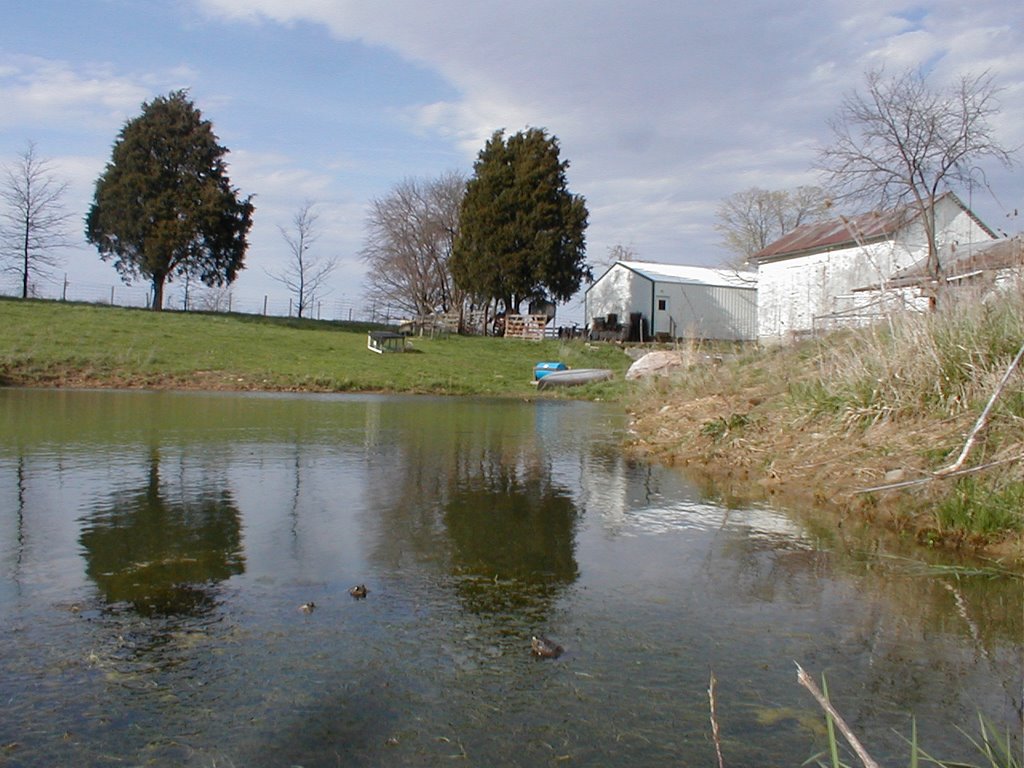
I was out behind the barn washing the leafy green veggies and herbs this morning watching the barn swallows swoop over the pond getting bugs and bringing them back to their babies in the barn. It was a nice sight. The swallows were a bit perturbed that I was standing kind of in front of their doorway but would make it in to feed their progeny. We did not have barn swallows at the Crubaugh Rd farm because we had no barns. Farming without a barn is not an easy task and I don't know how we got along for over 10 years. I guess we just didn't know what we were missing and made do with what we had. Namely a house stuffed full of farming paraphernalia and no good place to do the cleaning and packing chores. We also had 2 Small sheds stuffed to the rafters with tillers, crates, row covers, irrigation tape, a forge, tools, hoes, chicken feed, fire wood, mowers, seed starting flats, compost, peat moss, flower pots, chicken crates, plastic sheeting for hoophouses, hoophouse supports, wire row cover hoops and many other items. Enough items to pretty much fill up a large bank barn. I do not know how we managed to cram all that stuff into the limited space we had but we did. I am so glad we now have enough space to do what we do for a living.

I am glad we own our own land and that we have such a pretty piece of land, at that. We have one of the most beautiful views I have ever encountered. We are on a high point (the top of the 40' pitch) and see our pond, our hillside covered with wildflowers, day lilies (we brought them from the old place) and waving grass. Beyond that is undulating terrain and large trees. It is simply spectacular and it changes constantly with the seasons and time of day.

And this varied terrain brings in a wide variety of birds. We have a bluebird family, chimney swifts, a kingfisher, many humming birds, several kinds of sparrows, grackles, turkey and black vultures, robins, blue jays, crows, many kinds of hawks, peregrines, chickens (oh wait, those are not wild), tree swallows, chickadees, cardinals, nuthatches, etc.. I suspect we will get ever more birds as they figure out we do not use poisons on our land and we leave areas tall and wild so there is a food supply for the wild life

Thursday, April 13, 2006

Toad Orgy

In the foreground there is a small group of toads (they are the lumps in the bottom center of the image) guarding strings of eggs

Spring is in full roar around here. The trees are greening up, flowers are blooming the birds are back and the pond is full of fish from small fry to some 4 pounders (we think). The pond is a fascinating environment. for example we had major toad orgy occurred yesterday starting early in the morning. They swam and called and laid eggs all day. This was followed by an exodus from the pond going north up the hill towards the market garden last night starting around dusk. Nate tried to eat a couple but found them nasty and spat them out. Their calls sound like some sort of alien invasion.

This morning there were still a few left overs in the pond, a few dead toads and a film of milt on the surface of the water. This afternoon one area of the pond where there is thick plant life a group of toads seem to be guarding garlands of eggs. In a week or so the pond should be boiling with tadpoles and than a second exodus from the pond to other places will occur with the new, small toads. It is highly likely the fish in the pond will be feasting on these toad eggs.

If the pond were in balance we would still have an annual toad orgy but there would also be herons, kingfishers and other birds that like to eat a toad on occasion so there would not be this explosion. In time the balance will happen but this is a young pond so the predator to prey ratio is way off, among other things.