Total Pageviews

Thursday, March 30, 2006

Plowin' the Fields

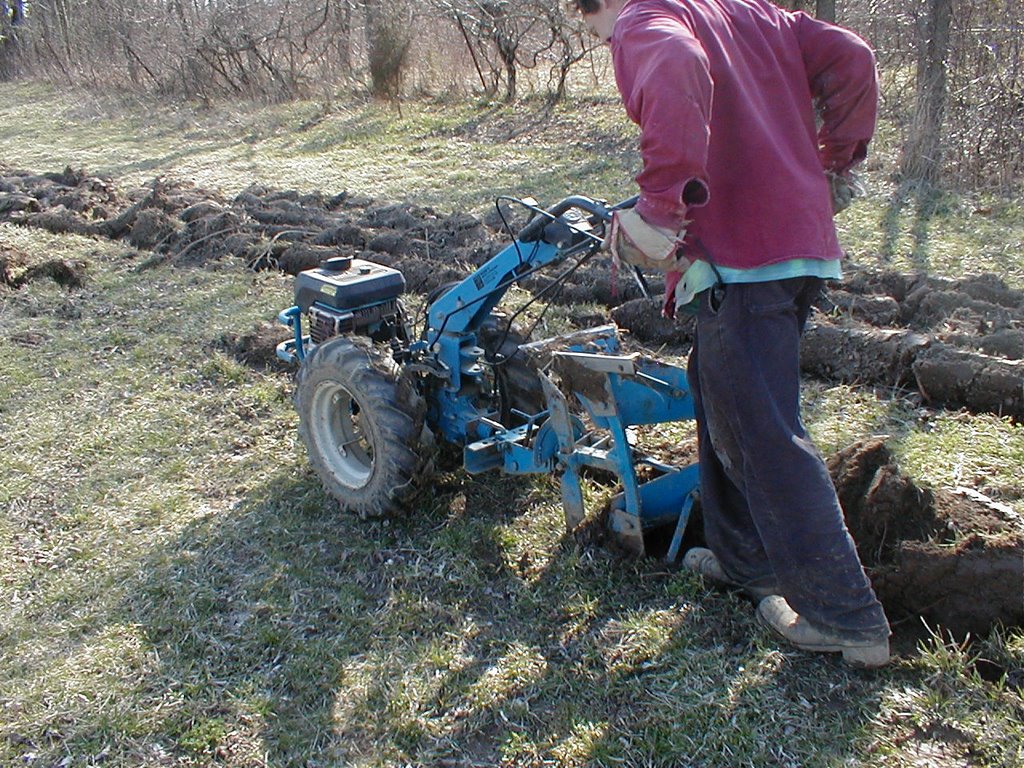
We use a 14hp BCS walking tractor with an adjustable single bottom plow to open the beds. The plow is able to be flipped from side to side so the person plowing (Eugene pictured below) does not have to go in the same direction each pass. Instead they can alternate directions.

Here is a shot of the plow attachment (which is also a potato digger though the one time we used it for that purpose we stabbed a lot of spuds)

Here Eugene is digging into the soil with the plow, opening a new bed. He will make four passes to get a 4' wide bed opened up.

Wednesday, March 29, 2006

Recent Pix

Here are some Pictures I took about 10 days ago when it was cloudy and much cooler

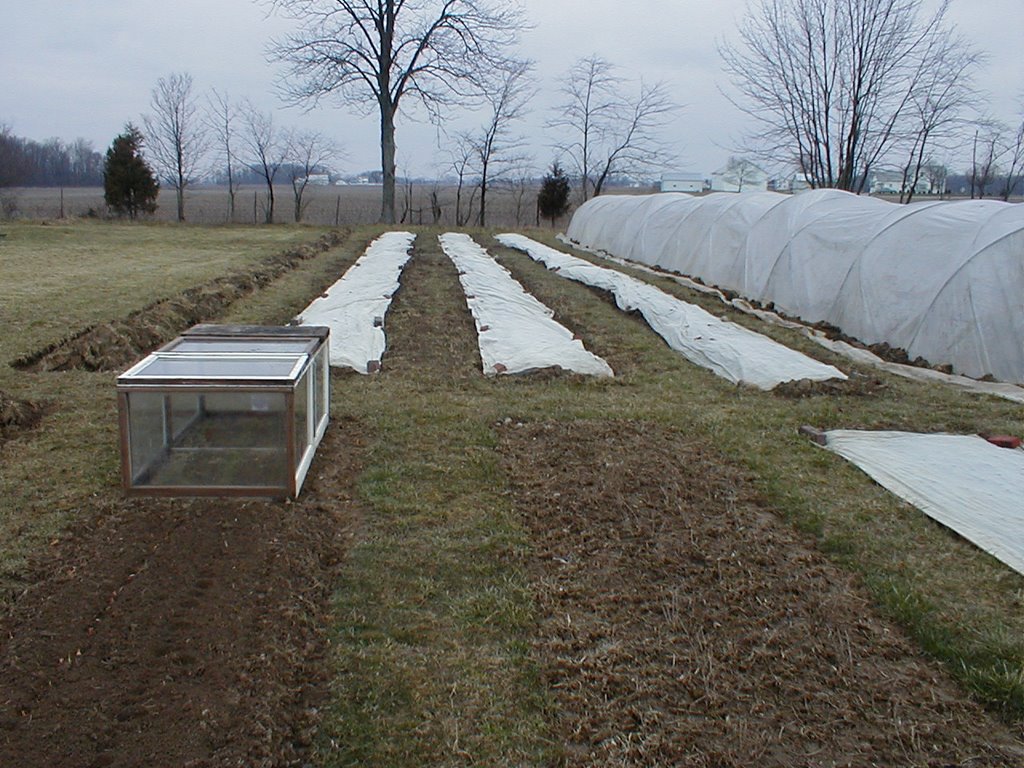
This shows our strawberry patch (the 3 rows under the white row covers) as well as a cold frame full of onions and leeks we direct seeded. You can also see a bit of a failed bed of spinach (the row cover to the right) and a bed full of dormant herbs (which as of the past couple of days has broken dormancy)


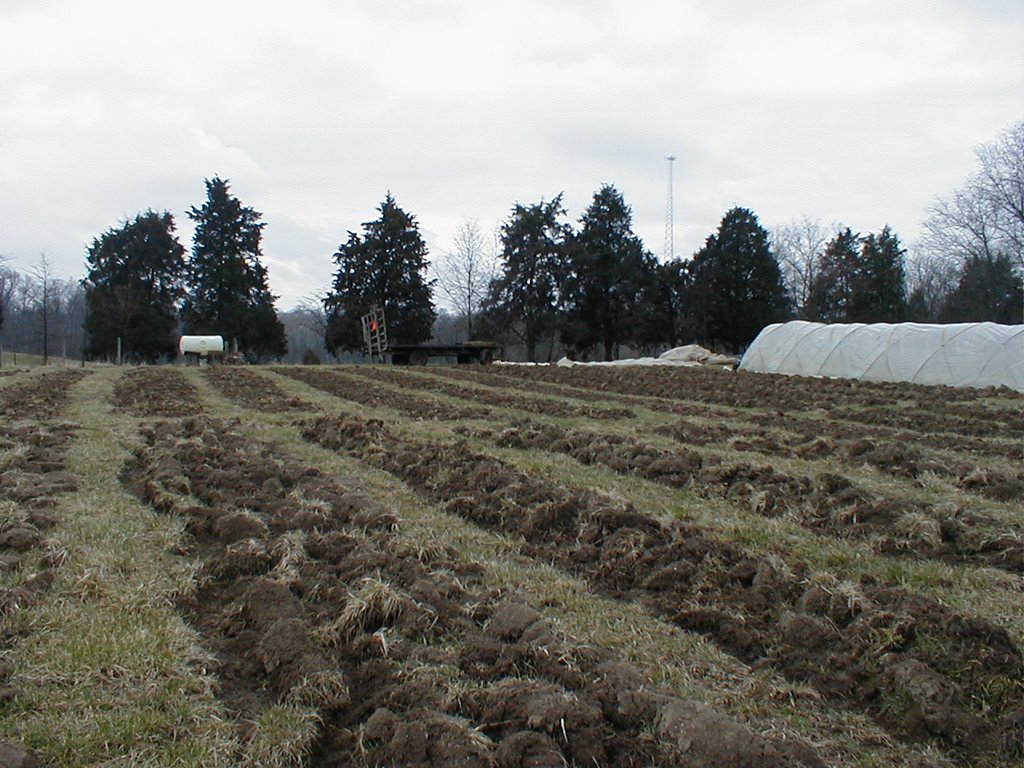
A picture looking south showing plow beds in front and tilled beds to the back. we have about 130 beds plowed up so far with another 40 or so to go. Only 30 or beds have beed tilled so far and out of the tilled beds about 20 have been planted. The white tank will be used for the drip irrigation system once we figure out how to fill it with rain water.


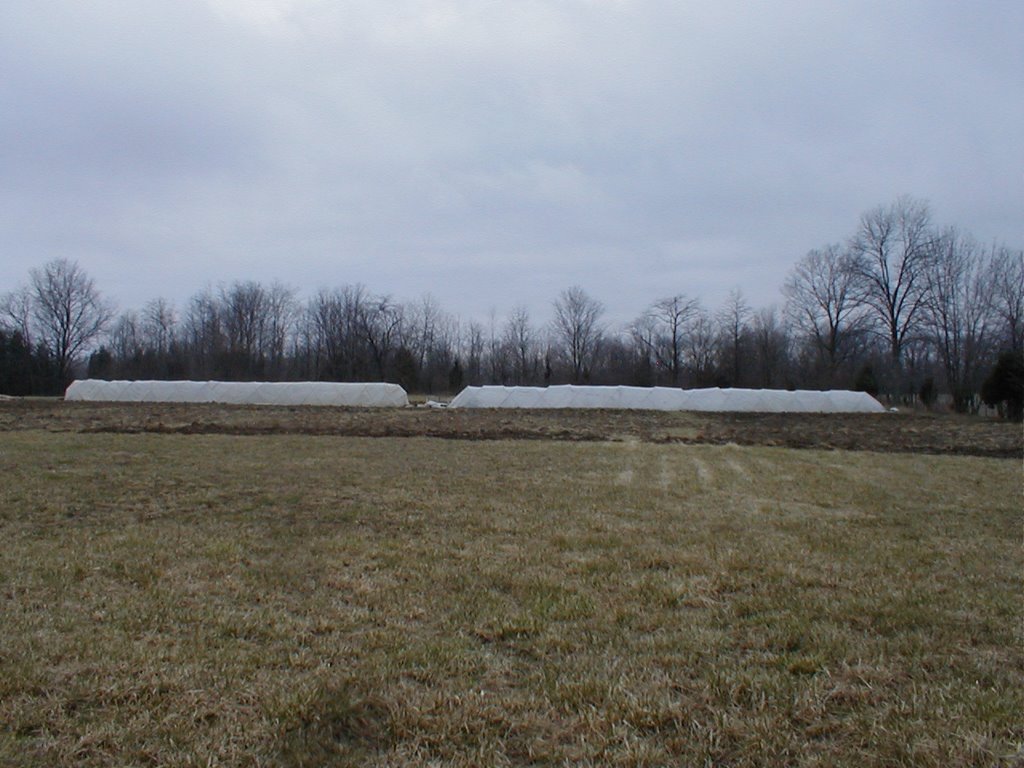
A shot facing west showing two hoophouses. The one on the left will be planted with cukes and zukes. The one on the right will get the early tomatoes. In front of the houses is what we have plowed so far.

Tuesday, March 28, 2006

Gearing Up

It's been raining on and off all day. We have gotten almost a whole cm according to our new rain gauge. But the rain has made the garden beds too wet to work in so we have not been doing much in the way of farming today. Won't do much tomorrow either because we made plans to go visit Eugene's mom in Yellow Springs and also there will be a total eclipse of the sun over north Africa, parts of southern Europe and the Middle East. When we used the biodynamic planting calendar, The Stella Natura, we noticed that all days that have any kind of lunar or solar eclipse anywhere over the planet were bad days to transplant plants or harvest things but wonderful days to kill weeds and till the soil. I once hoed a bed of shallots at the same time a solar eclipse was happening and no weeds grew in that bed for 8 weeks! It was as if I has used some sort of strong, chemical herbicide. It was truly amazing.


Lettuce seedlings in a cold frame getting hardened off before transplanting. The green is Simpson Elite, than Rouge D'hiver, than Marvel of Four Seasons and finally in the right corner lollo rosa. These were transplanted yesterday evening

Despite things being a bit quiet around here today we have been quite busy the past 5 days (or when ever it was I posted here last). yesterday Eugene got a bunch of beds tilled and ready for seeds and transplants and we spend a lovely evening sowing seeds (parsnips, spinach and radishes), transplanting 170 lettuce plants and than putting row covers over everything. We finished about the same time it was too dark to see. Eugene went out this morning to check on our work and said the row cover and hoops over the lettuces needed some adjusting. It is hard to put together things you cannot see.

Along with putting seeds and transplants into the ground I have been making soil blocks just about daily. I am either making small blocks to start smaller seeds or large blocks to put the sprouted seeds into. Right now we have a full compliment of light tables. There are tomatoes, cucumbers, cabbages, kale, broccoli, zucchinis, celery, sage, parsley and 4 flats of lettuce about 10 days away from being ready to go in the ground.

Since April is almost here it is time for a lot of summer crops to be started inside. By Tax day I should have peppers, eggplant, the main crop of tomatoes, more zucchini, more cucumbers, more broccoli, more cabbage, more lettuce (probably 2 or 3 more plantings). Before tax day we should have gotten several thousand onion sets in the ground and before the end of April we will do likewise with onion seedlings we started from seed. Onions started from seed yield a lot better quality than those started from sets but we had a lot of set sized onions (that means very small) from last year of types we could not find seed for this year.

This past Saturday we had a load of Fresh Aire Farm compost delivered. We like to make our own compost for a variety of reasons, a big one being it is a lot cheaper than buying the stuff and getting it delivered. But because we have moved and are starting a new farm we are really short on compost. I think we have about 2 or 3 cubic yards ready to use and need about 6 to 8 cubic yards for the beds and making soil mix. But we are lucky in that we are close to one of the finest compost makers in the USA in Dan Young. And Dan brought us 5 yards of some gorgeous compost Saturday morning and dumped it by the hoophouse that will be getting cukes and zukes in about a week. The stuff is nice but it was not cheap at $140 for 5yds plus another $50 to deliver (and that delivery charge has likely gone up in the past few days with the rise in petroleum based fuels). But I think it was money well spent.

It is now nearing dinner time. So far I have made a cole slaw (or cabbage salad as my grandmother Ada called it) and a spice cake for supper. I believe Nathan's kosher hot dogs will go with the above. Topped with home made pickle relish and red onions-Yum.

Friday, March 24, 2006

Search Keywords Today

3 people found this blog using " sexual attachments for cordless drills" I am not sure if they have a sexual attachment for cordless drills or they want such attachments (ain't the english language fun?). I do find it strange that this blog shows up on the first page of this search. Does this mean this blog will get flagged by the gummint as a pornographic blog and shut down?

1 person get here by typing into google " jeff gordon rv bus driver" Again I am not sure if they think Jeff drives an RV (I am sure he has at some point in his life) or if they wanted information on ther person who drives Mr. Gordon's RV to the Nextel Cup NASCAR races. Perhaps this is an omen and Jeff Gordon will end up being a RV driver after his racing career is over

1 person Googled " buy raw butter in indiana" This I know something about. Go to the Weston Price website (link in the side bar to the right). They have a huge database of all the farms in the US that sell raw milk products.

Those are the keywords/terms today

Lettuce and Antibiotics (A Rant)

I just finished making many soil blocks and "pricking" 4 kinds of lettuce into those soil blocks. Than I put them under lights where they will spend the next 10 days or so growing bigger and bigger before being put in a cold frame to harden off for a week or so. After being hardened off they will be ready to transplant into the garden. the first batch of lettuces is out in the cold frame going through their hardening phase and next week (weather permitting) will be ready to be transplanted into the garden. In another 30 days after that they should be ready to cut and sell. It felt good to go and do something garden related.

I have been remiss in posting much this week. It's not that there has not been a lot going on here on the farm it is mostly because I have had an ear infection. I decided to go to see a doctor about it last week and was prescribed antibiotics that caused several side effects (I did not think I was allergic to all classes of penicillin but it looks like I am). So I went back on Tuesday and got sulfa based antibiotics and ear drops. I also had my ear irrigated to remove the plug of pus that was interfering with my hearing (What?). It was nice to be able to hear out of my left ear again and the ear drops seem to be working but the new antibiotics caused me to feel like death warmed over after taking them for 36 hours. I was tired, listless and full of pain-your basic flu symptoms but without a fever. And than on top of it all I got a yeast infection. If you have never had one you are lucky, if you have you know what I am going through. A burning itch in my nether regions that I would not wish on anyone I liked.

Fortunately Eugene had just made some yogurt out of the fresh raw milk we bought at the farmers' market on Saturday and yogurt is the best remedy for a yeast infection. And this yogurt because it was made with clean milk from healthy cows is powerful stuff. So along with eating yogurt to keep my intestinal flora alive despite the onslaught of antibiotics (as of yesterday evening it is a former onslaught but it will take a few days to get things close to normal in my gut) I am now using the stuff topically as well.

I gotta say I do not do well on antibiotics and I do not plan on taking them ever again. they are a truly evil drug. The last time I had to take them for an infected finger the damn things almost gave me a heart attack and cause some wild mood swings that were hard on Eugene

And yet most Americans take them incessantly. They take them for viral infections (which is a useless thing to do as antibiotics are not antiviral drugs and will do zero for a virus). They get a lot of antibiotics in their meat and milk if they eat anything other than organic or pastured meat and milk. I suppose this is why so many Americans are so unhealthy and must have health insurance. They consume way too many toxic drugs, most unknowingly. Of course the industrial food people will tell us that the drugs fed to livestock are okay, even good for us. The Pharmaceutical folks will tell us we cannot possibly be healthy without their drugs (Of course, if everyone was truly healthy big Pharma would wither and die. It is in their best interests to have as many sick people as possible because sick people take drugs and healthy people do not). But what do expect from an industry run by former drug pushers, you know the rich white frat guys who supplied their brothers with all kinds of recreational wonders like LSD, MDA, Cocaine back in the 1960's and 70's. Than they graduated went on to take over the family pharmaceutical business. And now they have more power than perhaps someone who has taken acid numerous times should.

The good news is despite my drug problems my ear seems to be on the mend and the drugs are leaving my body and things are getting back to normal.

Tuesday, March 21, 2006

Todays search term-"tuberculosis deaths raw milk ohio"

A few items I found today about raw milk because some one got to this blog by googling "tuberculosis deaths raw milk ohio" which lead to me doing the same search to see just what google came up with and found many reports on Raw Milk including:

The blog Dvorak Uncensored has a post about Milk being Illegal in Ohio

And than there is the Supplemental Report in favor of raw Milk

Why You Don't Want to Drink Pasturized Milk


What is real milk?

The Campybolactor Blog which you would think would nothing but negative things to say about raw milk is surprisingly neutral and has a lot of recent stories posted on this blog

WantMilk.org has a lot of recent information on the bill to legalize raw milk sales in Ohio that is pending in the Ohio state house right now.

Monday, March 20, 2006

%#@@*!% Mice

I am procrastinating about going out to the barn and making soil blocks so I can replant all the seeds a (now dead) mouse ate over the weekend. The little bugger ate the tops off of all but 7 lollo rossa lettuce seedlings and pretty much all of the tomato seeds.

The mouse could not be happy with the 25 pounds of black sunflower seed we have for the wild birds. No, it had to crawl all over the light tables where we start our seedling and eat them as well. I suppose it, like me, has been jonesing for greens. But unlike me it is an uninvited guest (or was). I hope this was the only mouse in the seed starting room.

So now I am off to make a zillion mini soil blocks and than I will fill them with lettuce and tomato seed as well as basil, broccoli and cabbage. Perhaps the best way a person can spend the last few hours of winter, planting seeds.

March Winter Market Fun

A shot of the March winter market. We are the white van in the middle. Scott Downing's apple stand is to the right, Karen Baldwin's soap and egg concern is to our left


Last Saturday was the March edition of the winter farmers' market in Oxford, OH. We went with very few things to sell. Some popcorn, parsnips, a few winter squash, small yellow onions, gourds, catnip, tomato juice, apple sauce and a few other items. Our sales reflected the fact we had almost nothing to sell. In the past I would have blown off market but I had made arrangements to meet a virtual friend in person. So off to market we went and around 10am Susan Setzer showed up with her father in tow and we met and chatted for a bit and than she had to leave and I had to go back to doing farmers' market things. I believe this is the first time I have met an internet friend in person and it was really nice. I met her via the OGL/Organic gardening list, an email list I have subscribed too for many years. It has a lot of knowlegable people and I have gotten a lot from the list over the years. And it is fun to see what someone looks like. Your mind's eye tends to create people that do not exist in reality. Nice to get that reality check.

The main thing I did was buy food. I ended up buying more food than I sold. I picked up my raw milk order, I bought some swiss chard from the Marcum's. God was it good-had it for dinner last night. Chard is my favorite green and I have not had any in months. I wish I had bought two bags of it instead of just one. I guess I will have to start some chard seed to day. I also bought many heads of lettuce from Harv Roehling. I got some Braun de Morge's, some sort of oak leaf and some lollo rossa. Unlike the chard i have not been jonesing for lettuce because I started cutting the little bit we had from last fall. But there is only one pot of that left. So Harv's lettuce will have to do us until our first crop gets big enough to cut (probably 3 to 4 weeks)

I picked up 6 dozen eggs from Karen Baldwin. I sure hope this avian flu H5N1 paranoia does not put all pastured poultry people out of bidniss. If this happens I guess I will have to quit eating eggs because the eggs raised in CFO's are just gross. They taste bad to me and have a dreadful pale yellow yolk. I remember trying all sorts of grocery store eggs when we got rid of our pastured hens and all were bad. Do not believe the Eggland's Best claims that they have the best eggs in the world, they do not. They have eggs that taste like the cheaper eggs for which you pay a lot more.

I also bought meat from the Filbruns-bacon, stew beef (which will be a part of dinner tonight) some cajun brats and I believe some italian sausage. So far this week we have spent over $100 at the Filbrun's. On friday we went to their farm and bought $96 worth of soil amendments. When we get broilers we will go there and spend hundreds on chicken feed. I also brought up the NAIS issue with Dale. because he is a german baptist he does not do TV or radio and does not have internet in his house so he did not know a lot about NAIS but was aware of it. So I gave him some information and websites to check out the next time he went to the library. He seems very upset by the prospect of NAIS and well he should since he has over 5,000 chickens and turkeys on his farm that would all need to be tagged.

After buying meat it was time to pack up and leave. So we did and drove back home. Got home, got unloaded and was just getting lunch started when we got a knock on the door. Someone was interested in buying some of the junque in front of the store front. So Eugene went out and sold the guy $26 worth of electric fence stakes. About an hour later another guy knocks on the door and ends up buying a wagon wheel for $50 (which we have to deliver). So we ended up making more money sitting at home than going to market. This gives me high hopes for the farm stand being successful

Sunday, March 19, 2006

Blame Big Chicken Farms for Bird Flu Threat

from http://www.chron.com

March 19, 2006, 1:41AM
Blame Big Chicken Farms for Bird Flu Threat
Lethal virus is a product of the industrial poultry trade

By WENDY ORENT


Chicken has never been cheaper. A whole one can be bought for little more than the price of a cup of coffee from Starbucks. But the industrial farming methods that make ever-cheaper chicken possible may also have created the lethal strain of bird flu virus, H5N1, that threatens to set off a global pandemic.

According to Earl Brown, a University of Ottawa flu virologist, lethal bird flu is entirely man-made, first evolving in commercially produced poultry in Italy in 1878. The highly pathogenic H5N1 is descended from a strain that first appeared in Scotland in 1959.

People have been living with backyard flocks of poultry since the dawn of civilization. But it wasn't until poultry production became modernized, and birds were raised in much larger numbers and concentrations, that a virulent bird flu evolved. When birds are packed close together, any brakes on virulence are off. Birds struck with a fatal illness can easily pass the disease to others, through direct contact or through fecal matter, and lethal strains can evolve. Somehow, the virus that arose in Scotland found its way to China, where, as H5N1, it has been raging for more than a decade.

Industrial poultry-raising moved from the West to Asia in the past few decades and has begun to supplant backyard flocks there. According to a recent report by Grain, an international nongovernmental organization, chicken production in Southeast Asia has jumped eightfold in 30 years to about 2.7 million tons. The Chinese annually produce about 10 million tons of chickens. Some of China's factory farms raise 5 million birds at a time. Charoen Pokphand Group, a huge Thai enterprise that owns a large chunk of poultry production throughout Thailand and China as well as in Indonesia, Cambodia, Vietnam and Turkey, exported about 270 million chickens in 2003 alone.

Since then, the C.P. Group, which styles itself as the "Kitchen of the World," has suffered enormous losses from bird flu. According to bird-flu expert Gary Butcher of the University of Florida, the company has made a conscientious effort to clean up. But the damage has been done.

Virulent bird flu has left the factories and moved into the farmyards of the poor, where it has had devastating effects. Poultry may represent a family's greatest wealth. The birds often are not eaten until they die of old age or illness. The cost of the virus to people who have raised birds for months or years is incalculable and the compensation risible: In Thailand, farmers have been offered one-third of their birds' value since the outbreak of bird flu.

Sometimes farmers who don't want to lose their investments illicitly trade their birds across borders. In Nigeria, virus-infected chickens threatened with culling are sold by the poor to even poorer people, who see nothing unusual in eating a sick bird. So the birds — and the bird flu virus — slip away to other villages and other countries.

The Southeast Asian country without rampant bird flu is Laos, where 90 percent of poultry production is still in peasant hands, according to the U.S. Department of Agriculture. About 45 small outbreaks in or near commercial farms from January to March 2004 were quickly stamped out by culling birds from contaminated farms.

Some researchers still blame migratory birds for the relentless spread of the bird flu virus. But Martin Williams, a conservationist and bird expert in Hong Kong, contends that wild birds are more often victims than carriers. Last spring, for instance, about 5,000 wild birds died at Qinghai Lake in western China, probably from exposure to disease at commercial poultry farms in the region, according to Grain. The virus now in Turkey and Nigeria is essentially identical to the Qinghai strain.

Richard Thomas of Birdlife International, a global alliance of conservation organizations, and others dispute the idea that wild birds carried the flu virus from Qinghai to Russia and beyond. They point out that the disease spread from Qinghai to southern Siberia during the summer months when birds do not migrate, and that it moved east to west along railway lines, roads and international boundaries — not along migratory flyways.
What evidence there is for migratory birds as H5N1 carriers is contained in a study published in the Proceedings of the National Academy of Sciences. Researchers examined 13,115 wild birds and found asymptomatic bird flu in six ducks from China. Analysis showed that these ducks had been exposed earlier to less virulent strains of H5 and thus were partly immunized before they were infected with H5N1. On this slender basis, coupled with the fact that some domestic ducks infected for experimental purposes don't get sick, the study's authors contend that the findings "demonstrate that H5N1 viruses can be transmitted over long distances by migratory birds."

Even so, the researchers conceded that the global poultry trade, much of which is illicit, plays a far larger role in spreading the virus. The Nigerian government traced its outbreak to the illegal importation of day-old chicks. Illegal trading in fighting cocks brought the virus from Thailand to Malaysia in fall 2005. And it is probable that H5N1 first spread from Qinghai to Russia and Kazakhstan last summer through the sale of contaminated poultry.

But an increasingly hysterical world targets migratory birds. In early February, a flock of geese, too cold and tired to fly, rested on the frozen waters of the Danube Delta in Romania. A group of 15 men set upon them, tossed some into the air, tore off others' heads and used still-living birds as soccer balls. They said they did this because they feared the bird flu would enter their village through the geese. Many conservationists worry that what happened in Romania is a foreshadowing of the mass destruction of wild birds.

Meanwhile, deadly H5N1 is washing up on the shores of Europe. Brown says the commercial poultry industry, which caused the catastrophe in the first place, stands to benefit most. The conglomerates will more and more dominate the poultry-rearing business. Some experts insist that will be better for us. Epidemiologist Michael Osterholm at the University of Minnesota, for instance, contends that the "single greatest risk to the amplification of the H5N1 virus, should it arrive in the United States through migratory birds, will be in free-range birds ... often sold as a healthier food, which is a great ruse on the American public."

The truly great ruse is that industrial poultry farms are the best way to produce chickens — that Perdue Farms and Tyson Foods and Charoen Pokphand are keeping the world safe from backyard poultry and migratory birds. But what's going to be on our tables isn't the biggest problem. The real tragedy is what's happened in Asia to people who can't afford cheap, industrial chicken. And the real victims of industrially produced, lethal H5N1 have been wild birds, an ancient way of life and the poor of the Earth, for whom a backyard flock has always represented a measure of autonomy and a bulwark against starvation.

Orent is the author of "Plague: The Mysterious Past and Terrifying Future of the World's Most Dangerous Disease." This article originally appeared in the Los Angeles Times

Thursday, March 16, 2006

Of Doctors, Archaeologists, Lettuce and Asparagus Trenches

It's been an interesting past 24 hours. Yesterday I went to a doctor (nurse practitioner actually) because I have an ear infection that in a normal person would be so painful they would be hitting the lortabs hard. But since I have this incredibly high pain threshold when it comes to my head (I have had cavities filled with no Novocain, painful but not too bad) I have felt very little pain. At any rate, I went to see a medical professional, she looked at my ear and sinuses and declared me clogged up and sent me away with a prescription for Keflex, a penicillin drug, which is making my ear feel A LOT better (I can hear out of it for the first time in days) but the drug is making the rest of me feel not so great. You see I am very allergic to Amoxocillin which is a close relative to penicillin (which I am not allergic to) and most doctors when they hear I am allergic to amoxocillin than refuse to give me any other meds in that class and than I am forced to go out and buy incredibly expensive meds. Not this time. This time the medical professional actually listened to me and when I said I can take penicillin she said okay try this antibiotic (Keflex) and call her if I get any adverse reaction to it. Other than feeling a bit depressed physically (like I have a cold) no reactions to it so far.

After the doctor visit we came back home and got beds ready for strawberries which meant burning holes every foot into the middle of the mulch before putting it down. So eugene and me did that for a while than it was time to put down the irrigation tapes (they go under the mulch) and finally we dragged the mulch over to the beds where it is going and put it down. This was supposed to be an easy task but one bed was too wide and the soil to wet to work with so Eugene ended up tacking down the fabric and hoped for a windless night (which we had) so the fabric would not be picked up by the wind and moved. The other two beds were drier and narrower so they were no problem. And now we have our strawberry beds ready to receive the strawberry plants that are in the barn in a box with the asparagus roots.

For dinner I picked some lettuce we had been growing on pots since November and at one point decided for some reason the stuff was too bitter to eat. But because the conventional lettuce at Kroger's is expensive, small and in bad shape I decided to see if the lettuce we had was really inedible. It was not, as a matter of fact it was the best salad I have had in months. Can't go wrong with rouge d'hiver and a some young dandelion greens.

Today we had an appointment for an archaeologist to come out and look at our place and he arrived around 3pm and liked what he saw, took a few chert samples with him and suggested we might have a paleo site (the land has a terminal moraine going through the middle and that means that yes, there probably were hunters around here 20,000PB). I wish we were independently wealthy and could take the time to do a complete dig to phase 4 but we have to farm to make a living...

Before he arrived I spent the morning making soil and soil blocks so the lettuces seeds that had germinated in small blocks could be transplanted into larger blocks. that took a couple of hours mainly because I could not find a bucket of premade soil and ended up having to make an entire batch of soil. About 3 minutes after I finished making the soil I found the bucket of premade soil mix (figures).

While I was farting around with soil mix and lettuce Eugene was screening compost and preparing the asparagus beds which need to be trenched about 18" deep. He stopped the trenching because of the archaeology visit and we all walked around the land for an hour or so. But after the visit was over he went back to work and about 5 minutes after that it started to hail and continued to do so for about 15 minutes.

Now it is dinner time and time for me to make some chili using tomato sauce I canned up last fall using our fantastic Opalka tomatoes, onions and garlic we grew as well as some frozen peppers from last season and hot peppers we grew too. I will also make a pan or corn bread and I think I will pick some more yummy lettuce for a salad.

Wednesday, March 15, 2006

Soil Blocks

The keyword used to find this blog today is soil blocks so I will write about soil blocks.

For you SB newbies a soil block is something you start seeds in, like a Jiffy pot™. Soil blocks allow air pruning to happen which lessens transplant shock. To use soil blocks you will need a soil block maker or two (Johnny's Selected Seeds has a wide variety of the makers from tiny to huge). We use the mini blocks and the 2" blocks for our seed starting activities. I see there is now a 4" block maker which would be wonderful for tomatoes.

Next you have to have some sort of soil mix to put in the blocks. I use the recipe in Eliot Coleman's New Organic Grower pps 140-1
basic Mix:
(a bucket = 10 qt)
3 buckets peat moss (which has been screened through a .25" hardware cloth)
1/2 cup lime or wood ash
2 buckets perlite or coarse sand (perlite is my choice, sand tends to erode out of the blocks especially if top watered)
3 cups base fertilizer (a 1:1:1 of green sand, kelp meal (Eliot uses blood meal) and colloidal Phosphate)
1 Bucket soil (It is suggested to get this from last year's garlic area)
2 Buckets Compost (screen this like the peat)

Mix everything together thoroughly

For the mini blocks use this:
16 parts peat
1/4 part colloidal phosphate
1/4 part greensand (do not substitute, if you cannot find greensand leave out)
4 parts compost
Mix thoroughly

Okay, now that you have soil mix for blocks the next thing to do is to add water and mix it up so you have something that resembles brownie dough. it should be wet enough so when you pick it up it will make a ball and a bit of water will drip out of the ball of dirt. In other words, we are looking for a cohesive substance. if it is too dry or too wet the soil blocks will not keep together. The best way to test is to make some wet soil and than start making blocks. If they are not keeping together either add more water (a little at a time) or add more soil mix until you have the right consistency. It would probably be a good idea to make 50 to 100 practice blocks before doing this for real. When you are done with the practice blocks just dump them back into the container you are using to make your mud pies in.

I use an old hotel pan (one of those shallow rectangular stainless steel pans you see on a hot buffet line). I use to manage kitchens and picked up several over the years and they work for us but they are pricey. A plastic tub will work quite well for a small project. But if you are doing a lot of blocks a wheelbarrow is nice or, if you have one, a cement mixer (I have not used one but I have talked to people who do use them and they say it works well).


Okay you have your soil mix the perfect consistency, now all you need is something to put the blocks into. I use seedling flats nested in permanest trays so I can bottom water the soil blocks (if you water from the top even with a very fine mist you will cause erosion and the blocks will not be able to air prune the roots so all the seedling roots will grow together thus making transplanting a real pain for both you and your plants. Air pruning of roots keeps transplanting shock to a minimum). If you do not have permanest trays you can use anything that has a lip and will hold enough water to keep your blocks moist. if you do a lot of your own seedlings permanest trays are a good investment. I think they cost around $8 each.

Now take the block maker and plunge it into the wet soil mix so each cell is completely full. I like to make a mound of soil that is higher than the cells are deep and plunge into that and than I check to make sure the soil is packed, but not too well packed. If the blocks are too dense the roots have a hard time getting established. Now take the full block maker and put it where you want the blocks and depress the plunger and VoilĆ  you have your first soil blocks.

Hint:If you are making 2" blocks to put the mini blocks into do not forget to put the mini block pegs (little plastic cubes that screw into the 2" block maker) into the big blocks so there is a perfectly sized depression in the bigger blocks.

Hint: in a tray of 2" blocks be sure to leave a couple of spaces blank so you have someplace to put in water and this also makes it a lot easier to remove the blocks when it is time to transplant

Hint: When it is time to harden off the seedlings make sure they are in a place where rain cannot get to them or the blocks will melt in the rain. If this means moving the trays inside do it.

Tuesday, March 14, 2006

First Spring Rains

This past weekend we had some pretty good flooding. Not enough to do any damage but the wall by the back of the barn was a beautiful waterfall for several hours Sunday Morning as it drained the water from US 127 and the neighboring fields. It seems we are the drainage for a lot of area.

The top field had a lot of real estate under water for about half a day. I'd say about half the beds were submerged or close to it but by the day's end most everything had drained except for a few beds to the north of the field. But despite the draining water the beds are still too wet to get into at all. This is a pity because our strawberry and asparagus plants arrived today and are in need of planting. Hopefully they can wait 48 hours so we can get the landscape fabric we will be using to mulch the berries prepared (need to cut or burn holes in the mulch every 24" so the berry plants can be planted through the mulch) and than laid down and dug in. We'd do the mulch today 'cept it is very windy and propane torches, plastic cloth and high winds do not mix well. The weather report sez we should have fair weather through tomorrow so maybe we can get them in the ground tomorrow.

But I doubt it because I have an ear infection (not painful but I am totally deaf in the left ear due to a lot of crap building up in the ear canal) and will be going into the doctor around 1pm and than at 3:30 or so Dr Ron Spielbaur, Miami U's archaeology person is coming out to scope out the place. So that pretty much blows the afternoon.

Nothing like several days of flooding rain to put a wrench in one's plans