Total Pageviews

Showing posts with label Basil. Show all posts

Sunday, September 23, 2007

Our Season So far


Despite the drought, we have had a good growing season. Not everything has grown well but most of our crops have done well for us this year. Roots have not been all that great for us. The carrots have been ravaged by carrot maggots and we have lost about 1/2 the crop. Beets have been hit and miss all summer. We have generally had a few but they have rarely been great beets. Some kinds of radishes have done exceptionally, other types have barely made roots. Onions, garlic, leeks and scallions, on the other hand, have done very well for us this summer (and will continue on into fall and winter).

Kale has been spectacular, though lately it has not been growing well. The chard was doing well until early August when it got some fungus that looks like black pepper has been sprinkled all over the leaves before the leaves turn brown and rot. The leafy cool weather greens did well in spring and we have had arugula since early August. Who knew arugula will grow well in hot dry conditions with no irrigation? Annual herbs have done especially well. We planted a lot of basil this year and all of it has produced abundantly. Parsley has also done well, though we had some major germination problems this spring so only have 12 plants. Dill has been a surprise. Eugene planted some in early summer and it got forgotten until late August so it went to seed all on its' own and has done a super job of thickly reseeding itself making for a gorgeous bed of cutting dill. Cilantro has been real hit and miss. It hates hot dry conditions so has not grown very well most of the season, that should change in a few weeks since fall has now arrived.

Winter squashes have done well but by mid summer the summer squashes had begun to give up on life. Same with the cucumbers, we had great cukes early but the main season cukes were hit and miss. Probably because we were growing several new types and did not know what we were doing with them. Melons were decent. Not terribly prolific, well, they were but so were the voles early on. The voles damaged at least 75% of the early melons. But Eugene and the dogs got on the ball and got good control of the varmints so we got many cantaloupes, Winter squashes have done well though, by mid summer the summer squashes had begun to give up on life. Same with the cucumbers, we had great cukes early but the main season cukes, charantais melons and watermelons all through August and September.

Corn was another disappointment. We rarely do good sweet corn. It is very hard to get clean well filled ears producing it organically. We do not use treated seed so we cannot plant until the soil is at least 60˚F which this year was mid May, well after they rains had left. So from the get go we had some serious issues with the sweet corn. What we ended up with was basically crappy corn. About 10% was sellable another 15% we froze for winter and the rest was composted. I don't know if we will continue to grow sweet corn. In theory, we need it for the farm stand, though our sales were not horribly impacted by not having much corn this year and I believe that we can get our customers not to expect sweet corn but to look forward to over 100 other produce items we grow at the store. For all the time and cost put into growing sweet corn it is one of our least lucrative crops. But I am positive Eugene will hanker to plant sweet corn next year and so it will be planted.

The nightshades-tomatoes, peppers, eggplant, potatoes have all done quite well. I have noticed these crops tend to do much better in dry conditions than wet. Last year we harvested, maybe, 200 peppers the entire season and most went into the freezer and were not sold. This year we have already harvested close to a thousand sweet peppers and the season is far from over. The hot peppers have loved the hot dry conditions and have been extra prolific. Tomatoes would have liked a bit more rain, I think, but overall they did well, though it seems the season was a bit short as after this week we will likely not have any tomatoes and I noticed at market this week very few other farms still have 'maters. Eggplants have done better for us in the past but this was a good year for them, no the less.

The strawberries have been a real workhorse all season. Early and mid September was not a great time for the berries but other than that they have produced high quality fruit. The raspberries have been a disappointment. Between the Easter freeze, birds and Japanese beetles we have not gotten a good harvest from either the Latham which produce one time or the heritage that produce spring and fall. The berries we have managed to harvest have been excellent, just not at all plentiful.

Now that it is autumn we will be harvesting spring mix and lettuces soon. Hopefully, we will get some rainy weather this fall, though I am not counting on it. Lettuce, especially, likes rainy conditions. Thankfully we have a drip irrigation system and we know how to use it so the leafy greens will grow well enough for us.

Wednesday, September 19, 2007

Ah, Basil


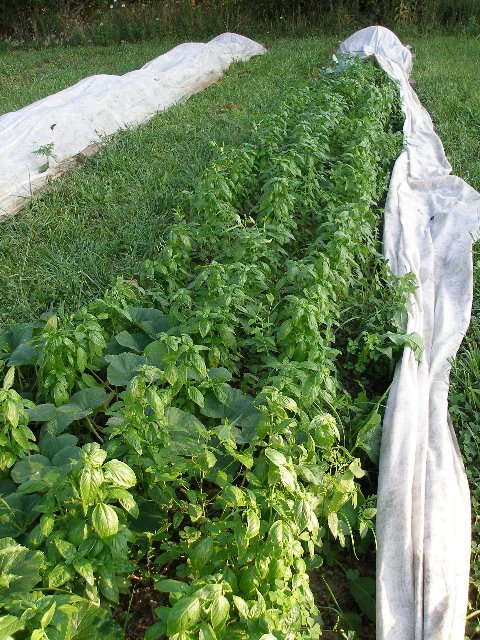
Genovese basil just beginning to make flowers


Basil is one of my favorite market garden crops. This year we put in 250' linear feet which I can harvest 10 pounds at a time twice a week in high season. Harvesting 10 pounds is not as fun as it sounds.

Basil is one of our best selling crops. We sell it two ways, a small bag with approx an ounce of basil in each bag and the big bag with a 1/2 pound of basil for those smart folks who freeze pesto for winter use (something I need to do, I have a half pound of frozen pesto/garlic/oil (not really pesto but close) and I know from experience that is not enough to get us through winter/spring.

This year I grew two kinds-Genovese (regular basil) and Reuben, a beautiful red basil with no flavor. Fortunately, I grew very little Reuben compared to the wonderful green basil. Last year we discovered basil does well planted early in a hoophouse. We had a bunch of cucumbers damp off (die) so there was about 25' feet of space in one of the hoophouses so I started basil seedlings and got them transplanted in late April. By June 2006, we were harvesting. So, this year we repeated the basil experiment only this time it was planned and the basil got a whole 50' of space and was put in a bit earlier. It did not do quite as well as the unplanned early basil. Early on, the early stuff threatened to die outright (and some Reuben did die). It was a bit too cool for the basil. But soon enough it got warm enough and the daylight hours long enough and the early basil flourished. I just stopped harvesting it, because it has gotten pretty seedy. The main crop basil we planted outside of a hoophouse has flourished this summer. Though it too really wants to make flower tops, have sex and got to seed. That just means I have to cut it more often to keep the flower stalks at bay.

Now I am at the end of the basil season, plants want to make flowers/seeds and the temps at night are a bit cool for the uncovered basil. If I am lucky, I will get another 3 to 4 weeks of harvest before the plants are spent. Than I will pull them up and hang them in the barn to dry so I have dried basil all winter and spring to use and sell (there are some things that I feel dried basil is better than fresh, home made salad dressings and spaghetti sauce come to mind) before the fresh stuff next year is ready to cut.

Monday, October 09, 2006

Basil with Recipes


I'm doing some laundry and trying to fit some of Eugene's mother's things into our already fairly crowded house. We have succeeded in setting up the overly large TV (Fran was no huge fan of ostentatious TV's but was given this a couple of years ago by her niece) and now I am getting a room ready to put a twin bed together so we have a fer real guest room.

But what the topic here is really about is basil. Basil has been one of our best crops this year. We started it early and it has been providing us with fresh and dried basil since early June. We did two succession plantings this year. One in April in a hoophouse and the second in June outside under row cover. We start cutting it when it gets 4 to 5 sets of leaves and it responds to the cutting by putting out 2 new stems for every stem cut. After a month a twice weekly cutting you can get some very bushy plants that will produce a lot of basil leaves. We had a wetter than normal growing season which helped the basil out quite a bit as it likes it wetter than drier.

Basil is a wonderful herb. Many cultures regard it as holy. Me, I regard it as delicious. We use fresh basil is salads as an additional leafy green.

We use it in pesto

1 cup Fresh basil
2 or more cloves of garlic
1/4 cup pine nuts or walnuts
1 cup fresh parsley
1/2 cup grated parmesan cheese
1/4 cup olive oil
salt to taste

Destem the basil and parsley.
put the ingredients in in this order
garlic, pulse a few times, walnuts,
pulse, cheese, basil, pulse, oil and process for about 30 seconds or until smooth

We use it in fresh tomato basil sauce

4 to 6 medium to large tomatoes, chopped
1 medium yellow onion, chopped
1/2 cup fresh basil stemmed and chopped
2 or more cloves of garlic, minced or pressed
olive oil
salt to taste

Heat a large frying/sauté pan, add the oil and let that heat until it shimmers. Than add the yellow onions and cook them until they start to turn translucent, about 4 to 5 minutes. Than add the maters, basil, garlic and salt. Cook another 10 minutes or so and serve over hot pasta. Grate some good parmesan cheese over top and serve with crunchy garlic bread

We dry it for use in a lot of cooking like good old spaghetti sauce, on garlic bread, on pizza, etc. Dried basil is 3 to 4 times more intense flavor wise and can generally be used in any recipe that calls for fresh basil. The big exception is pesto which must have fresh basil as an ingredient.

The other thing we do with our dried basil is sell it at our farm store, farmers markets and over the web at our Local Harvest Store front. It's a nice crop to have in the colder off season months when we have little to nothing actually growing.