Yesterday was Derby day. I rarely miss watching the Kentucky Derby. I used to work with trotters and pacers and have retrained several ex-race horses to be jumpers and dressage horses. So I was excited to see that Michael Matz had a horse in the race. For the non horsey, Mr. Matz was one of the US Equestrian Team's top jumper riders and trainers and a couple of years ago he made the switch to thoroughbred racing horses.
I have long wondered what would happen if a top show trainer started trainer top flight race horses. Show riders generally are also the trainers of the horses the ride so they develop a truly intimate relationship with their show animals. They get to know them very well and develop a deep trust with each other. This is a very different relationship that goes on with thoroughbred racehorse trainers who never ride their horses and therefore never develop the kind of trust a show rider will have and therefore looks at the training of a horse differently. It is a lot like the difference between how an organic farmer looks at the farm and an conventional grower looks at a farm. Both work but in very different ways. The organic grower and the show horse trainer tend to operate holistically and the others tend to operate linearly
Because the show people tend to take this more holistic outlook in how they do things I have long assumed that if one of these guys were given a stable of top flight horses they would quickly climb into the top ranks because they would add things to the training regimes that trainers who do not ride would not know about. I do not know if Michael Matz takes his horses and trots them up and down hills at his farm but it would not surprise me at all and this sort of work would give a race horse a nice edge in that they would improve their balance and endurance and this is work most jumper, 3-day event and dressage trainers would do with their horse to get them fit and keep them happy.
I do know from working on both harness tracks and show barns that the race trainers do not know about a lot of techniques that show trainers use. For example, the idea of teaching a horse how to extend and collect their gait is foreign to most racing people but I have noticed the great race horses know how to do this naturally. This leads me to believe any horse taught collection and extension would be an improved racehorse. And there are many other training techniques that the show people use that would improve any racing performance.
Yesterday it was proven to me with Barbaro's impressive win going away from the pack in a virtual hand ride that Mr. Matz is likely including a lot of ideas from what he learned in his decades of working with show jumpers in the training of his race horses and it is working. I believe we are seeing the beginning of a stellar race training career. And we just might see a triple crown winner this year as well
Sunday, May 07, 2006


Saturday, May 06, 2006
Bird Flu Facts
"Bird Flu"
Do you know that 'bird flu' was discovered in Vietnam 9 years ago?
Do you know that barely 100 people have died in the whole world in all that time?
Do you know that it was the Americans who alerted us to the efficacy of the
human antiviral TAMIFLU as a preventative?
Do you know that TAMIFLU barely alleviates some symptoms of the common flu?
Do you know that its efficacy against the common flu is questioned by a
great part of the scientific community?
Do you know that against a SUPPOSED mutant virus such as H5N1, TAMIFLU
barely alleviates the illness?
Do you know that to date Avian Flu affects birds only?
Do you know who markets TAMIFLU?
ROCHE LABORATORIES.
Do you know who bought the patent for TAMIFLU from ROCHE LABORATORIES in
1996?
GILEAD SCIENCES INC.
Do you know who was the then president of GILEAD SCIENCES INC. and remains a
major shareholder?
DONALD RUMSFELD, the present Secretary of Defence of the USA.
Do you know that the base of TAMIFLU is crushed aniseed?
Do you know who controls 90% of the world's production of this tree?
ROCHE.
Do you know that sales of TAMIFLU were over $254 million in 2004 and more
than $1000 million in 2005?
Do you know how many more millions ROCHE can earn in the coming months if
the business of fear continues?
So the summary of the story is as follows:
Bush's friends decide that the medicine TAMIFLU is the solution for a
pandemic that has not yet occurred and that has caused a hundred deaths
worldwide in 9 years.
This medicine doesn't so much as cure the common flu. In normal conditions
the virus does not affect humans.
Rumsfeld sells the patent for TAMIFLU to ROCHE for which they pay him a
fortune.
Roche acquires 90% of the global production of crushed aniseed, the base for
the antivirus.
The governments of the entire world threaten a pandemic and then buy
industrial quantities of the product from Roche.
So we end up paying for medicine while Rumsfeld, Cheney and Bush do the
business.
Do you know that 'bird flu' was discovered in Vietnam 9 years ago?
Do you know that barely 100 people have died in the whole world in all that time?
Do you know that it was the Americans who alerted us to the efficacy of the
human antiviral TAMIFLU as a preventative?
Do you know that TAMIFLU barely alleviates some symptoms of the common flu?
Do you know that its efficacy against the common flu is questioned by a
great part of the scientific community?
Do you know that against a SUPPOSED mutant virus such as H5N1, TAMIFLU
barely alleviates the illness?
Do you know that to date Avian Flu affects birds only?
Do you know who markets TAMIFLU?
ROCHE LABORATORIES.
Do you know who bought the patent for TAMIFLU from ROCHE LABORATORIES in
1996?
GILEAD SCIENCES INC.
Do you know who was the then president of GILEAD SCIENCES INC. and remains a
major shareholder?
DONALD RUMSFELD, the present Secretary of Defence of the USA.
Do you know that the base of TAMIFLU is crushed aniseed?
Do you know who controls 90% of the world's production of this tree?
ROCHE.
Do you know that sales of TAMIFLU were over $254 million in 2004 and more
than $1000 million in 2005?
Do you know how many more millions ROCHE can earn in the coming months if
the business of fear continues?
So the summary of the story is as follows:
Bush's friends decide that the medicine TAMIFLU is the solution for a
pandemic that has not yet occurred and that has caused a hundred deaths
worldwide in 9 years.
This medicine doesn't so much as cure the common flu. In normal conditions
the virus does not affect humans.
Rumsfeld sells the patent for TAMIFLU to ROCHE for which they pay him a
fortune.
Roche acquires 90% of the global production of crushed aniseed, the base for
the antivirus.
The governments of the entire world threaten a pandemic and then buy
industrial quantities of the product from Roche.
So we end up paying for medicine while Rumsfeld, Cheney and Bush do the
business.
Tuesday, May 02, 2006
Farmers' Market Starts and Other Issues
Today is our first market of the season. I feel like I should be a bit nervous and running around getting things together but other than harvesting crops, I think we are pretty much ready to go. And I should be out harvesting as it is dawn but we are having a thundershower so I will wait until the rain passes.
Picked up my new digital camera yesterday and of course I cannot use it because I am not running a new enough version of mac OS X. I have 10.2 and I need at least 10.3 to use the software that came with the camera so I can download the images to my hardrive via a USB cable. Not a huge problem as I have a 1 gig memory card on order form Amazon that should arrive in a couple of days and I will go to a local electronics box store to see if they have a card reader that is affordable (I suspect it will cost much less than buying the upgrade to Mac OS 10.3 which is around $100 US.). Despite the hardware/software incompatibility problems the camera is way cool and can do so much more than the old one.
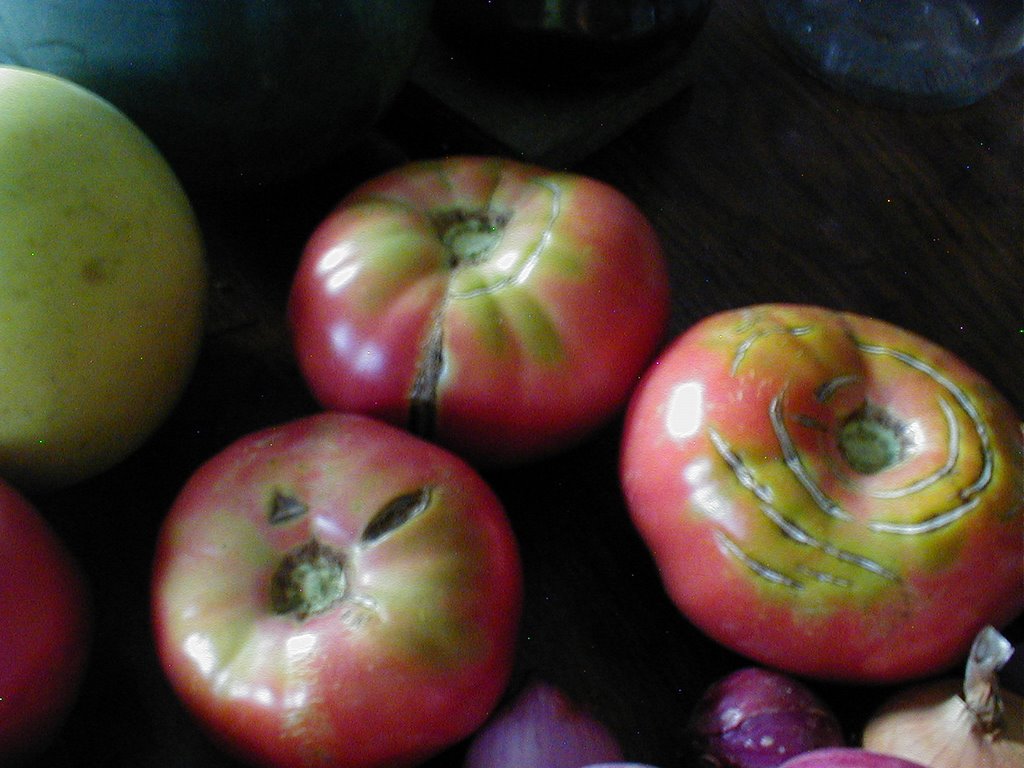
After getting the camera and spending a couple of hours figuring out I cannot download pix to my Mac I went and started our tomato crop for the year. We are doing 11 different kinds of tomatoes: Glick's Pride, Big Beef, Pink Brandywine, Yellow Pear, Red Pear, Sungold, Yellow Taxi, Dr. Wyche's Yellow, Green Grape, Opalka and a Opalka cross we have been growing out for 3 years now trying to get one of the mutations to stablize out. We are going for the stripe genetics in hopes of creating a new striped sauce tomato. Should know something in maybe the next 4 to 7 years.
I started the tomatoes in small soil blocks and as soon as they germinate I will make 10 to 12 trays of 2" soil blocks and will move them into those. They are slated to be transplanted around June first and I do not want huge plants because they are quite hard to put into cloth mulches so that is why I started them so late in the season.
Saturday, April 29, 2006
All I want for my Birthday is...
My birthday is coming up May 11th and I am getting a new Digital camera Olympus SP-310 7.1MP Digital Camera with 3x Optical Zoom to replace my Olympus Camedia with 1.3 mega pixels. I am very excited about this new camera.
The ironic thing is the 7mp camera costs about the same as my 1.3 mp camera did 5 years ago.
I was thinking I wanted an Canon EOS Rebel digital SLR camera but at $550 to $1200 it was way too much (not to mention getting extra lenses would cost as much as the camera body itself). Than I got to reading about digital SLR Cameras and found out that dust getting between the lens and the camera body is a big issue. And than I got to thinking you know, digital photography is not like film photography at all so why get a camera that was designed for film and converted to use digital technology? Why not get a camera that is made for the digital era. So I did.
Now I just have to get to the Post office when they are open and pick up the camera that Amazon says is waiting for me there. Probably won't happen today as the PO closes at noon and I am not likely to drive into town just to get the thing and than make another trip in later to go do a workshop south of Oxford (which has become a saga unto itself apparently. But it has not affected us much other than moving our presentation up a half hour thus allowing more time for our hoophouse demo which is a good thing)
Thanks for the swell b-day present Dad
The ironic thing is the 7mp camera costs about the same as my 1.3 mp camera did 5 years ago.
I was thinking I wanted an Canon EOS Rebel digital SLR camera but at $550 to $1200 it was way too much (not to mention getting extra lenses would cost as much as the camera body itself). Than I got to reading about digital SLR Cameras and found out that dust getting between the lens and the camera body is a big issue. And than I got to thinking you know, digital photography is not like film photography at all so why get a camera that was designed for film and converted to use digital technology? Why not get a camera that is made for the digital era. So I did.
Now I just have to get to the Post office when they are open and pick up the camera that Amazon says is waiting for me there. Probably won't happen today as the PO closes at noon and I am not likely to drive into town just to get the thing and than make another trip in later to go do a workshop south of Oxford (which has become a saga unto itself apparently. But it has not affected us much other than moving our presentation up a half hour thus allowing more time for our hoophouse demo which is a good thing)
Thanks for the swell b-day present Dad
Wednesday, April 26, 2006
Hoophouse Workshop This Saturday
We will be doing a hoophouse workshop this coming Saturday at 4pm at Harv Roehling's farm south of Oxford, OH as a part of the M.O.O.N/OEFFA chapter's 1st annual "Let's Get Growing" program. This will be a day full of workshops and farm tours. We will be the last workshop and Eugene plans on putting together one of our hoophouses from scratch starting with bending the metal conduit into hoops and going from there. This may turn into a very hands on demonstration, I dunno. But I do know it will be very informative.
For more information about this program either click on the "Lets Get Growing" link or the title of this entry and you will be taken to the MOON website where you will find all the information you will need.
For more information about this program either click on the "Lets Get Growing" link or the title of this entry and you will be taken to the MOON website where you will find all the information you will need.
Market Season Starts Next Week!
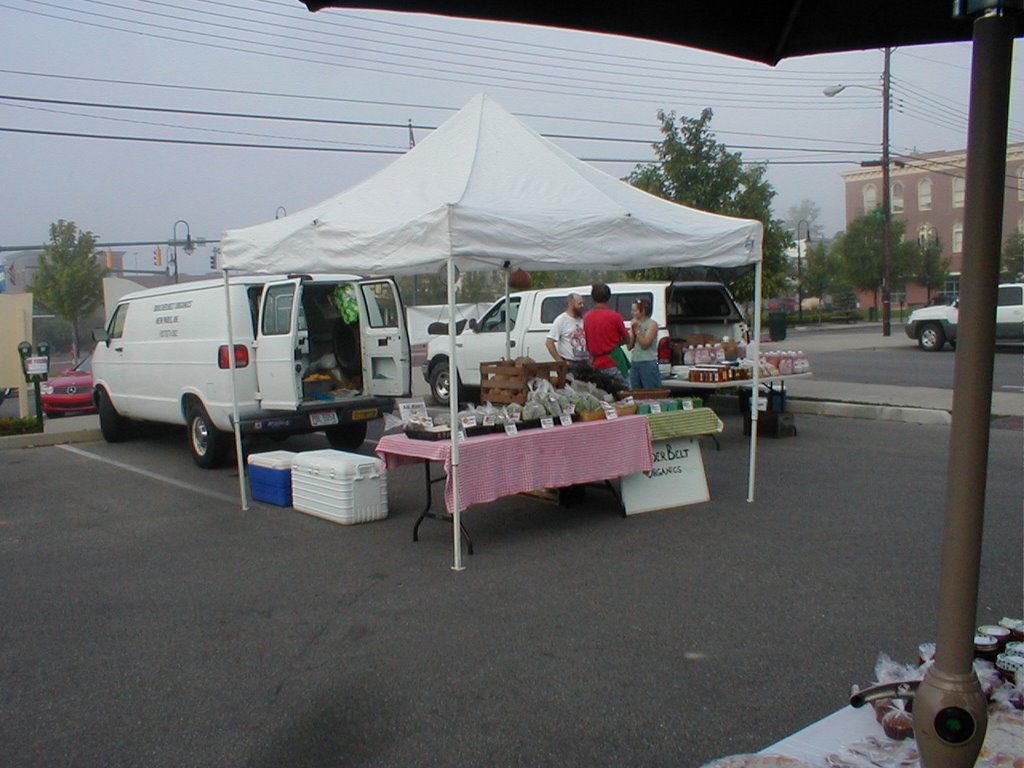 Our farmers' market set up at a Saturday Market in 2005
If we do not have enough food we will likely opt to stay home on the farm and sell from the store-it will be a lot easier for us not to have to pick, pack and load the van and than drive 30 minutes to Oxford, unload the van, set up the stand and finally get around to selling our wares. This gets harder and harder to do twice a week with each passing year. Especially the Tuesday market where we have to park on the street and unload everything we need, and put it in the park. Early on in the season when we have light items it is not so bad but in the summer when we have about 35 crates holding about 100 pounds each and it is 95˚F out it gets hard and we really start to question our sanity. The Saturday market is much easier because we can sell from the back of the van. We still have to haul the tables, crates of produce, the EZUP shelter, etc., but it is only a couple of feet from the van to where we want things, not across the street
Not to mention with the price of gas it will be cheaper to stay on the farm.
In past years we generally had a lot of items ready to go for the first markets but not this year. We were not able to get our hoophouses up until March because we had no beds ready to go until than (now we have about 85% of them ready for planting and have about 50% filled up). Normally there would be things like spring mix, strawberries, spinach, kale and chard ready to go. We will have all of these things in the near future just not for the first couple of markets. We will have some lovely arugula and heirloom lettuces for the first week along with onion sets, popcorn, garlic powder, some basil plants, chives and a few other items but it will not be the full table I like to have, ah c'est la vie.
But soon enough we will have an abundance of items as we have a lot of items planted and growing such as snow peas, sugar snap peas, spring mix, strawberries, lettuce, spinach, chives, lovage, oregano, tarragon, garlic, onions, zucchinis & cukes in a hoophouse, tomatoes and basil in a another hoophouse, melons soon to go into a yet another hoophouse, radishes, cilantro, etc..
If you are in the Oxford area either Tuesday afternoon or Saturday morning stop by and see us.
Monday, April 24, 2006
Taters and Onions
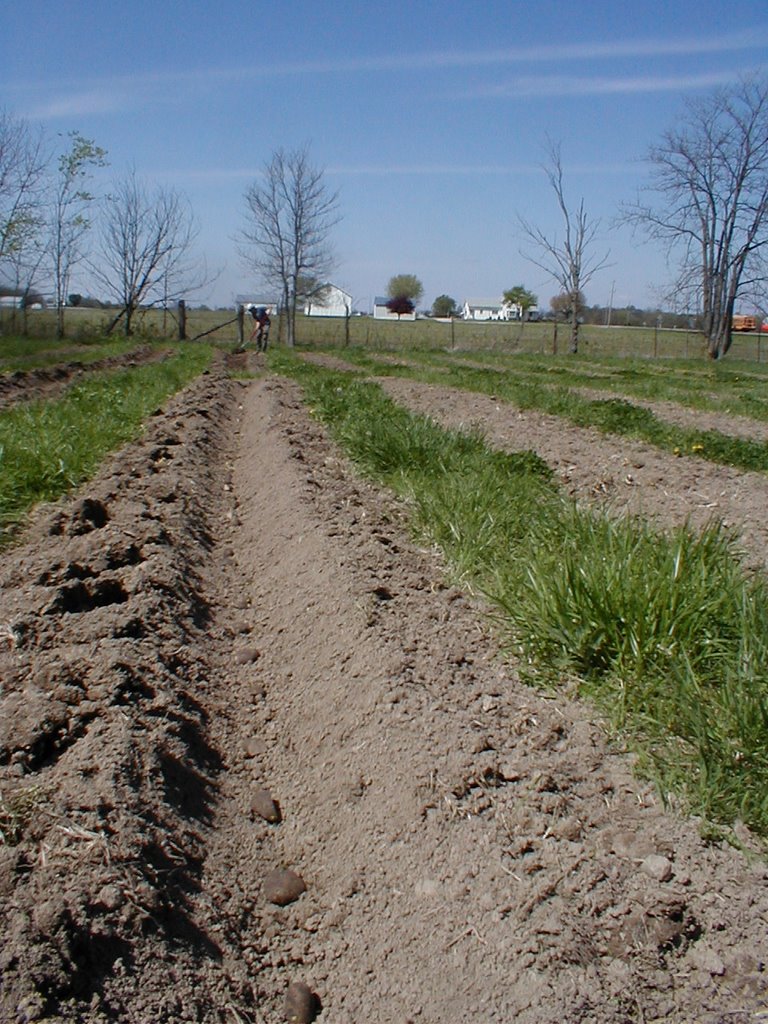
A shot of a trench with seed potatoes waiting to be covered. In the background is our neighbor's farm (the white buildings)
Eugene "chitted" (i.e. cut up) the spuds about 7 days ago after letting them sit in a well lit room for over a month to green up. In the past we chitted within 24 hours of planting, sometimes while we were out in the field planting. But I was reading some comments on the Sustainable Ag listserv by Robin Follette and she said she chitted at least a week before planting. This caused the sprouting eyes to make rootlets which is something we want, so we will be chitting earlier than later in the future.
Went up to the field with 3 bread trays of potatoes. One had french fingerling, another had early white and the third had pontiac red. Eugene decided the trenches were not deep enough so he took the potato fork and dug out more dirt and I went behind him with a rake and raked the dirt out of the trench. Did this for 6 50' beds. After that was done we started putting the potatoes in the trenches and that is when we were called away from work by a guy by the road. He sells produce at the 127/40 intersection and was checking us out and wanted to see if we wanted to sell him any produce. We said probably not and talked with him for about 20 minutes than went back to work. Got the first 2 trenches filled with taters and were starting on the 3rd and 4th trenches when out next door neighbor, whom we had not met, walked across his field to introduce himself. He was pleased that we had cleaned up most of the junk that had been sitting in the field and told us he had farmed our farm back in the early 1950's but since than it had been in pasture. We made small talk for a few minutes than we went back to work and he walked back across the field to his home. We finished up setting the potatoes and Eugene started covering them with soil.
After that took a break, drank water and than planted the onion sets. Normally we do onion from seed because you get bigger and better quality onions. And we did start several hundred onions and leeks from seed this year. But because we did not have seed for all the kinds of onions we wanted to grow we used sets as well. And since we we had a lot of tiny onions left over from last year's crop and they are the perfect size for replanting we have planted a lot of sets as well. So now we have about 3 beds on onion sets growing and looking quite good to boot. We also have a bed of onion seedlings though it is mostly sweet onions, not the yellow cooking type (aka hot onions).
Planting onion sets is pretty straight forward. Place them 6" apart and push them firmly into the ground, repeat 400 more times and you are done.
We also had a banner morning for mouse trapping. Trapped 3 of them, one in the house and two in the seed room (and with no further damage to any seedlings or seeds) plus Trina, our clawless cat, caught a mouse around 4am in our bedroom (or maybe brought it upstairs to show us, I dunno). We do not know if she was successful in killing the vermin (she has no claws after all and no one had ever taught her how to hunt until Navin came into her life just 7 months ago) but at the very least she scared it badly. It was squeaking in terror while we sleepily told Trina what a good kitty she was for catching the mouse.
Maybe this eveing we will do a bit of fishing in the pond (which is now full of black tadpoles hugging the edges trying not to become some fish's meal). I was watching several largish fish swim around that looked like the would be fun to catch. We seem to have 5 or 6 bass-like fish that are better than 15" long and many large bluegill as well.
The Eggplanthead's Last Stand

This will probably be Eggplanthead's last appearance on this blog. As you can see he is getting pretty shriveled and there just ain't a whole lot left to the guy.
Friday, April 21, 2006
The Farm Store and Better Built Barns
I have not written much about the fact we are about a month from opening up our farm store. The plan is to sell our homegrown produce plus that of other local growers. I have been getting the word out that we need a sweet corn grower and this morning I got an email from a farmer about 15 miles NE of us that he has 78 OEFFA certified organic acres and needs a market for his sweet corn (as well as spinach, beets and green beans). I was hoping for, but not expecting, certified organic sweet corn to sell this summer. Looks like I will get my wish. If things turn out as planned we will have a place for local growers to successfully sell their food and crafts to the public. if there is one thing that the local farmers need is more outlets for local sales
At any rate, we are planning to get this store open in about 3 weeks (mid May). I don't believe we will have a great deal at first since we were not able to start serious planting until the beginning of this month. Normally we will have things ready to go by mid April but since we had to open up new ground and move and all the other things that one needs to do to start a new farm we had to give up on the fall and winter planting plans (but we will be ready to do this for 2006/7).
One thing we will have (we have it right now!) is yard barns. We have become sales agents for the Better Built Barn corporation. This guy named Rick came out a few weeks ago and asked if we would be interested in allowing him to put several barns on our land and we would get 10% of every sale made here. Since we did not have to invest a single penny and will get three sheds to put farmers that want to set up and sell on our property, we said sure. Yesterday 3 of the show barns arrived and sometime in the next week the rest will be put in place. Now all we need are a few interested parties to come by and buy one
At any rate, we are planning to get this store open in about 3 weeks (mid May). I don't believe we will have a great deal at first since we were not able to start serious planting until the beginning of this month. Normally we will have things ready to go by mid April but since we had to open up new ground and move and all the other things that one needs to do to start a new farm we had to give up on the fall and winter planting plans (but we will be ready to do this for 2006/7).
One thing we will have (we have it right now!) is yard barns. We have become sales agents for the Better Built Barn corporation. This guy named Rick came out a few weeks ago and asked if we would be interested in allowing him to put several barns on our land and we would get 10% of every sale made here. Since we did not have to invest a single penny and will get three sheds to put farmers that want to set up and sell on our property, we said sure. Yesterday 3 of the show barns arrived and sometime in the next week the rest will be put in place. Now all we need are a few interested parties to come by and buy one
Ding Dong the Mouse is Dead!
So the night before last (Wednesday night) the mouse came in and had its way with more seeds (but did leave the pepper seedlings alone, at least) so we went and bought some sticky traps and laid 4 or them around the light tables and this morning when I went out to check on the seedlings and seeds this morning there was a mouse stuck to a card trying to get loose. Despite my rhetoric about being able to kill the thing if caught alive I could not and got Eugene to kill it. Hopefully this will stop our problems.
But if not we have more sticky cards.
But if not we have more sticky cards.
Thursday, April 20, 2006
Flock-Killing Planned if Bird Flu Found
Flock-Killing Planned if Bird Flu Found
WASHINGTON, Apr. 19, 2006
(AP) If deadly bird flu shows up in U.S. chickens or turkeys, the government will kill off any flocks suspected of having the virus even before tests are completed, officials said Wednesday.
At greater risk are free-ranging chickens and small, backyard flocks _ as many as 60,000 in Los Angeles alone.
If bird flu arrives, "quick detection will be key to quickly containing it and eradicating it," said Ron DeHaven, head of the Agriculture Department's Animal and Plant Health Inspection Service.
Most of America's chickens come from big commercial farms that keep birds indoors and are well-protected against the spread of disease. Yet there are many flocks in people's backyards _ officials are unsure how many _ and free-range flocks that are outdoors and could mix with wild birds or their droppings.
Officials encourage those producers to bring flocks inside and watch for signs of flu _ dead birds; lack of appetite; purple wattles, combs and legs; coughing or sneezing; diarrhea _ and report them immediately to state or federal authorities.
"We can't afford for this virus to be smoldering six months before we find it," DeHaven said in an interview with The Associated Press.
Owners will want to report sick birds because they will be paid fair market value for destroyed flocks, DeHaven said. Stopping the spread of bird flu has been more difficult in countries that can't afford to compensate farmers, he added.
The virulent strain of bird flu spreading through Asia, Europe and Africa has killed 110 people and hundreds of millions of birds. Scientists fear it could mutate into a form that spreads easily among people, sparking a worldwide epidemic.
Authorities say it's likely to arrive in the United States this year. The government is testing more wild birds than usual, as many as 100,000 in Alaska and other migratory pathways. Chicken and turkey companies are testing nearly every flock for the virus.
"If the virus does arrive in the U.S., we think we'll find it quickly," he said. "We don't think that it would ever make it into the food chain."
Regardless, poultry is safe to eat if people cook it to 165 degrees and follow basic kitchen safety rules, DeHaven said.
If the virus turns up in commercial chickens or turkeys, the government plans to quarantine the farm, restrict bird movements within about two miles and boost testing within about six miles.
If screening tests suggest a potentially virulent flu virus is present, and the birds show signs of flu, they'll be killed immediately, even before more detailed testing is finished, DeHaven said. Flocks would be confined and killed with carbon dioxide gas, essentially putting them to sleep, DeHaven said. Authorities refer to this as "depopulation."
Disposal of dead birds is tricky, because they still may carry the virus. In the past, large numbers of birds have been buried, put in landfills or incinerated, but those things can be expensive and cause bureaucratic hassles.
Now, the industry intends to compost the carcasses inside houses where birds are killed.
To be composted, carcasses are layered with mulch, hosed down and left alone, inside, for four to six weeks, said Richard Lobb, spokesman for the National Chicken Council, an industry group. Intense heat generated by composting is more than enough to kill the virus, Lobb said.
The government has vaccines to protect poultry from the virus but is reluctant to use them because vaccinated birds can still spread the virus without appearing sick, said John Clifford, the department's chief veterinarian. Vaccines could be used in flocks surrounding the area of an outbreak, he said.
___
On the Net:
Agriculture Department: http://www.usda.gov
Biosecurity for the birds campaign: http://www.aphis.usda.gov/vs/birdbiosecurity/
Okay, this plan seems to be against the small holder with healthy pastured poultry. I noticed that all outdoor flocks will be executed even before a test says whether or not they are actually infected while the factory farms will just be put under quarantine. it os nice that growers will be reimbursed for their dead birds at fair market value. I sell my birds for $4 a pound (and believe me they are worth every penny) and I even have a paper trail that says this has been the case for the past 5 years but I will be willing to bet if the feds come for my birds I will get nothing approaching what I get for a dressed whole bird and will more likely get the fair market value of a factory farmed bird. Likely around 30¢ a pound (which would not even cover for the feed they get over 7 weeks much less our labor or the cost of the chicks)
Lucy
Okay, this plan seems to be against the small holder with healthy pastured poultry. I noticed that all outdoor flocks will be executed even before a test says whether or not they are actually infected while the factory farms will just be put under quarantine. it os nice that growers will be reimbursed for their dead birds at fair market value. I sell my birds for $4 a pound (and believe me they are worth every penny) and I even have a paper trail that says this has been the case for the past 5 years but I will be willing to bet if the feds come for my birds I will get nothing approaching what I get for a dressed whole bird and will more likely get the fair market value of a factory farmed bird. Likely around 30¢ a pound (which would not even cover for the feed they get over 7 weeks much less our labor or the cost of the chicks)
Lucy
The State Of the Small Farm
From: http://gristmill.grist.org/story/2006/4/13/112749/099
What's at stake in the 2007 Farm Bill
Posted by Tom Philpott at 12:54 PM on 13 Apr 2006
Since moving to the North Carolina mountains in 2004 to launch a farm project, I've learned some sobering lessons about idyllic rural life.
To wit, small-scale organic farming is an art form -- and as with most artistic endeavors, the hours are long and the pay is crap. How did I wind up penniless and exhausted, sporting a beat-up pair of Carhartts? You'd think I had set up shop as an abstract painter in some squalid, ruinously priced Williamsburg, Brooklyn, garret.
(There's much to love about the farming life, too: for example, the volunteer broccoli raab that's sprouting up everywhere in one part of the garden, a triumph of unintentional permaculture. Saute it with a little olive oil, garlic, crushed chili, and vinegar, and you remember why you came to the farm in the first place.)
The USDA's Economic Research Service recently released two reports on the state of farm economics. The information contained therein can help greens as they formulate an agenda for the 2007 Farm Bill (which may be even more important than defending biofuel and hybrids from critics.)
The first one, Economic Well-Being of Farm Households (PDF), should be handed out at farmers markets and in CSA boxes everywhere. It's only four pages; here are some highlights:
- Commercial mega-farms -- those with at least $250,000 in annual sales -- represent just 7 percent of U.S. farms but command about 70 percent of total farm sales.
- Those large farms are profitable (although, as we'll see below, they lean heavily on commodity subsidies). But "the other 93 percent of farm households have negative farm operating profits, on average, and draw most of their income from off-farm sources." In other words, Earth to Philpott: Get a job.
- The smaller the farm, the less profitable it is: "farm operating margins become more negative and share of household income from farm sources decreases as farm size diminishes."
- Here's the kicker: 85 percent of U.S. farms generate income of less than $100,000/year. These farms generate just "15 percent of [total U.S. farm] sales, and earn negligible income from farming." (Emphasis added.) Ouch!
- And here's why I say that farming has become a labor of love, complete with requiring a "day job" for support: "Off-farm sources of income (including employment earnings, other business activities, other investments, and transfer payments) provided 85-95 percent of household income over 1999-2003, up from around 50 percent in 1960." That's a macro number, including even the mega-farms that draw hundreds of grand per year in subsidies.
The other report, "Growing Farm Size and the Distribution of Farm Payments" (PDF), offers its own shockers. To wit:
- Farms with sales of between $10,000 and $99,000 -- where my own Maverick Farms falls -- have an operating profit margin of (gulp) negative 24.5 percent.
- Not surprisingly, young people aren't going in to small-scale farming -- probably because they can't afford to. "Over 30 percent of operators in the $10,000-$99,999 sales class were at least 65 years old by 2003, versus 13 percent of the operators of very large family farms." When these old operators retire, think their kids will want to continue a business that brings in a quarter less than every dollar spent?
- Government commodity payments -- the Farm Bill's meat -- increasingly support large farms rather than small ones: "Farms with less than $250,000 in production value (2003$) received 63 percent of commodity payments in 1989; by 2003, they received 43 percent of payments. But farms with at least $500,000 of production received 32 percent of all commodity payments in 2003, up from 13 percent in 1989."
Note that the study's data set ends in 2003, thus not really accounting for the 2002 Farm Bill, signed into law by Bush, which has been churning out cash to big farms like a cow pumped full of Monsanto's growth hormones.
What, then, are the implications for greens of the 2007 Farm Bill?
If we accept the premise that small-scale organic ag, geared to a nearby market, is more environmentally responsible than Big Ag, then it's time to redirect federal farm policy. As things stand now, farm policy works toward bolstering the power of the large chemical-intensive farmers and their customers -- grain-buying giants like Archer Daniels Midland.
There's no reason the Farm Bill couldn't be reformulated to support small-scale ag, though. I'll be laying out ideas for how that can happen here and in other publications over the coming months.
Subscribe to:
Posts (Atom)