Showing posts with label heirloom. Show all posts
Showing posts with label heirloom. Show all posts
Wednesday, August 08, 2012


Saturday, August 13, 2011
How to Choose a Good Cantaloupe
How to Choose a Good Cantaloupe
(this does not work for watermelon)
Smell the blossom end (opposite of the stem end), there should be a strong, sweet aroma
There should be no stem as a ripe melon “slips” of separates completely from the stem when ripe in the field. If there is stem than the melon was harvested green but could still be ripe if the aroma is strong and sweet.
Skin should have a golden cast to it and strong netting. green ribbing is common in many heirloom ‘loupes and is not an indicator of unripeness
 |
| Golden Gopher heirloom melon |
Friday, April 02, 2010
Saved Heirloom Seed to the Rescue
Yesterday was the day to start 700+ eggplant and pepper seeds. we like these seedlings to be about 7 to 9 weeks old when we transplant them out and since we transplant such warm loving crops out at the end of May/early June, April 1st seemed like the perfect time to start them (plus our biodynamic calendar, The Stella Natura sez it was a fruit time which is a great time to start fruiting plants).
In order to start seed you need to know a couple of things. How much space has been allotted in the market garden and how many varieties will be planted. I knew that there was a total of 40 50'x 4' beds reserved for all the night shades (tomato, potato, peppers, eggplant) and out of that 2 beds were reserved for eggplant and 16 for peppers. The next step was to go get the seed packets and see what we had to plant.
The eggplant was easy-we had a total of 12 different packets of seed. 6 of the packets were 6+ years old and so assumed dead so I tossed those seeds out (by tossing out I mean putting the seeds in the compost and saving the packets for other uses such as seed saving). This left me with 6 varieties-Dancer, Nadia, Casper, Galine, Rosita and Oriental Express. Since Galine was bought to replace Nadia and Rosita to replace Dancer (probably because these varieties come from Peto Seed which is a part of Semenis which is Owned by Monsanto, but I would have to look this up to be sure) and both those seeds are 3+ years old, they were not planted.
The peppers were also easy because most of the seed we are using this year we bought this year. So it was a matter of going through the pepper seeds and picking out all the brand new clean, unopened seed packets and putting them aside. I chose 7 varieties, Valencia, an orange pepper we have done for years and years because it is a great pepper, Islander, a purple pepper, Revolution, the best red bell pepper out there as far as I am concerned, Lipstick, a red pimento pepper that is new to us this year, Flavor burst, a yellow Italian type reputed to have great flavor (this is also a new variety for us this year), Jalapeno and Cayenne because, while we do not sell a lot of hot peppers, these two are pretty essential to have around for personal use.
I also used this time to figure out what tomatoes will be planted this year but that is another blog post for another time...
After I figured out just what varieties I would plant I than figured out just how many seeds needed to be started to cover our asses. There is a bit of an art to this. You do not want to run short and find you don't have enough plants to fill beds and you do not want so many that after you are all done you have many flats of seedlings sitting around that Eugene refuses to kill for months on end, getting bigger and bigger. You may ask why we don't sell these plants? We don't because by the time we know what could be sold (the leftovers after transplanting) it is so late in the home garden planting season that it is hard to sell vegetable seedlings, so we make a very feeble attempt at doing so. And we are not at all set up to do seedlings for sale. We need a lot more seed starting space and a proper greenhouse that can be heated and that takes $$$.
When I figure out how many seeds to start I take into account the germination will not be 100%, more like 80% for new seed and for seed that is 3+ years old much lower rates of germination. And at least 20% will die for some reason before transplanting. Our first year here we have had 90% die off due to mice decapitating most of the pepper seedlings. So I like to start around 50% more seed than is needed as it is always better to have it and not need them than to need them and not have them. And because we do a lot of heirloom and specialty hybrids it is not as if we can trot off to the local TSC or Wal-Mart and pick up packets of the varieties we need (actually when K-mart had the Martha Stewart seed collection I found for several things like Chioggia beets and Costata Romanesque zucchini were in stock). For most things we have to order through the mail which takes extra time (as I will not pay $50+ for over night delivery for a mofo $10 packet of seed).
Okay, so with all this information I went out to the barn and made 700+ tiny soil blocks, took a break and than came back with Eugene in tow to get all these seeds started as well as finding/making tags so we know what's what. This is simple and yet amazingly important step-all pepper and eggplant seedlings look a like, never ever think you can tell one from the other. And when it comes time to prick the seedlings into 2" soil blocks there will be trouble. There will be even more trouble when it comes time to transplanting the mystery seedlings as one would have no idea what goes where. The problems get even larger when harvest time rolls around 90 days after planting the seeds.
So we started sowing seed and find we did not order enough seed for many of the peppers. This is in large part because both Fedco and Johnny's have gone nuts on using very confusing and changeable units of measurement for their seed sales. Some seeds are measured using English units (oz, pounds, etc..) some use metric (grams, Kilograms, etc..) and some are sold by the thousand. So this means you have to have the ability to convert from measurement to another and it seems we are not great this ability (nor are many market growers, judging by the bitch fest about this topic on the market farming email list in Jan and Feb). Also Eugene's eyes are weakening and the boy is too vain to wear glasses (I am talking cheaters, not prescription) so he missed a couple of crucial decimal points and thus instead of ordering 400 Revolution pepper seeds (4 grams) he ordered 40 (.4 grams) - but we got lucky and Fedco sent 65, about 1/3 the amount we need.
This pisses me off because 2 years ago he did exactly the same thing (but that was the year of the terrible pepper season for western Ohio so it really did not matter in the end, we would have lost them no matter what). The good news is I can still order this variety through Fedco because after years of resistance they have on-line ordering and now will take seed orders until September, instead of shutting down the orders in early spring and I see they have Revolution seed in stock. So I have just ordered a whole gram of seed (Woo Hoo!!!).
Any Hoo, we found, in the end, we were short on a lot of pepper seed variety (due to the confusion of changeable metrics) and thus ended up with not enough potential plants to fill the space allotted. So I looked to see what we had in saved seeds from years past and found Chinese Giant in red and yellow. So I planted enough of those to fill up all the small blocks. these are older seed so they may not germinate well, if at all. And these are not my first choice as the fruit tends to come on late and the peppers tend to not ripen without getting hit with something, so low yields of usable fruit, generally. Still we did have these heirlooms on hand and they did save the day.
But now that additional Revolution seed has been ordered and should arrive in less than a week we should be all right for red bell peppers and probably won't need many of the Chinese Giant.
Tuesday, January 26, 2010
Seed Buying
One of the big events in winter for us farmers is the seed order. Since we garden on acres this is a far larger undertaking than when we did home gardens. Ordering has happens much earlier for us growing commercially than for home gardeners. In fact we get our commercial catalogs about 3 weeks earlier than the home gardener catalogs (we know this because several of the companies we use have both). So in mid December we get our first catalogs-Johnny's and Fedco Followed by Seed Savers Exchange. A those are the 3 main companies we use for our seed supply.
There are a whole lot of companies we will not use due to the fact they source most of their seeds from companies owned by Monsanto (Peto and Semenis seeds). Jung's is one of them. Okay, another big reason we will never ever buy from Jung's Seeds ever again is they have sent us a lot of horrible plants and seeds. The rhubarb we got from there all died within 12 months, 95% died within 3 months. Than there were the trees they sent us last year that should have come in March or early April but cam in mid June and all but 1 were dead. We also do not like the policy of no refunds, store credit only. And they have bought up a lot of smaller companies (that people think are still independents) such as Totally Tomato
Vermont Bean Seed Co., Burpee, Cook's Garden, Earl May Seeds, Gardens Alive (not really a seed place they are more into fertilizers, pest control, etc.. and used to be a really good place to buy organic inputs), Lindenberg Seeds, Mountain Valley Seeds, Park Seeds, T&T Seeds, Tomato Grower's Supply, Willhite Seed Co., Nichol's, Rupp, Osborne, Snow, Stokes, R.H. Shumway, The Vermont Bean Seed Co., Seeds For The World, Seymour's Selected Seeds, HPS, Roots and Rhizomes, McClure and Zimmerman Quality Bulb Brokers, Spring Hill Nurseries, Breck's Bulbs,
Audubon Workshop, Flowers of the Month Club, Wayside Gardens, Park Bulb's and Park's Countryside Garde.
I also have quit buying seed from Baker Creek because they have send too many wrong or poorly bred seed. This is a shame because I really like Baker Creek. they are independently owned, they do not sell any GMO seed nor source with companies that do. All things that are important to me. but the seed quality for the most part sucks and in my market garden I have to have good to great seed quality and the seed should match up with what it says on the packet. I would say with Baker Creek, 3 out of 5 times there have been mistakes on their part.
Now savvier readers will note I order from Johnny's Selected Seeds and that Johnny's does indeed source some seeds from Semenis/Peto Seeds (though I hear rumors saying they have stopped or will stop buying from these corporations). The reason I make this exception for Johnny's is because I have been a happy customer for over 15 years, the seeds are top flight. There are very few mistakes made and when they happen they always make good, often within hours. they are an employee owned independent seed house with inhouse seed breeding program that is second to none. They are an official AAS trial site because of their location and great breeding program and they have one of the best seed catalogs in the world. And they have signed the Safe Seed Pledge (This link has a list of all the seed houses that have signed this pledge in 2009).
Around Christmas time we get the first catalogs (Johnny's first than Fedco a week later and finally SSE) and we start looking through them and also looking at the list of seed needs I complied last year as we used up the seeds (this is something that I had not done before 2009-or if I did I lost the list before seed ordering time. This saved a lot of time and made the order far more accurate than in the past). this year Eugene did the order and I was the one who got to put the orders on the order blanks, check to make sure we got everything (we never do and this year has been no exception. IIRC we still need a few tomato types) and than the order is calculated, checks are written and than everything is put into the correct envelopes, stamped and sent out.
This year Johnny's got $193, Fedco $207 and SSE $17.50. I know we still have to order strawberry plants which will be another $75 or so. And there will likely be other orders for seeds due to various reasons. And believe it or not this is a relatively small seed order for us. Many years we spend over $600 on seed alone (and several thousand on other inputs and equipment).
After the orders are dropped into the mail box at the Post Office we go home and sit around and await the incoming orders.
As per usual, Johnny's was the first to send us our order. About a 10 days ago the UPS guy delivered a box full of seeds and we were happy. We took the box inside and went through the seeds and found 3 kinds on back order. But within 3 days those seeds had also arrived at the post office. After the Johnny's order came the Seed Saver's order of heirloom tomatoes arrived. And yesterday we picked up the Fedco order at the post office. Or at least the majority, as many things are on back order and one thing was out of stock Even'star American Rapa which seems to be something for spring mixes so not a big deal that there is none. Besides I contacted Fedco and asked if they could send Hamburg Parsley instead of a refund and they said certainly (because they are flexible like that). one thing i am very happy about is the fact our onion seed arrived yesterday. You see CR Lawn, Fedco's founder always includes a newsletter with the order and he wrote that 6 varieties of onions have been on back order but during his writing 3 types arrived at their wearhouse and thus Fedco was able to fill some of their onion orders, including ours. This is important because onions (and leeks and shallots) really need to be started by Feb 1st for best results. It really sucks to see the term "Back Order" next to the seeds you need early as possible (and it is even worse when there is a note stating those seeds will not be available for 2 to 3 months and you already know there are none to be had anywhere because you already checked out 15 different companies for the variety-this happened to about 10 years ago mainly because we were not ordering our seed early enough, so we got smart and got into the habit of ordering early in the year).
Now that we have our seeds let the planting begin! And it will today with onions, leeks and shallots (and maybe kale and lettuces too).
Thursday, February 05, 2009
What We are Doing: Early Feb.
It is mid winter but not to early to start planting things for the market garden. So far we have planted several kinds of onions and 2 kinds of leeks (I am waiting on the seed to arrive for the Musselburgh leeks, an heirloom am excited to try). We also have started White Russian and Winterbor kale.
Soon we will start lettuce for head lettuce (I do not mean iceberg lettuce. All lettuce comes in heads be it leaf, bibb, buttercrunch, lollo or iceberg) inside under lights along with broccoli, cabbage and chard. Most of these things will go into a hoop house for a few weeks until it stops getting really cold at night. Than the hoop houses will be removed and they will be under row covers for the rest of their lives.
In March we will do a lot more seeds. More broccoli, lettuce and cabbage will be sowed indoors along with early zucchini, tomatoes and peppers. We will also start celeriac, parsley, rosemary (which takes about 3 to 5 weeks to germinate and has very low germination too boot) and early basil. Out doors we will start transplanting the onions and leeks and will sow seed for spring mix, arugula, scallions, spinach, parsnips and plant shallot sets. I believe we also have plans to open up more beds so we have more planting room.
We prune fruit trees and deal with the raspberry and blackberry brambles in late Feb/early March. Pruning is amazing important. Without proper pruning the quality of fruit goes way down quickly as does yield. The first year we were here we were faced with 3 apple trees that had not been properly pruned in at least a decade (if they ever were pruned correctly). the fruit was small and full of bugs and disease. the trees themselves were less than healthy and had a lot of kind of dead wood on them. So Eugene did what one should not normally do-he took off nearly 50% of the trees. You generally do not want to take more than 1/3 in any given year but these trees needed major help so they were well pruned. Since than the apples have been much bigger and much higher quality and Eugene has not had to prune more than 25% of the trees since than. The brambles are much easier to deal with because we put them in.
The heritage raspberries get mowed down in late winter because they are an everbearing and we have found the do best if they are not allowed to set fruit in the spring. The Latham raspberries have to have all the old canes removed along with any canes that cross other and canes we don't want. You want to end up with no more than 6 canes per linear foot. Last year these berries went nuts and had a bumper crop (I have never seen so many berries in my life!) so there is a lot of stuff to remove this year. Once we remove everything we will also remove any perennial weeds (dandelion, thistle, etc..) and than put on a nice 6" layer of mulch which is generally a mix of straw and cedar chips to feed the berries, keep the soil on the acid side and keep the weeds down (not that many weeds can compete with these brambles)
The other thing we will plant sometime in March are nut trees. We ordered something like 10 nut trees and when ever they arrive they will go in the ground. We have a fantasy of developing a nut grove. I'll bet the local squirrels will love us for this idea
Tuesday, January 13, 2009
Seed Ordering Time
January is seed ordering time here at Boulder belt. The seed order used to be a huge event for us that caused a great deal of stress (what if we forget something? What if we get it WRONG!!??!?). we would get the seed catalogs in the mail (most arriving by Jan 1st because we are commercial growers and commercial growers get their catalogs before the home gardening crowd). We would study the catalogs for days dreaming of spring and planting and warm mornings and fresh food being harvested daily and other unwintry thoughts. We would put big black stars by the seeds we wanted to buy and would fill out order forms and check them twice than send in the orders.
And every time we would discover we had missed something important and would freak out.
These days we do not find the seed order is such a big deal because we have started in the past two years putting 2 to 4 seed orders every year pretty much in every season. So if something is forgotten we no longer freak out. Instead we just order whatever it is we need and grumble about S&H charges that could have been avoided if we only had order whatever with the rest of the seeds.
So far this year we have put in our orders to Johnny's selected seeds and Fedco and have only forgotten one item-5 pounds of sugar snap peas, one of our best selling crops. I have not decided if I want to put in another order to Johnny's or Fedco or go with one of the Heirloom companies-Baker Creek or Seed Savers Exchange. Both have sugar snap seed, I believe. But we have not order sugar snaps from either of those companies before so don't know the quality. We usually get our peas from Fedco or Johnny's and do know what to expect form them.
Something that has come up in the various forums I use about seed buying-The fact that Monsanto bought Semenis seeds and now controls something like 85% of the global seed stocks. We at Boulder belt do research where the seeds we buy come from and we avoid buying Monsanto owned seeds. This has meant dropping several hybrids that have always done very well for us and finding substitutes. This has not been an easy task for a couple of crops. I have yet to find a replacement I really like for the Fat n Sassy green to red bell pepper. It has been fun trying out different peppers both hybrid and heirloom. I have found many heirloom varieties I like a lot but none have come close to replacing this red bell (but I have found some wonderful yellow, purple, brown, red cheese and other peppers that now have a place in the market garden)
We used grow a wonderful pure white sweet onion called Superstar that we dropped because of the Monsanto connection and have yet to find anything close. So now we grow heirloom sweet onions that are not as pretty but have no ties to Monsanto and have excellent taste, though rarely are as mild as the Superstar.
I am hoping today we finish up the seed ordering for this month. We still have to order some tomato seed. There are two heirlooms I want to grow-Paul Robeson, a black beefsteak mater named for the performer/activist, Paul Robeson and also Green Zebra because Miami University is interested and we have not grown a green full sized mater in years. We grew GZ about 6 or 7 years ago and it was prolific, pretty but not the best tasting mater that we grow. We also have to order eggplant and of course the sugar snap peas. I think we will also order several flower varieties. We have been wanting to grow sunflowers for years and I think this is the year to do so. Sunflowers can brighten up any day and it looks like we are going to go through a lot of very dark days and will need sunflowers to rescue us all. And we need yarrow and there will likely be many other seeds we will decide we cannot live without.
Wednesday, April 30, 2008
Tomatoes For 2008
We love heirloom tomatoes here at Boulder Belt Eco-Farm. We started this love affair back in 1994 when we were given the seeds of a pink Brandywine tomato by Susan Domonkos, a friend of mine from my horsey days at Old Stone Riding Centre . we dried the seeds and planted them that spring and got wonderful pink beefsteak maters and we were hooked.
This year's roster of tomatoes is as follows
Dr Wyche's Yellow-a huge orange beefsteak mater with great taste
Great White-bought this seed last year, misplaced the packet and wondered in august why we had no white tomatoes, even though I knew I had ordered seeds. Found the seeds this spring (exactly where they were supposed to be) and planted them. These will be white or ivory in color. I have no idea what they will taste like.
Nayagous-we grew this black tomato for the first time last year and it was wonderful. The plants are prolific producers of golf ball sized perfectly round black maters, taste is excellent
Crincovich-a huge pink tomato from Czechoslovakia with an unpronounceable name. Like the Nayagous we grew these for the first time last year and loved them.
Black Krim-our friend Wyatt gave us a couple of black krim plants last year so we saved seed. I was introduced to black krim back in 1989 or 90 while I was working at DiPaolo's restaurant in Oxford, OH (which is not to be confused with the current DiPaolo's restaurant in Oxford, OH which has nothing to do with the DiPaolo family or the incredible cooking they used to do there on North Beech St). George DiPaolo Jr. ordered black tomatoes one day and we in the kitchen were fascinated by this strange fruit. Sometime in the 1990's I grew Black Krim in one of our early market gardens and was not too impressed (and I discounted the fact I didn't really know what I was doing back than and the land where they were planted was in great need of soil improvement). Burt the Krim's we grew last year were beautiful and tasty so they are now in the tomato rotation.
GL-18-a wonderful red mater that is the rarest of all out tomatoes. You can sometimes find these seeds via the Seed savers Exchange annual yearbook but known as Glick's Pride. We saved this variety from extinction back in 1994 or 95. A colleague, Wendy Carpenter, at the Richmond farmers market had found seeds for these while visiting her dying grandfather-in-law who had been a tomato breeder in the 1940's. She planted the thousand or so seeds and got 3 plants and from one of those plants I got two tomatoes and saved the seeds and have been growing them out each ever since. This season they are the main red tomato as all the hybrids we used to grow as our main red crop are now owned by Monsanto and we will not buy their products. I will miss Big Beef but GL-18 is an excellent replacement.
Amish Paste-Grew this for the first time last year and loved them. They make incredible tomato sauce and are prolific as hell. these replace Opalka which got crossed pollinated with other tomatoes so we lost the strain. I love Opalka but they are not great producers and in market farming you need to pay attention to yields and always opt for the heavy yielders.
Red Grape-one of our cherry tomatoes. It's red and shaped like a grape. Nice tasting
Cherrywine-a cherry type we are developing. We had a pink brandywine cross with a sunsugar and got these wonderful pink cherry tomatoes with great taste. Boulder Belt is the only place you will find these as we have not gotten this stable enough to start distributing seeds. It takes about 5 to 10 years to get a tomato strain to stabilize into an open pollinated variety.
BB Striped-another breeding experiment. We got these wonderful striped (red and yellow) tomatoes when a pink brandywine (the slut of the garden) crossed with an opalka and we got these rather misshapen striped tomatoes. For the past 6 years we have been selecting for taste and color and this year we should have a stable open pollinated variety. These look a lot like the German Johnson striped (which we grew last year but dropped because our BB striped is a better tomato).
Costoluto Florentine-A wonderful red tomato from Italy. We grew these for the first time last year and at first I wrote them off as bad tasting, diseased plants not worth bothering with. But a month later these determinant plants were producing these beautiful red fluted fruits with a taste that is second to none. So I kept seed
Yellow Taxi-this is the oldest of the tomatoes we save seed from each year. After discovering the world of heirloom tomatoes via the pink brandywine we ordered yellow taxi seed, probably from seed savers exchange. This is a wonderful determinant lemon yellow tomato. When we started with this it would mature in about 65 days which is quite early for a tomato but through 14 years of selection I have gotten our strain to mature in 52 days, about the earliest tomato there is. We use these for early hoop house production as for this is what we have been breeding them.
Sunsugar-one of the few hybrids we grow. this is the best tasting cherry tomato we grow by far. these orange beauties are early , prolific and tasty as well as our best selling cherry mater. once people taste them, they tend to get addicted.
Early Girl-We felt we needed a red hybrid to replace Big Beef so we are trying early Girl, one of the oldest of the hybrid tomato varieties. I have not grown an early girl tomato in probably 20 years. We will see if we like them.
Early Big Red-I have no idea what these will be like. We ordered something from Schumway's and they sent us this "experimental Variety" to try so I started some seeds from the packet. Sounds like they are red, big and early. they just might be our hybrid replacement for Big Beef
Opalka-Eugene found a volunteer Opalka plant last year that was true to type and saved seed. Maybe these will be pure and we can start growing them again. Though with the Amish paste being as good tasting and far more prolific I don't know why we would continue to grow this variety other than for old times sake.
Sunray-we got these from our friend Wyatt. these are a beautiful yellow orange fruit, egg shaped with great flavor and an heirloom, though I do not know the history of them.
Yellow Pear-A pear shaped cherry tomato that is yellow. these are perhaps better to look at than to eat, though they are one of our most popular sellers.
Green Grape-This is reported to be one of the oldest heirloom tomatoes around. these produce a green round fruit a bit smaller than a golf ball with a really nice taste. We have not grown these in several years but i found some seed from 2002 and decided to see if the seed was still viable. I started about 150 seeds and got 10 plants which should be more than enough as they are prolific and due to their color not our best seller (though once people eat one they are usually hooked)
Matina-an early red tomato we got to try as a hoop house tomato. I know nothing about them other than they have a strange shaped leaf and will be big plants and they are an heirloom.
So that is the list of the 20 kinds of tomatoes we will be growing this year
Friday, March 21, 2008
First Day of Spring
It was nice yesterday so I went to work. Planted about 100 lettuce seedlings in a hoop house. It was a hodgepodge of varieties-lollo rosa, cracoviensis, marvel of four seasons, Amish deer tongue, forellenschluss and Simpson green leaf. All heirlooms. They should be ready to harvest in 35 to 40 days. Just about right for the first regular season Farmers Market.
Planting lettuce in a hoop house on a sunny day is hot work. I was dripping sweat in minutes and realizing a long sleeved t-shirt and jeans was way too many clothes. But I did not want to get naked (Eugene was okay with the idea, though) so I sucked it up and dripped on the seedlings while I dug my hands in the warm damp earth planting cube of lettuce after cube of lettuce. once in the ground we gave each plant a hit of kelp/fish solution and put up #9 wire hoops and than a layer of row cover over top of them.
After that was done I went in for lunch and did some business with Miami University which is getting into supplying local foods to their numerous dining facilities. they have a local foods dinner coming up next week and needed root vegetables so we have sold them all our remaining taters, rutabagas, parsnips and about half of the leeks we still have in the ground and a dozen heads of garlic. After that we will pretty much be done with our winter vegetables. that is as it should be, it's spring after all.
The afternoon was spent cleaning and mulching the asparagus and Eugene pruning the two big and unkempt apple trees. I hate heights. No let me rephrase that, I am terrified of heights. So I don't do ladders or getting up on roofs or things of that nature if I can avoid it. That means if the tall trees are gonna get pruned Eugene has to do it. Fortunately he seems to enjoy climbing around in trees with saws and cutter. More power to him.
I stayed on the ground and spent the afternoon yanking dead asparagus canes out of the ground and putting them into a pile. I really should have worn gloves as the things will give your hands a lot of tiny cuts. I knew that going into the job and yet I went with naked hands and now regret that decision. Cleaned up 6 50' beds than went in to wash the cuts on my hands and rub them with shea butter. My hands were really sore, not so much from the cuts (though those did and do hurt) but muscle soreness. I had to do some serious yanking on some canes and my hands were not used to that kind of abuse (but they will get used to it soon enough). The shea butter helped my hands a bit and I went back to the garden to finish the job by digging up some of the perennial weeds which was not all that much fun with sore hands and heavy waterlogged soil. But I got many weeds extracted and than started cutting open bales of organic straw and spreading it on the 6 beds occasionally picking out thistle down and entire flower heads. This is a hazard with using certified organic straw-there tends to be a bit of thistle seed in it but with my sharp eyes I can usually get 95% of it out. I really do not want to get a thistle problem in the asparagus beds if I can help it so it pays to be alert when using the Filbrun's straw.
Got done with the mulching around dusk and picked some tiny heads of lettuce that overwintered under a row cover and were basically forgotten and assumed dead. They were not dead and quite delicious. And it looks like they will grow into nice sized heads of marvel of four seasons and buttercrunch. I also found a patch of cilantro that made it through winter and should get nice in the next 2 or 3 weeks. went back to the house and star fed the dogs than made dinner of brats from the Filbruns hogs and the lettuce and some scallions we over wintered. A locally grown meal except the buns and condiments.
Took a long hot shower and rubbed my now very sore and swollen hands with arnica, watched Lost and went to bed. Over night the arnica did wonders to my hands and today they are hardly sore at all. It's amazing stuff.
It was a good way to usher in the vernal equinox
Thursday, March 13, 2008
Seedling Madness
Yesterday was spent dealing with seedlings, lots and lots of seedlings.
The first round of lettuces went out to a hoop house where they will be transplanted in the next couple of days. The first round of onions and leeks went into a cold frame because they grow better in such conditions than under lights in a too warm and humid for them grow room.
I was good to see all those flats and pots of seedlings going outside because the second round of lettuces germinated and had to be put into 4 flats of 2" soil blocks (49 per flat). This round of lettuce includes two of my favorites-lollo rosa and cracoviensis, both heirlooms. Also did with 3 flats of kale-winterbor, Holona (aka Dinosaur kale) and Russian white. the winterbor we have been growing for years and the other two are new to us.
I still have to do up another 3 or flats of large soil blocks for the celery and celeriac that is just beginning to germinate. Hopefully, I will get to that today after harvesting the leeks for the farmers market this Saturday in Oxford. otherwise they will wait until Saturday afternoon or Sunday morning.
I also did another round of onions yesterday as the Stella Natura indicated it was a good day to plant root seeds. We thought we had enough planted with the first go round but two pots of red onion seed failed to germinate (well one had a whopping 2% germination rate, the other zero) leaving us with 6 pots of onions. So I prepared 6 additional pots and planted more Ailsa Craig, Boulder belt Sweets and some older Copra seed which had fairly poor germination but needed to be used up or thrown out so I sowed them very heavily in hopes of getting 2 full pots of seedlings. I also did a pot of some red onion seed Eugene saved last year that has been doing well for us.
While I was doing that Eugene made soil mix, trimmed the blackberry canes, carried lettuces up to the hoop house, tried to dog proof the fence only to find while he was fixing one part, Nate was wiggling out of a new hole he had created further down the fence line so he could run across 127 to see the dogs on the other side of the road. Damn Dogs.
And it is still early in the season. I have not gotten into the thousands of tomatoes, peppers, eggplant, basil, etc., seedlings that will be started in the next couple of weeks. Or all the seedlings that need transplanting or all the perennials that need mulching or the fruit trees that need pruning. We have a lot on our plates but it will all get done as it does every year.
Saturday, March 01, 2008
Things Are Picking Up
Things are beginning to pick up here at Boulder Belt Eco-Farm. We have several crops started under lights in the germination chamber (which is a room in the barn that has heat so we put all the seed starting equipment in there). We have broccoli, leeks, onions and lettuces growing at the moment.
The onions are germinating very slowly which has me a bit worried but I think the problem is the growing medium has not been getting enough moisture and has been allowed to dry out on top (these seeds are in rather deep pots so I am pretty sure there is water in the soiless mix just not where the seeds are). I noticed yesterday evening that the Copra onions are germinating fairly well as are both kinds of leeks but the rest of the onions are pretty hit and miss. But all the alliums seemed to respond to getting the soiless medium they are in very wet. I have not checked on them yet today (it is not even dawn yet). I am curious to see if they are growing better with more moisture. Or if I over did it and have started a mold problem.
The broccoli was started 4 days ago and within 48 hours had germinated. I am hoping that using the Stella Natura and planting the broccoli on a flower day will mean big heads this spring. last year we had a huge failure with the broccoli and in reading the How to use section in the Stella Natura I think I found out why. We planted the broccoli on a leaf day which means few broccoli heads and a lot of leaves, which is what we got. I did check to see when we planted the broccoli last year and sure enough it was on a leaf day. We also planted cauliflower on the same day and got spectacular (for us) cauliflower. It was the first time cauliflower actually worked for us and made beautiful heads and everything. It was a horrible seller (because the heads were not nearly as big as the chemically induced heads one sees at the grocery) so it will not be grown by us this year.
The Lettuce was started 10 days ago and is about 15 days away from being big enough to be transplanted into a hoop house. The plan was to do 200 heads of 6 kinds of lettuce, Simpson, (green leaf) Amish Deer Tongue (heirloom, green), red sails (red leaf), Marvel of Four Seasons (red bibb, heirloom), Lollo Rosa (red and green frilly lollo type, heirloom) and Cracoviensis (green and purple asparagus lettuce, ancient heirloom and one of the best tasting lettuces we have ever grown).
When we start most seeds we use tiny soil blocks. A seed or two is placed onto each mini block. When the seed germinates it is moved to a 2" soil block that has a square hole that is the same size as the mini block. Basically, I take the mini block and drop it into the hole in the larger block and I am done. Repeat the action several hundred more times. The large block is big enough to hold the seedling for 4 to 8 weeks which is about all the time that is needed before it is transplanted.
Squash is an exception, with squash we have no more than 3 weeks to get them transplanted. They grow big quickly. So starting early zucchinis can be tricky if the weather does not cooperate. This happened last year. We got squash started in March so it could go into a hoop house in early April and we got the Easter Freeze which made it way too cold for the zukes to go into a hoop house so we ended up tossing the plants into the compost, having no early zukes for the first time in about 5 years and starting over. hopefully we will be able to do early zucchini this year, that the weather Gods and Goddesses will smile upon us and allow a fabulous crop of specialty zucchini to come early to Boulder Belt and the Oxford Farmers Market and the SW Ohio Locavores.
Now that we have some crops started the next step is preparing a couple of hoop houses to receive the crops and than hardening off the seedlings and transplanting. Lettuce will be the first to go, than broccoli and than all the onions and leeks (which history tells us will take the two of us several weeks of transplanting to get everything in, unless we get some help). And of course, in that time we will be starting more seedlings in the germination chamber. Soon things will get a bit complicated, though nothing out of the ordinary.
Saturday, February 16, 2008
Feb. Winter Market Prep.
We have a farmers market this morning and that meant a 7 hour day harvesting and cleaning produce yesterday. I was surprised how much time it took the two of us to get things together considering all we harvested was leeks, mizuna, red mustard tat soi and spring mix.
The harvesting of greens was nice. It got sunny so the hoop houses warmed up to around 70F quickly. It got so warm I was working in a T-shirt and still pouring sweat. Kind of like working on a hot summer day (okay, a very warm spring day). We did the last major cutting of the spring mix. Eugene felt slow and puny because he is slow at greens harvesting and I am very fast. This is one of the farm, tasks where I am a lot better at it that he is and I think this bruises his ego a bit (but it strokes mine so we are all good and even.). So I ended up with two full plastic grocery bags of spring mix and he had 1/2 a bag. Together we got 15 bags of cleaned spring mix.
We also got 15 leeks from another hoop house. I believe I have mentioned how well leeks do in unheated hoop houses before. They are still doing fantastic and it was a joy to pull and clean them. They also have been very very tasty, perhaps the best leeks I have ever eaten (and I have been eating a lot the past month because we have them and they are sooo damn good). Pulling leeks is a muddy endeavour. You have to get over top of the leek in order to get a clean pull out of the ground. Otherwise, the greens want to beak off and if that happens the leek is ruined for market (but can be dug out of the ground for home use). For me to do this means having to put one foot in the bed (which is a big no no on our farm because walking in beds causes compaction, but sometimes you have to break a rule or two) so I pull straight up. Once the leek is out of the ground the dirt has to be shaken off the root ball and than the roots cut off. This means whomever is pulling leeks will get a lot of dirt on their body and I did. Normally I would not mind the dirt but I did not want to go back to the house, take off my mud covered boots and wash my hands and knife in order to go cut spring mix and not get the salad greens all muddy. But since we got such a haul from the leek hoop house (we also harvested kale, mizuna, tat soi and red mustard) we decided to take all that to the store before harvesting spring mix and that got me close enough to the house to go in and get somewhat cleaned up.
Once the greens and leeks were harvested we turned our attention to cleaning everything we had just picked plus several items that have been put up for winter such as potatoes. We store potatoes with their dirt on and clean as needed as they do not store nearly as well cleaned up. Washing the potatoes was interesting. They are stored in a couple of dead fridges in the barn and are kept naturally, almost at freezing in those fridges. So when we poured the dirty spuds into the wash water it was like pouring several pounds of ice into the water. It was stinging, numbing cold washing the spuds. Not at all fun. But soon enough the potatoes were washed and bagged and put into coolers (or should I say warmers) to keep them from freezing at market
Than there were the rutabagas we harvested a month ago into a couple of buckets and than put the 'bagas dirt, leaves in buckets into the fridge. The fridge has been smelling like rotting cabbage/rutabaga for a while so it was high time to take a good look at the rutabagas and see what's what. And what I found was a whole lot of beautiful 'bagas and few that had been damaged by cold in the field and were slowly rotting away (I believe the stinking culprits). I helped their cause by depositing them into the compost bucket so they can continue to rot and eventually help enrich the soil in which they were grown. For the rest I trimmed the roots and cleaned dirt and got them ready for today.
The final step last night was going through all the onions, garlic and winter squash and tossing out the bad ones. We lost a lot of butternut squash (we will cut them open, remove the seeds for roasting and cook up all good squash parts and freeze the puree for spring summer use) but the delicata squash seemed in excellent shape. The red onions are in sprouting mode. We are saving most to use as onions sets and for seed production (we grow several heirloom onion vareties). But we still have quite a few left. the yellow onions will be in major sprouting mode in 2 to 3 weeks it looks like. the garlic is still doing fine.
After going through everything we than started in on the second to last step before we will be ready to go. putting everything in coolers so they will not freeze at market this morning. In summer we use coolers to keep things cold and in winter we use them to keep things warm. Without them we would lose a lot of produce. So yesterday evening we filled coolers with winter squashes, onions, garlic and potatoes. this morning the carrots, radishes, turnips, chicken and greens will go into coolers. Than everything will be loaded onto the van and we will be off to market by 8:30am this morning so we can be all set up by 9:30am.
Hopefully the locavores will be out enforce and we will sell out.
Monday, January 21, 2008
SSE: Where Boulder Belt Stands
I was looking at my Google Ad-sense stats and noticed that the past couple of days have seen a rather large increase in traffic to this blog (but sadly no increase in click on the ad sense ads, c'est la vie). This got me to check out the website where my blog stats are logged and I found that over 110 people came to this blog because of the Post I have on the upset at Seed Savers Exchange. This is THE STORY of the year for us green thumb folks, it seems. It certainly is a dramatic story no matter which side you are on.
Now what side is Boulder Belt on? neither at the moment. It is simply too soon to be able to tell what is going on. Right now SSE is saying as little as possible. Just about every gardening forum and email list has some sort of conversation going on about this and there is a lot of emotion and conjecture being tossed around with very few facts. Lots of people are boycotting both SSE and Johnny's Selected Seeds (Rob Johnston, founder of JSS, is on the SSE Board of directors). I am not boycotting either. I just sent in a $300 order to Johnny's for seeds and plants. They are about the best in the business and I see no reason to withhold my business from them just because Rob is sitting on the SSE board and was involved in Kent Whealy's termination (which may or may not have been justified). I intend on putting in a much smaller order to SSE in a week or so. I want to buy nipple fruit seeds from them and there is likely a few rare heirloom veggies I will decide I cannot live without.
Friday, September 07, 2007
Cherry Tomato Hell

Cherry tomato hell has hit Boulder belt. This happens every year when we have more cherry tomatoes than we can possibly sell but they have to be harvested anyway. If we do not pick them they will start splitting and rotting on the vines which will attract the wrong insect crowd as well as a lot of fungi, bad bacteria and viruses. The result will be dying vines loaded with inedible fruit long before frost kills them off. Something we want to avoid
So yesterday afternoon I went out with a gray 3/4 bushel crate in hand and started harvesting the loaded vines. I started with Cherrywine, a pink cherry we are breeding/stabilizing. I plopped the crate on the ground and sat down in front of the first plant and started in on picking. I picked handfuls at a time, careful to toss on the ground any that were split, bitten into by hornworms or army worms or were soft and/or off color. All of these things means that the tomatoes will start rotting in their bins after picking and as we all know, one bad tomato spoils the whole bin. After 45 minutes I had the cherrywines finished meaning I had about 30 ponds of small maters and my head, arms and hands were greenish black from picking. So I went back to the house to wash up and have a smoke.
After my break I unloaded the garden cart which had about 100 pounds of butternut squash Eugene had harvested earlier in the day. I took the squash into the store front and loaded the cart with 4 gray crates and went back out to the mater patch and got back to work. This time out I harvested the sunsugar tomato. These are a cherry orange cherry tomato with a fantastic flavor and our best seller. Because this sells so well we had an entire 50' bed devoted to them (plus around 10 other plants that I got in a seed trade that were supposed to be 4 other kinds of heirloom tomatoes, not sunsugars). So once again I plopped down a crate and sat down in front of the vines and proceeded to pick. The sunsugars despite not having been well harvested for at least 10 days were in pretty good shape. After doing the Cherrywines I expected a lot of splitting and other ills but most were A-OK. I did have to deal with the problem of these plants being on short stakes and not well tied up so the tops were draped over and touching the ground meaning I had to lift up the vines with my left hand so I could pick the interior of the plants with my right hand. Next year we will buy some more fence stakes so we do not try and support tall plants with short stakes. I found several small hornworms while picking and I made sure I did not destroy any garden spider webs as they are helping us keep the white fly and cuke beetle population under control. An hour later I was done with the sunsugars and had around 50 pounds of them.
Next I was off to harvest the yellow pear which were a mess. These are on shorter stakes than the sunsugars and the plants are taller. The good thing is there is only a half bed (25') of these guys. So once again I sit down in front of the plants and start taking hand fulls of yellow, pear shaped cherry tomatoes. Unlike the sunsugar and cherrywines, these guys fall off the vines at the slightest touch. So I had to pick a lot up off the ground. These also decided that it would be best if the majority grew in the middle of the vines (i.e. underneath where the vines had flopped over. So I had to sit literally under the plants holding them up with one hand while picking handfuls with the other. All the while, at least half were falling to the ground. The good news was there were very few split or chewed fruits despite being ignored for at least a week. I was surprised to find 4 hornworms and an army worm on these plants since they had so little bug damage. Now they will have a bit less.
I took the crates of yellow pear and sunsugar back to the storefront, where we are storing the tomatoes. I ran into Eugene who asked if there were any more cherry tomaotes to pick and I said yes, the Red Pear and red grape still needed harvesting so he took a crate and brought in red pear. I went back to the house to wash the green/black crap off of my hands and arms and than went back out and harvested some okra and than half the red grape.
I stopped when I got 1/2 bushel because these are not our best seller and the red grape are a mishmash of tomato types because we planted seed we saved last year from an F1 hybrid. This means we have 4 different kinds of tomatoes growing in the red grape area, including a couple of red grape plants. We also have a round red cherry, a mini paste and a red saladette. I will save seed from the kind that are true to type and hopefully, next season most will be what we want.
Anyhoo, we now have well over 100 pounds of cherry tomatoes. Today I will go through them and the large tomatoes (of which we have around 1000 pounds) and toss into the compost any that are getting soft or, worse yet, have deflated. Than I will make pint boxes of cherry tomatoes in preparation for tomorrow's farmers market in Oxford. I like to have around 60 boxes made up and ready to go. It makes life easier at market if we do not have to be constantly refilling boxes with cherry tomatoes.
I hope we have a good market for them Saturday, I have no idea what I will do with over 100 pounds of cherry tomatoes if they do not sell. I can dry some and I suppose I could make tomato juice out of them if it comes down to that (of course I also may have hundreds of pounds of big tomatoes to deal with as well.). I will cross that bridge if and when I come to it.
Sunday, August 19, 2007
Tomato Picks and Pans
I grew 27 different kinds of maters this year, most of them heirloom. Here is a synopsis of many of them so far this summer
Crnkovich Yugoslavian-huge pink fruits with great taste. Medium to heavy fruit set, earliest tomato this year. Very similar to German Johnson, better than pink Brandywine. Will save seed
Nayagous-beautiful black tomato. Top notch taste, very little cracking, no catfacing, good set of fruit. Better than Black from Crim by a country mile. Will save seed
Amish Paste-great set of fruit but very slow to ripen. Did have some BER problems early on but not as bad as I did with Opalka which this is replacing. I have not used these much but did make a killer pasta sauce last Thursday so they do have good taste.
German Striped-big misshapened fruits that look just like a striped fruit I have that came from a pink brandywine x opalka cross, though not as good tasting. Will not save seed
Costoluto Florintine-this is supposed to be a huge red, round mater with the best flavor on earth. Not. These are horribly misshapened, medium red tomatoes with so so flavor. I grow average red hybrids with better flavor. Lots of cat facing and cracking with these babies. Will not save seed
German Johnson-these are really nice, heavy set of fruit, nice shape, good pink color, earlier than Pink Brandywine, better flavor than BW. will save seed
Red pear-poor flavor and these have a real cracking problem. I have been growing these for 4 years and trying to breed out the cracking with only some success. They are pretty and contrast well with yellow pear.
Egg-I got these in a trade so I do not know what they are supposed to do. I have red saladettes on plants that have succumbed early to blight (or something). Will not grow these again.
Glick's Pride-this is a mater I have been growing out for over 11 years. I go the seeds from a friend who's grandfather-in-law had bred in the 1940's. She found 10K seeds and got 3 or 4 to germinate and gave me some and I have been saving and growing them ever since (as are some folks at SSE growers network). Nice round red fruit with good taste-very rare.
Dr Wyche's Yellow-huge orange fruits, great taste. An improvement over Russian persimmon (which we also grow).
Yellow Taxi-very early lemon yellow fruits with a pink blush on the inside. Nice refreshing clean flavor, prolific for a determinant.
I got several seed varieties in a trade that were supposed to be white, black, big, small but all seem to be either sungold cherry tomatoes or a bright red saladette tomato.
A friend of mine gave me 7 or 8 heirlooms-black from Krim, a white, a yellow banana and few others. These were deeply shocked when we got them and have not been producing well but after 6 weeks in the ground are putting on new growth and we may get a good September harvest.
I also have several homebred "heirlooms" that I am breeding out. One is a beautiful striped mater. I am in year four and I believe '09 seeds will be a stable OP. This year 95 percent came back true to type. This is called Boulder Belt Striped
I also have a pink brandywine x sungold cross that I am developing as a pink cherry tomato. Right now I get either a pink saladette or pink cherry and I believe it will be another 3 to years before I get stable cherry seed seed stock. I am in year 2 of this project. I call this one Cherrywine.
Tuesday, December 19, 2006
Seed Ordering
 Heirloom Red Ruffled peppers, one of the kinds of seeds we save
The seed order is where a great deal of our money goes. Even though we save a lot of our own seeds we will still spend several hundred dollars on our order. The reason we do not save all of our seeds are numerous. Some are just too difficult to do. I have tried saving broccoli seeds but they always come out sterile for me. Some we do not have a good way to isolate the parents so we do not get a mixing of genetics (this includes melons and squash, though we do save some zucchini seeds that we grow out in early spring). Some varieties we buy are hybrids and while hybrids do make viable seed it will not be pure and therefore we do not know what will come up the following season.
This year I am facing a problem of losing several favorite hybrids such as fat n' sassy peppers and superstar white sweet onions. This is due to Monsanto buying out Semenis Seeds and the aforementioned varieties (along with something like 15 others we used to grow) are now owned by Monsanto, a company I will not knowingly support. So I am dropping these varieties and have to find replacements. the onions will be pretty easy as there are some great open pollinated sweet onions out there such as Siskyou Sweet and Ailsa Craig, though neither is a white sweet onion.
The good thing for me is the fact Fedco Seeds has been a leader in this "do not buy Monsanto seeds" deal and in their 2007 catalogue have clearly marked the questionable seeds (by discontinuing them) and, for many, have found good substitutes. the other catalogue we use, Johnny's Selected Seeds, still carries all the Monsanto/Semenis varieties even though they, like Fedco are anti-GMO. But I assume their reasoning is that despite the current ownership of certain varieties, these are wonderful cultivars and should still be offered to growers who want them. This makes it hard for me not to buy certain varieties such as Fat n Sassy, which, so far I have not found a replacement for. Last year I trialed Ace pepper but did not like the size, shape or taste and it was a poor seller too boot. I have found a variety called Orion which looks like it might be comparable to Fat n' Sassy. there is also a variety called x3r Red Knight that looks good and because it is in both catalogues is not a Monsanto owned seed (Orion might be as it is in Johnny's only).
Yesterday I did an inventory of the seeds we have and with Eugene we wrote down about 3/4 of the seeds we will be ordering from Fedco. Still have to get the Johnny's order started and that is the plan for today-to get to the point of filling out order forms. We have to have the Fedco order in by Jan 4th as we order with a group of folks and that is the deadline for the group. We have no deadline for Johnny's but i have found if we are ordering onion seed the earlier we get the order in the less likely we will have those seeds put on back order (a very bad thing because onions need to be planted as early as possible and we like to get them started inside by mid January. If they go on back order we may not get the seeds until mid April when they are no longer any good to us) or find them sold out.
I mentioned we do save a lot of our own seed. Most of the seeds are either tomatoes, lettuce, beans or peas with a few peppers and leafy greens in the mix too. We also have a lot of butternut squash seed which we can successfully save because we rarely grow any other squash that will cross with butternut (some day I will write an entry on the sex life of winter and summer squash but not today). Oh yeah and some eggplant seed that likely did cross with the other eggplants and will give us some interesting fruits. Actually we have a lot of squash and melon seeds because Eugene loves saving seeds from such fruits despite the fact he refuses to isolate these crops properly for seed saving. So Eugene's seeds are generally a genetic cocktail of really interesting but not sellable results. This past season he planted zucchinis from seed he had saved and I think all 5 varieties of zukes were represented in new and wonderful shapes and colors. but while the squash were really beautiful they were not great eating and not what we expected. And when you garden for a living you really need expected results for most things.
Sunday, October 15, 2006
After the Frost
One of the big events on our garden calendar is the first frost of the year. We do a lot of season extension but that first frost brings on a lot of anxiety for us and I don't know why because generally by the time the first frost arrives we have hoophouses and row cover exactly where they need to be and all the plants that will be and saved are well protected. This is how it was this year. We have been ready for the killing frost for about 3 weeks now
And so the frosts came this past Thursday, Friday and Sunday mornings. Any tender summer crops such as tomatoes, peppers and basil are all dead. So that means they get removed from the garden ASAP so we can get the remaining fall/winter crops in the ground (mainly spinach, lettuce, arugula, garlic and spring mix) and cover crops which is mainly winter rye because it works well for us and we have a lot of seed we have saved from previous years.
Work wise this means getting the dead things out of the ground, tearing up the landscape fabric we used as mulch against weeds and cleaning that up so it can be stored (this is a plastic mulch but it lasts for years and years and because it is woven and not extruded it breaths and lets in water. We like landscape fabric.) and than the bed is ready to be tilled or raked and planted with something.
We are still doing farmers' markets, we have 4 hoophouses up with things like strawberries, zucchinis, cucumbers, tomatoes, peppers and eggplant in them so we still have plenty to harvest. Not to mention the cold lovers like kale, lettuce, spring mix, arugula, spinach, rutabagas turnips beets, chard, etc., that are not in hoophouses because they do not need such protection yet (that comes when we try and over winter these cold crops). When I think about it, we still have a heavy workload and I guess we will through the beginning of November when all regular farmers' markets stop giving us a lot more time to do things around the farm.
We farmers rarely get any kind of break from farming as when the fall works stops we will be crunching the numbers from this season, making the big decisions about what to plant, what crops to drop and what new crops to try. This year we are looking for a new yellow storage onion, new red onion and a new red pepper to replace hybrids that are now owned by the Monsanto Corporation, an entity we will not knowingly buy seed from. I am hoping we can find heirlooms to replace these hybrids as an extra TV bonus as we would like to be planting 100% heirloom varieties in the next 5 years or so. And there will be several heirloom tomatoes that will catch my eye to be tried next year as well as other crops like zucchinis, melons, lettuces, etc..
Wednesday, April 26, 2006
Market Season Starts Next Week!
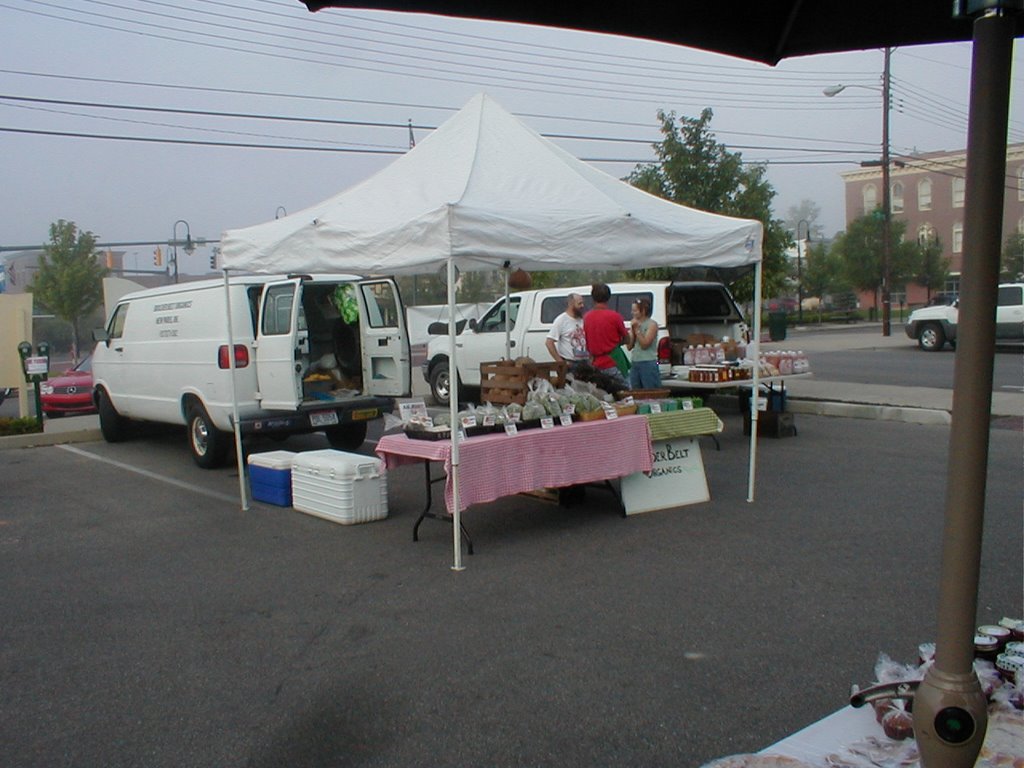 Our farmers' market set up at a Saturday Market in 2005
If we do not have enough food we will likely opt to stay home on the farm and sell from the store-it will be a lot easier for us not to have to pick, pack and load the van and than drive 30 minutes to Oxford, unload the van, set up the stand and finally get around to selling our wares. This gets harder and harder to do twice a week with each passing year. Especially the Tuesday market where we have to park on the street and unload everything we need, and put it in the park. Early on in the season when we have light items it is not so bad but in the summer when we have about 35 crates holding about 100 pounds each and it is 95˚F out it gets hard and we really start to question our sanity. The Saturday market is much easier because we can sell from the back of the van. We still have to haul the tables, crates of produce, the EZUP shelter, etc., but it is only a couple of feet from the van to where we want things, not across the street
Not to mention with the price of gas it will be cheaper to stay on the farm.
In past years we generally had a lot of items ready to go for the first markets but not this year. We were not able to get our hoophouses up until March because we had no beds ready to go until than (now we have about 85% of them ready for planting and have about 50% filled up). Normally there would be things like spring mix, strawberries, spinach, kale and chard ready to go. We will have all of these things in the near future just not for the first couple of markets. We will have some lovely arugula and heirloom lettuces for the first week along with onion sets, popcorn, garlic powder, some basil plants, chives and a few other items but it will not be the full table I like to have, ah c'est la vie.
But soon enough we will have an abundance of items as we have a lot of items planted and growing such as snow peas, sugar snap peas, spring mix, strawberries, lettuce, spinach, chives, lovage, oregano, tarragon, garlic, onions, zucchinis & cukes in a hoophouse, tomatoes and basil in a another hoophouse, melons soon to go into a yet another hoophouse, radishes, cilantro, etc..
If you are in the Oxford area either Tuesday afternoon or Saturday morning stop by and see us.
Wednesday, December 14, 2005
Seed ordering time
One thing I have been asked a lot over the years is what do you farmers do in the winter.
My smart ass reply is "as little as possible..." but in reality we keep pretty darned busy over winter getting ready for the coming season. One of the more important chores is getting the seed order done before January 1st. yes January 1st, you see we commercial gardeners have to get a lot of our seeds started by early April (which is when most home gardeners are just getting around to ordering their seeds) and we cannot afford to order late and find our seeds either out of stock or on back order because we have deadlines to hit with our crops like having something to harvest for the first farmers' markets or first CSA pick-up.
And we boulder belt farmers are worse than most because we are into season extension and starting a lot of crops very early in hoophouses which means getting a lot of seeds started in Feb. or even Jan.
And so the task for this week is to take inventory on the seeds we have. Look over the catalogs we have on hand (because we have moved several places have not found us) and decide what we need and write the order down on the appropriate forms.
I don't like doing inventory because I am a person who will toss out seeds and my husband and partner in this farming activity is a person who hates to throw away ANYTHING much less seeds that might or might not work. So we generally have little sparring matches over whether or not we should be saving the 7 year old seed with zero germination rates (that really bad) that there are 5 other seed packets of the same variety that are newer and viable.
Eugene does not like me doing the inventory on my own but I do anyway because he dislikes it so much he finds other things to do out in the barn or in the field and will not come in and do the task until we have 1 day left before having to order the seeds and than mistakes are made that come back to haunt us months later. Mistakes like forgetting to order any red tomatoes and not noticing this until you are all ready to pop the seeds into soil blocks. And by that time it is a bit late. Sure I can go on-line and order the seeds and have them shipped overnight so the seed cost is something like a buck a seed but that is stupid and hurts our bottom line so I try to avoid that from happening.
After the seed order is in we start our taxes, perhaps the merriest time of the year for us all (and you have not experienced taxes until you have done a form "F")
Wednesday, December 07, 2005
Fedco and why Boulder Belt will be Growing Heirlooms

God, I love Fedco Seeds. I got their catalog in the mail two days ago and found CR Lawn (yes that is the owner's real name) has decided to drop any and all seeds owned by the Monsanto Corporation. This was not a huge problem last year but over the past year Monsanto has bought Seminis seeds and Seminis had about 1/5th of the catalog of the world's vegetable seeds, mostly hybrids.
Now why did Fedco drop Monsanto? Because Monsanto is the biggest seller of ag chemicals and Genetically Modified Seeds (AKA GMO). They have 88% of the GMO market world wide and now they want to take over the veggie seeds and likely make many of them into GMO's. Monsanto is the 1800 pound gorilla that a lot of us small sustainable hippy farmers rail against. They have been quite hostile to our way of farming for decades.
Now to those of you who are aware of GMO's and say hey they are a good thing, no one has ever been harmed by them. To you I say go out and find me the peered reviewed food studies that have been done on humans (or even rats) You will first find only one short term inconclusive study has been done on humans and most of the other feeding studies either have problems in protocol or the subjects are getting sick and dying from eating biotech corn, soy, cotton seed and canola (but the industry surpresses such findings so they are quite hard to find). You will also find a growing body of peer reviewed evidence that says yields are down, environmental damage is up and more RoundUp™ has been sold since the intro of RoundUp ready crops (so much for the argument that GMO crops use less chemicals and yields more than non GMO crops)
But I digress, dear reader, this post is about Fedco. So Fedco has dropped a lot of varieties, many of which we have been using for years. And that has gotten me to think about what we grow and why. In the beginning we grew a lot of heirloom crops (an heirloom is any plant that is Open pollinated (OP) -i.e. a seed from two parents of the same variety that yield saved seed that comes back true to the parents-and has a good story/background history). As a matter of fact about 90% of our crops were heirloom the first couple of years. But we found that the buying public, especially if they are not well educated foodies, find the heirlooms strange and not worth eating (much less buying). Our bottom line was bottoming out with the heirloom veggies so we decided over the years to drop more and more of them and replace them with hybrids. Hybrids are the result of two (or more) parents of different varieties. The plants are generally uniform and often, but by no means always, better yields . Hybrids have been around for about 75 to 100 years and are really the first stab at genetic engineering with crops (but unlike GMO's, sex is used in reproduction and the passing of genetic material). Seed saved from hybrids almost never comes back true and often the plants will not produce edible fruit. This makes the farmer beholding to the seed company. Since the farmer cannot save seeds from hybrid plants the farmer must buy seed every year from a commercial source. One of the things hybrids do a lot better than OP/Heirlooms at is shipping. OP's tend to be very delicate and will not stand a lot of handling and sitting in warehouses. They generally must be sold and consumed within a few days of harvest. Hybrids have been bred for decades to be able to withstand shipping and storage and can still look good weeks after harvest (granted all the nutrients and taste will be gone, but it will look good)
Over the past 2 or 3 years I have read research that indicates that OP/heirloom plants have a lot more nutrition than hybrid crops and since I am in the business of grow HEALTHY food this is something I pay attention to. The past several years we have been doing something like 60:40 hybrids to heirlooms. This season we will try for a 20:80 hybrid to heirloom. I know I will have to buy hybrid red tomatoes because too many people seem to like the tasteless red globes. But for every red tomato hybrid we will have 4 or 5 fun heirloom maters such as Persimmon, West Va Hillbilly, yellow taxi, Opalka, Brandywine and others I have yet to decide upon. Tomatoes is what got us going on heirlooms and seed saving about 11 years ago. And why grow red round maters when there are 1800+ varieties out there in all shapes, colors and tastes. There are purple, black, white, orange, yellow, striped and green tomatoes in the world. there are tomatoes shaped like grapes, pears, cherries, peppers. Some are sugary sweet some are sour, some are tart some are not. Knowing this I cannot in good conscience grow boring red maters.
Same with squashes. Hybrid zukes are tasteless and boring. But the heirloom zukes come in many colors, shapes and, for the most part, have great taste. Same with melons, peppers, corn, winter squash, etc..
So now you know a part of the game plan for next season-HEIRLOOMS
Subscribe to:
Posts (Atom)