Total Pageviews

Tuesday, April 18, 2006

Good Days


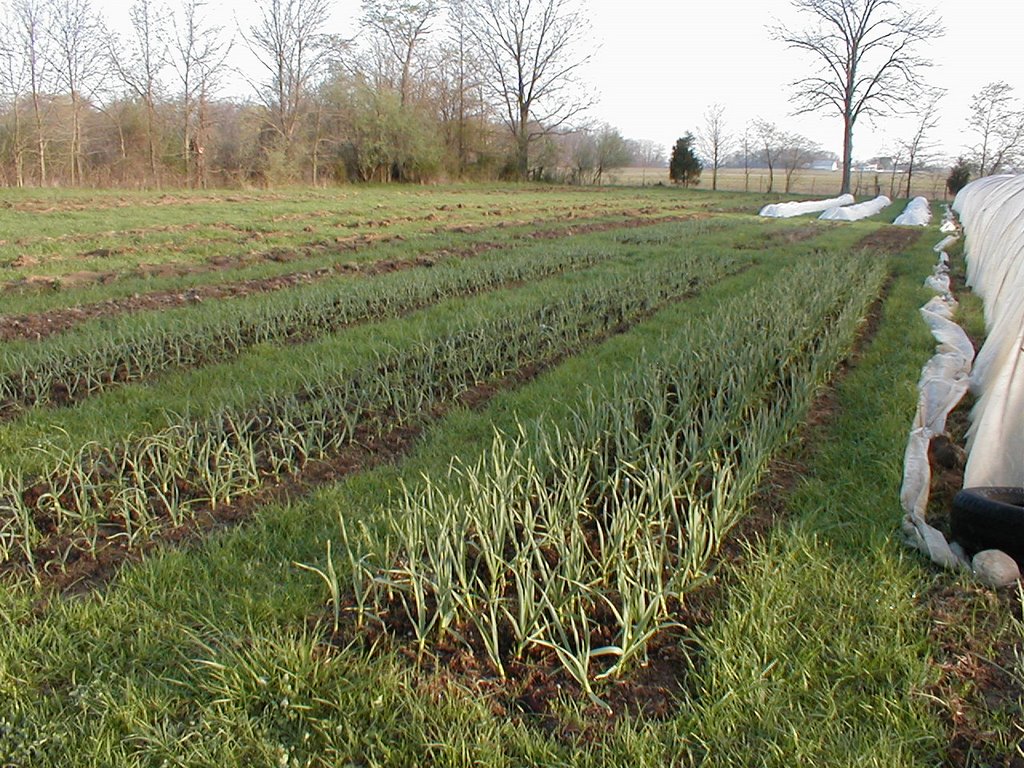
Heirloom garlics on a beautiful mid April Morning

It's been an good past couple of days.

Got a worker lined up for June this morning. She’s the younger sister of this year's market manager for the Oxford Farmers' Market Uptown.

Saturday went to the Talawanda Alumni FFA auction to see if we could score a produce washer. We got out bid on that but did buy a couple of peach trees that were put in that afternoon. We also went to the last Winter market of the year as customers, not vendors. that was interesting, everyone wanted to know where we were and why we were not selling (had very little to sell). It was a beautiful morning and lots of people showed up to buy things. It probably helped that earlier in the week I emailed into a call in show on WMUB about cooking telling about the last winter market. Several people said they had heard my comment read on the radio. Nothing like a bit of free advertising. I bought eggs, a loaf of bread, a bag of chard (I have been craving chard) and picked up the milk order.

We got storms Friday and Saturday nights and 1.5 inches of rain so Sunday not a lot got done, it was just too wet. Monday I made many trays of soil blocks, pricked broccoli and cauliflower into larger blocks along with some mystery peppers I found in a bucket of discarded small soil blocks (we recycle the soil blocks and sometimes they have seeds that were not germinating when they were in trays but will once they get covered by soil in a bucket). I was happy to find all these pepper seedlings. I need to replace the ones that the mouse/chipmunk critter ate. I just wish I knew what kind were. And I started 17 different kinds of flowers to be put here and there around the farm and Eugene put in about half of the onions we started in pots and cut up (chitted) the potatoes for the first planting of the year.

Today Eugene put the plastic over the 3rd hoophouse and is preparing ground for leeks and planting the 2nd succession of peas. Later on today we plan on putting in kale, cabbage and broccoli seedlings as well as the last of the onions in pots.

Right now I am waiting on the last rise of a loaf of maple wheat bread than into the over for it. So I blog.

Monday, April 17, 2006

$%%@#@^&**^ Mice Redux


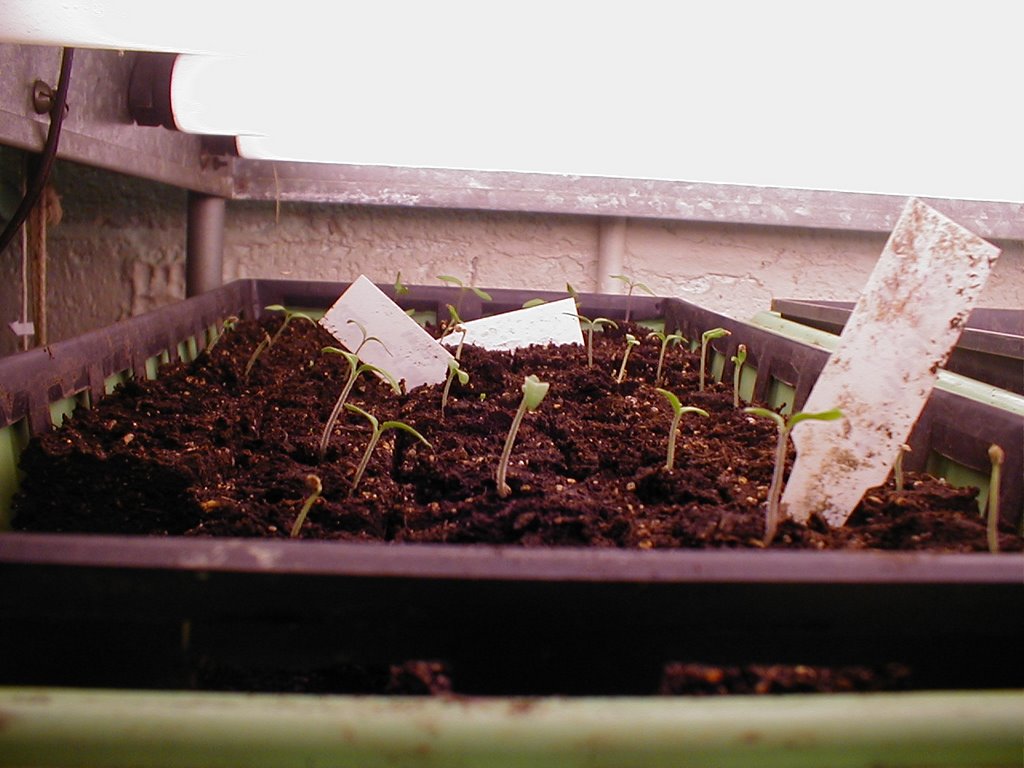
Peppers seedlings on a light table about 7 days ago before being beheaded by a small critter


Living and working on an organic farm may seem to many to be the ultimate way to live one's life free of stress and full of beauty. These would be the folks who have bought into the romantic ideals of farming. In reality farming is one of the more stressful jobs you can have. You are at the mercy of the elements and wild animals both big and small. And either can destroy a lot of work in a very short amount of time. We have, in the past, had wind take out hoophouses, floods kill crops in the fields, odd/early cold snaps do great damage to cold sensitive plants, birds and dogs take chickens. These are things farmers stress about

We recently have been getting a lot of mouse or chipmunk damage to our pepper seedlings. Some critter gets on the light tables and eats the heads off of the baby plants. This is real nice to find first thing in the morning after you have spent half a day, the day before, making soil blocks and moving germinating seeds to bigger blocks. So we have been doing many superfluous things to stop the critter and few have worked.

One night we put cardboard guards around all the legs and cords thinking this might stop the critters from climbing onto the stands. No dice, they breached our system easily and beheaded more seedlings. We have traps and about once a week one gets a mouse and on Friday put out more traps in the grow room. Took down the plastic sheet that was dividing the room in half making it easier to heat the area where the seeds are germinating. And than we moved all the stands away from the walls (thinking mice can climb rough brick walls easily) on Saturday with the help of an old friend, Scott, who showed up to volunteer his time on our farm (he helped put in 2 peach trees and start the trellis for the grape arbor as well). We also moved a lot of the seedlings out to cold frames since no critters are eating the seedlings in the cold frames. But because a cold front came through last (Sunday) night it is now too cold to keep things like peppers and eggplant in the cold frames so back to the warm grow room they went. It's a damned if you do damned if you don't situation. Leave the peppers outside and they will get cold damage. Take them inside and they may get killed (but at least if they do not get beheaded they will produce later in the summer, the cold damage seedlings will not, been there, done that)

Yesterday evening Navin the senior cat had killed a mouse outside the grow room door.

Maybe, just maybe, all these things together will stop the pepper seedling carnage. There was no damage Sunday to what was left of the seedlings so perhaps we have made it too difficult for the mice to get at the seedlings (we also have removed all germinating melon seeds from the barn altogether as these seem to be prized fare for the critters and a huge attractant). I have not checked things out this morning. But I am hoping that I will not go in once again to see all my work destroyed.

Today the plan is to replant the peppers and if these get killed than I will have to either buy pepper seedlings (very expensive), plant again and hope it is not too late in the year to get a crop (it takes about 8 to 10 weeks to get peppers ready for transplanting than it is another 80 to 110 to get ripe peppers and if these things get planted past mid June there is not enough time left in our growing season for this to happen) or just give up altogether and have no peppers at all (not acceptable, we make decent money off of this crop plus I use a lot of peppers in my cooking).

I hope, at this point, the critters have found the room not as hospitable and better things growing outside now and will leave the seedlings alone.

Thursday, April 13, 2006

Toad Orgy

In the foreground there is a small group of toads (they are the lumps in the bottom center of the image) guarding strings of eggs

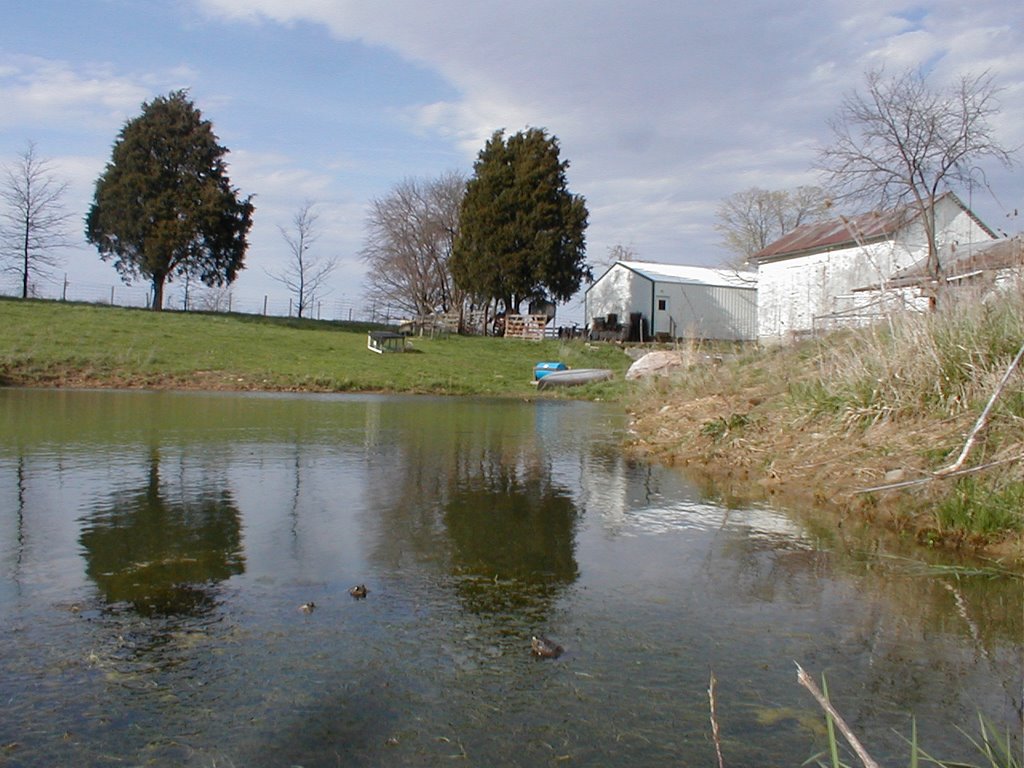
Spring is in full roar around here. The trees are greening up, flowers are blooming the birds are back and the pond is full of fish from small fry to some 4 pounders (we think). The pond is a fascinating environment. for example we had major toad orgy occurred yesterday starting early in the morning. They swam and called and laid eggs all day. This was followed by an exodus from the pond going north up the hill towards the market garden last night starting around dusk. Nate tried to eat a couple but found them nasty and spat them out. Their calls sound like some sort of alien invasion.

This morning there were still a few left overs in the pond, a few dead toads and a film of milt on the surface of the water. This afternoon one area of the pond where there is thick plant life a group of toads seem to be guarding garlands of eggs. In a week or so the pond should be boiling with tadpoles and than a second exodus from the pond to other places will occur with the new, small toads. It is highly likely the fish in the pond will be feasting on these toad eggs.

If the pond were in balance we would still have an annual toad orgy but there would also be herons, kingfishers and other birds that like to eat a toad on occasion so there would not be this explosion. In time the balance will happen but this is a young pond so the predator to prey ratio is way off, among other things.

Tuesday, April 11, 2006

Another Busy Spring Day

A shot from the Friday storms. The grass is a lot greener now than it was than. the boxes in the foreground are coldframes that were empty than but now full of brassicas and tomato seedlings.


It's been a busy spring day. It got up past 70˚F and was nice and dry. So Eugene and I finished prepping the plowed beds for the tiller. This meant squatting and heaving large chunks of sod back into the beds that the plow had placed in the aisle ways. It was a good aerobic work out but hard on my sciatic back. After a bit of dirt heaving Eugene got to tilling the beds we had just worked on and I worked on making mix for soil blocks and making soil blocks until I ran out of permanest trays.

At that point I got to inspecting the seedlings and noticed more mouse damage. The little F***s have now eaten several melon seeds, about half of the fat n sassy peppers seedlings (I hope there was enuff toxicity in the seedlings to at least give the rodent a good belly ache) and also has dug into the soil blocks displacing seedlings. I moved the melon flats to a shelf that so far the mouse/mice have not been able to get to and put a lot of things into the cold frames where they should be safe from marauding mice.

After lunch we set out to put in 4 flats of heirloom lettuce (marvel of four seasons, lollo rossa, nancy and rouge d'hiver. Okay, nancy is a hybrid bibb lettuce but the rest are all heirlooms and tasty). Eugene looked at the bed where we wanted to put the lettuce and decided 2 passes with the tiller was not enough and did a third. After he finished with that bed he did all the other beds that needed a 3rd pass (about 12) while I got the things together for the lettuce planting. To do the job right you need to have the plants, a bucket of compost, wire hoops for the row cover, row cover, rocks or bricks to weigh down the row cover, a rake to rake the bed and a trowel. So while he tilled I got everything together and brought it all to the work site.

Together we put down compost and than soil blocks with a lettuce plant in each and than started putting them in the soil. After planting the lettuces I watered them, put up the hoops and pulled the row cover over the hoops. Et voilà we were done with our second lettuce planting.

So the next thing to do was to check in on the newly planted cukes and zukes in the hoophouse. Not good. A vole or mouse had spent the afternoon while we were planting and tilling munching cuke and zuke plants along with some light arugula grazing. So we pulled the row covers off of the plants and thought about pulling the black landscape fabric off the ground because the little $#@@# like to hide and nest under mulch but than decided the weeds would over come the cukes and zukes so we left the stuff down. I think we need barn and field cats to control the rodents before they eat us out of house and home. All we have is Navin, a good hunter but the boy is going on 15 years of age and Trina who is clawless and does not know about hunting (we did not declaw her she came to us with her fingers already amputated). I sure wish we still had shiva around, he was a great mouser and voler. The dogs are into killing voles but they tend to dig after them and do more damage to the plants than the voles.

Now the sun is setting and it is time to do something about dinner

NAIS Op Ed Piece

NAIS and What It Means To You
Jennifer Smith, Capriherb Farm
January 19, 2006

Until recently NAIS (National Animal Identification System) was something that was non-existent.

This article hopefully will explain a bit about NAIS and how it will affect you!

The USDA has a Department called the Animal Plant Health and Inspection Services (APHIS). This Department is charged with protecting the National Food Chain, among other things.

A few years ago, there was an outbreak in England of Hoof and Mouth Disease. If you remember, several million animals were destroyed because of this outbreak. At that time, the USDA and APHIS took a look at the US food chain and decided that a "trace back" system was needed. Not only to protect the consumer but to also protect the National Livestock Industry.

In goats, we were affected because Scrapie is a disease that can have large financial affects with the sheep. And because goats "can" possibly get Scrapie, they were included. This was the beginning of a plan by APHIS to give all goats a uniform Identification so that if an animal were to be found (and there has never been a case of a goat getting Scrapie unless co-mingled with sheep), that herd/flock could be identified and tested.

The ADGA Board of Directors was very involved in this and worked to create a Unique Tattoo Policy which was approved by APHIS. It cost several hundred thousand dollars to get this implemented at ADGA.

Today, if you take your goats to market and don't take your registration certificates, or they aren't available, the auction house (and sometimes even if you do provide papers) will tag each of your goats so they will have a "trace back" to your farm if an animal shows up with a "reportable" disease such as Scrapie, Anthrax, Hoof & Mouth Disease, etc. To date, there has NEVER been a case in the USA!

In other words, our "national herd" is clean.

Because of the outbreak in Canada of a cow with BSE was found in the NW, the APHIS felt that more was needed, and developed a new program called NAIS.

That's the history. Now for what NAIS is and what impact it has on you and your farm.

>From the NAIS website http://animalid.aphis.usda.gov/nais/index.shtml
http://animalid.aphis.usda.gov/nais/index.shtml ):


The National Animal Identification System (NAIS) is a national program intended to identify specific animals in the United States and record their movement over their lifespans. It is being developed by the U.S. Department of Agriculture (USDA) and State agencies-in cooperation with industry-to enable 48-hour traceback of the movements of any diseased or exposed animal. This will help to ensure rapid disease containment and maximum protection of America's animals."

This all sounds very good and well on the surface, but it has implications that are far reaching and very scary to all of us! A Draft Proposal was launched April of last year.
Draft pdf 1
Draft pdf 2
In it is found what the Federal Government is doing, plans to do,
and has already done. It is very disturbing, to say the least!

The Draft says basically that every animal in the United States will have to be tagged in a way that can be easily read. This includes all fowl, alpacas, llamas, deer & elk, equines, cattle, sheep, swine, and goats! The USDA has also already intruded into your farm by targeting all land and owners through Global Positioning Satellites! What this proposes is that EVERY
owner of even a pet chicken register their "premises" with their State Government, who will pass this information on to the USDA. And every animal be uniquely identified as well. The goal is to have a trace back of any of these animals within a 48 hour period.

What does this mean to you as an animal owner? You will be forced to register your farm (premises) with the State. And give an inventory of every animal on your premises. The Government will be allowed by law to come to your farm at any time and check your inventory. This inventory will be required to be updated and reported within a 24 hour period. So if you decide to barbecue buckyboo, you will have to report it. If you have a coon
kill a chicken, you will be required to report it within 24 hours. If you have a doe die in labor, report it! And if your farm inventory doesn't match what is on record, then you will face misdemeanor charges, which could include jail time!

The implications become even worse if you dare take an animal off your farm. If you decide to ride your horse over to the neighbor's, you must report it within 24 hours. If you go to a show, you will have to report that movement within 24 hours. And even worse, if that could possibly be said, is the show will have to report every single animal at their show, within 24 hours. So if there is a county fair, the fair officials will have to report every
SINGLE animal as it comes onto the fairgrounds, then every animal again, as it leaves and where it leaves to. So terminal goats will have to be reported as to where they go as well. Does it get any worse? Well, yes it does. The USDA also will give special "premises numbers" to those who don't normally house animals but have contact with them. Do you have your feed delivered? Your feed store will have to have a premises number and report that they have delivered feed to your farm within 24 hours of doing so. Your Veterinarian will have to report every time you come to their office with
your goat. And report every time they visit your farm!

The draft proposal also will not allow tattoos as they can not be readily seen from a distance. In Texas they are already discussing putting radio tags on every animal. Those tags will be paid for by the farmer. And we all know that tags on goats ears last about 2 weeks if you have a goat that likes to chew. I can't even imagine how long a tag will last on a chicken'sleg! Even if they aren't radio tags, EVERY animal will need to be tagged.

There are several problems with this Draft Proposal. First, it goes against everything American. It goes against our right to privacy. It states that this information will be public, so any PETA organization will have access to that data. If you barbecue a goat, will your local PETA chapter be at your door? It also denies YOU, the farmer, the right to privacy on your property.

Secondly it puts a huge financial burden on you as a farmer. The program is called an "Unfunded Mandate", meaning the bulk of the cost will be born by the end user, YOU! The 48 hour trace back is dependant upon computers and it is being proposed that all this be done by the farmer via computer. If you aren't connected to the internet, I don't know what you will be doing. And the cost of the tags, having all your animals that die be documented for no
reportable diseases, etc will all be born by you.

This is a "Draft Proposal" right now. It is NOT law yet! But Ohio is working diligently to make this a reality in our state. The web-site for Ohio is:
http://www.ohioanimalid.com/oaid-index.stm
http://www.ohioanimalid.com/oaid-index.stm.

If you want to comment on the NAIS, I encourage you to contact the following people:

Ohio Department of Agriculture
Division of Animal Industry
Animal Identification System
8995 E Main Street
Reynoldsburg, Ohio 43068
614-728-6220
animalid@mail.agri.state.oh.us mailto:animalid@mail.agri.state.oh.us
mailto:animalid@mail.agri.state.oh.us

The State and Federal Congress and your Congressman can be found inside most Phone books.

On a Federal Level, your Ohio US Senators are:
Mike DeWine
http://dewine.senate.gov/
140 Russell Senate Office Building
Washington, DC 20510
(202)224-2315

George V. Voinovich
http://voinovich.senate.gov/contact/index.htm
524 Hart Senate Office Building
Washington, DC 20510
(202)224-3353

The USDA is:

Secretary of Agriculture Mike Johanns
U.S. Department of Agriculture
Washington, DC 20250

Or Office of the Director
terri.teuber@usda.gov
Terri Teuber Rm 402-A,Whitten Building
Washington, DC 20250-1301
202-720-4623

The President is:

President George W. Bush
The White House
1600 Pennsylvania Avenue NW
Washington, DC 20500
202-456-1111
Email: comments@whitehouse.gov

This really sounds like some scheme that Marx or Lenin has made up and that it could never happen in the USA. But it will become reality on July 2008 if we don't all contact our representatives and protest this very invasive intrusion into all of our lives!


Eat Real Food

The Upchuck Rebellion
http://www.alternet.org/story/33950

By Jim Hightower, Hightower Lowdown. Posted April 6, 2006.

The Good Food movement is leading the charge against expensive,
nutrient-free, artificial, unhealthy, corporate crap-food.


Even though winter is just beginning to release its frigid grip on most
of the land, I'm already thinking out of season, looking ahead to one
special thing: fresh, ripe, right-out-of-the-soil, good-and-good-for-you
summer tomatoes. Oh, I can taste them now! And eggplant, too. And
peppers. And all kinds of other edible wonders.

I'm a food guy. I've got a small but richly composted garden plot in my
backyard, I'm a regular at several farmers' markets, and I frequent a
number of great restaurants here in Austin, Texas. I love poking around
food stores of any variety, I like to browse through seed catalogs and
cooking magazines, and I always try to sample the local specialties as I
travel around the country. I enjoy friendships with quite a few chefs
and restaurateurs, and I love visiting with farmers and food artisans
who are doing creative things. Though it still pisses off the corporate
establishment, I was once the agricultural commissioner of Texas.

I know firsthand about the phenomenal cornucopia of good, fresh,
nutritious and delicious food that our country is capable of producing.
That's why it knocks me whopperjawed to see the stuff that dominates too
many American diets -- an array of industrialized, conglomeratized,
globalized products that have lost any connection to our good earth.
This stuff is saturated with fats, sugars, artificial flavorings,
chemical additives, pesticide residues, bacterial contaminants,
genetically altered organisms and who knows what else? Plus, the major
factor driving prices is not the cost of any actual food that might
still be in these products, but the cost of packaging, advertising and
long-distance shipping.

What has caused us to stray so far from the farm, so far from the
essential and wonderful sustenance provided by nature itself? The
answer, of course, is that the brute force of corporate power has been
applied both in politics and the marketplace to pervert our food
economy. During the past half century, control over our nation's food
policies has shifted from farmers and consumers to corporate lawyers,
lobbyists and economists. These are people who could not run a
watermelon stand if we gave them the melons and had the highway patrol
flag down customers for them! Yet they're in charge, saddling us with a
food system that enriches corporate middlemen while driving good farmers
off the land, poisoning our productive soil and water supplies, and
literally sickening those who consume these adulterated foodstuffs.

Revolt!

Do we have to swallow this? Of course not -- we're Americans, rebellious
mavericks -- and the revolt is on! For the past few years, a grassroots
movement has quietly but rapidly been spreading throughout the country.
I call it The Upchuck Rebellion: a growing number of people fed up with
the destructive power of industrialized food are declaring that they're
not going to take it anymore.

More than declaring ... they're taking action. Part of this effort is
political, trying to get the industrializers and globalizers to clean up
their act. At another level, however, America's food rebels are taking
on the idea of industrialization itself by creating their own
alternative food economies. These are based on local farmers, seasonal
consumption, organic and sustainable production, local food processors
and artisans, and local markets. The goals are (1) to build a system
that delivers tastier, healthier food; (2) to keep a community's food
dollars in the local economy; and (3) to treat food not as a corporate
commodity, but as a centerpiece of our culture.

Naturally, the Powers That Be have howled in derision at these efforts,
sneering that local farmers, consumers, entrepreneurs, chefs, marketers,
gardeners, environmentalists, workers, churches, co-ops, community
organizers and just plain citizens simply don't have the savvy to create
and run any kind of significant food system. However, my friend John
Dromgoole, who runs a successful natural gardening and composting center
in Austin, has a snappy retort to these elites: "Those who say it can't
be done should not interrupt those who are doing it."

This is a movement that has antecedents going back generations -- both
J.H. Kellogg and C.W. Post, for example, were health-food visionaries
more than a century ago (and both would be appalled by the products now
bearing their names) -- but the modern-day movement is barely 20 years
old. In this short time, however, these innovative doers have made
astonishing gains. Just in terms of raw numbers, today's "Good Food"
movement is impressive:

* Organic food topped $15 billion in sales in 2004 -- triple what
they were only seven years earlier. Sales are increasing by roughly 20
percent a year (compared to only about 2 percent for all other foods)
and are expected to reach $30 billion four years from now.
* Nearly two thirds of American shoppers bought some organic foods
last year -- up from about half the year before. About 40 percent of
consumers now say that they regularly buy some organic foods.
* There are now more than 8,000 organic farmers, with thousands more
trying to make the transition from industrialized production to organic
(a rigorous and costly process that should be assisted and funded by the
U.S. Department of Agriculture, which instead remains either indifferent
or hostile).
* From white tablecloth restaurants to barbecue joints, chefs have
been in the lead in introducing organic food to the public and in
creating the fast-growing market for locally produced seasonal foods.
* The growth and popularity of farmers' markets has mushroomed in
recent years, popping up in practically every city and most towns. Some
4,000 of these bustling, vibrant markets now exist, bringing local
farmers and artisans together with customers at all economic levels.
Likewise, the community-supported agriculture movement is fast
spreading. These CSAs allow consumers to buy "shares" in the production
of a local farm or group of farms, giving the farmers a defined and
reliable cash market and the consumers a weekly share of the crops. In
addition, the food co-op movement (once the rather funky domain of
hippies) is thriving. About 300 of them are in cities across the
country, doing some $750 million a year in business and providing local
producers another way around the corporate distribution system.
* The demand for organic and locally produced food has become so
mainstream that major supermarket chains and such national food
wholesalers as SYSCO have had to alter their once-rigid procurement
practices to make some of their purchases from organic and local
producers.

By eliminating the corporate middlemen (with their voracious profit
demands, bloated executive salaries, advertising budgets, bureaucracies,
lobbyists, lawyers and so forth), this localized marketing system links
farms directly to forks. The results are salutary -- small farmers get a
fair price that lets them and their families keep going, and we
consumers get food that is what it's supposed to be: tasty and
nutritious. In the bargain, our food dollars stay at home, generating
more economic activity in our communities.

Yes, say opponents, but the food is extravagantly expensive. No, it's
not. In season, organic tomatoes from a local farm can be cheaper than
the industrial tomato at the supermarket. And as organic production has
increased, overall prices are coming in line with nonorganic. In
Portland, Ore., for example, a small chain of grocery stores called New
Seasons features locally produced foods, and about 75 percent of its
stock is organic. A monthly price survey of Portland area supermarkets
shows that prices at New Seasons do not vary more than 3 percent either
way from those at the national chains.

But even when organic food costs more, it's important to consider what
you get for your money. Price is not the same as value. As one farmer
says, "You can get a day's worth of calories for 99 cents at a 7-Eleven,
but not a day's worth of nutrition." Or of flavor.

Plus, Washington spends billions of our tax dollars to subsidize
corporate-produced food, and the food industrialists also are allowed to
escape paying for the extensive pollution, soaring health costs and
ecological damage that are direct results of their methods. Rather than
paying for these enormous costs when we buy corporate food at Wal-Mart
or Burger King, we pay for them in our tax bills or by suffering
illnesses.

Another strong force propelling the good-food movement is cultural
connection. People are realizing that our corporatized world is out of
control -- empty, vapid, phony, valueless. One place where folks sense
that they might be able to get a grip again is food. By linking directly
with small farmers, cheesemakers and other homegrown producers, we
reclaim our place, our cultural identities, our values, our humanness.
Food, after all, is not merely fuel, but culture. It's in our art, songs
and literature. It's in our memories -- tastes, smells, sounds, visuals
and feelings. It's in our souls, giving us shared experiences with
family, friends, co-workers and community. By taking charge of what goes
on our plates and how it gets there, we begin taking charge of our
lives.

What's for lunch?

It's a cliche to say that our children are our society's future, but it
happens to be true. So, what are we teaching them about food? In class,
they get lessons on the five components of a good nutritional lunch,

Then the bell rings and they go face the reality of their school lunch.
Very few lyric poems have ever been written in praise of the "mystery
meat" and blah veggies of school lunch, but lately this midday repast
has gone from merely being bad to being bad for you. In today's schools,
the idea of lunch has been reduced to corporate-delivered sugars, fats
and calories, helping produce a growing epidemic of childhood obesity
and gross ignorance of what food should be.

School cafeterias are eliminating cooks and even kitchens, for their
"meals" come prepackaged from food-service corporations or are
contracted out to McDonald's, Domino's and other fast-food chains.
Two-thirds of America's middle schools and high schools sell sodas and
junk-food snacks, usually under exclusive contracts that bring big
corporate money to the school system. Rather than viewing school "food"
as a natural resource for nurturing and educating kids, administrators
have turned it into a money-making, corporate-branded commodity.

But a big change is coming. With little fanfare, a grassroots
"farm-to-cafeteria" movement has been spreading from school to school.
More than 400 school districts and 200 university cafeterias are now
building their menus (and, in many places, their educational curricula)
around fresh, local ingredients, much of which is organic. In nearly
every case, the change has come because some parent, farmer,
nutritionist, or other individual rose up to ask, "What the hell is
going on here?"

Vanessa Ruddy was one of them. In 2002, her son, Grant, enrolled at
Lincoln Elementary School in Olympia, Wash., and when she took a look at
the lunch menu, she did not like what she saw. While this school had
long shown an interest in good food (it had an organic garden, a
children's activity kitchen, and a harvest festival in the fall), the
lunch program at Lincoln was definitely old school.

At the bottom of the menu was the name of Paul Flock, the school
district's child-nutrition supervisor, and Ruddy decided to call him.
She put it off for a month, however, assuming he'd be a typical
bureaucrat, and she dreaded having to make a big fuss and wrestle with
the bureaucracy. Lo and behold, though, Flock welcomed her call and was
open to improving the menu.

Ruddy enlisted other parents to join her for a meeting in Flock's
office, and he asked what she wanted. "Organic Food" was her response.
Thus began an organizing process to get teachers, cafeteria staff, the
kids, farmers and other relevant parties involved and working together.
Sure enough, in October 2002, Lincoln Elementary opened its "Organic
Choices" salad bar, with a colorful and flavorful array of fresh,
organic, locally produced fruits and veggies. Ruddy said that the
school's cook told her, "You would have thought it was Christmas! You
should have seen the kids' eyes light up."

The chief concern was cost. For example, while the romaine, arugula, and
mustard leaf have far superior nutrient content, this mix of organic
greens costs four times more than iceberg lettuce's price tag of 72
cents a pound. But the team of parents and others overseeing the
development of Organic Choices found savings elsewhere, primarily by one
simple act: eliminating desserts from the lunch offerings (a move
enthusiastically applauded by teachers and parents). Lincoln actually
has cut its per-meal lunch cost by 2 cents, and the lunch program has
even started making money, due to teachers and parents eating lunch at
the school.

Since 2002 the salad bar has become a full-meal option, with cheeses,
beans, eggs, whole-grain breads, etc. Today all elementary schools in
Olympia have some version of Organic Choice in their cafeterias. "It's
all about a long-term investment in the health of our children," says
Lincoln Elementary's principal. "We are the responsible adults. We can
do this." Meanwhile, Ruddy has become a Johnny Appleseed for the
farm-to-cafeteria movement, speaking to others around the country about
bringing it to their schools. She offers two major tips: Get active.
Don't feel powerless.

The power of the table

This grassroots movement is not out simply to change some cafeterias,
but to change the corporate culture of food. And where better to start
than with our children? Why shouldn't every school have an Organic
Choices program, a school garden and a kitchen to give them the hands-on
experience of growing and preparing the food they eat, regular trips to
farms and farmers' markets, and a curriculum that connects them both to
nature and to their local community?

As school after school is finding, it's an awakening for kids to learn
that they have a relationship with food that is deeper, richer and far
more exciting than a Happy Meal at McDonald's. Alice Waters, the
wonderful pioneer of America's good-food movement who has created her
own "edible schoolyard" and "edible classroom" programs, is a tireless
promoter of this educational awakening. She says, "Students can learn
fundamental truths about where food comes from, about actions and
consequences, about the importance of stewardship of the land, and the
civilizing and socializing effect of the table." The farm-to-cafeteria
movement has now had an abundance of experience in all sorts of school
systems and is willing to assist others who want to give it a go. They
have learned a few universal keys to success:

* It takes a great deal of effort to break through the entrenched
food-procurement system.
* Start with the right school, where parents, administrators and
food-service personnel are open to the idea.
* Begin small, proceed slowly and build on success.
* Reach out -- be inclusive and transparent.
* Be understanding of the realities faced by both the food-service
staff and your local farming community.
* Contact everyone who has expertise, funds, connections and other
resources to assist you.
* Involve students in all phases of the process.
* Build a strong curriculum component into the project from the
start.
* Make it fun -- have community tastings, festivals, food art
projects, etc.

It's not easy to recapture power from an entrenched corporate culture,
but it is doable -- and the prize most definitely is worth the effort.

From The Hightower Lowdown, edited by Jim Hightower and Phillip Frazer,
March 2006.

Jim Hightower is the author of "Let's Stop Beating Around the Bush"
(Viking Press). He publishes the monthly Hightower Lowdown; for more
information about Jim, visit
jimhightower.com.


Sunday, April 09, 2006

Early Spring Storms

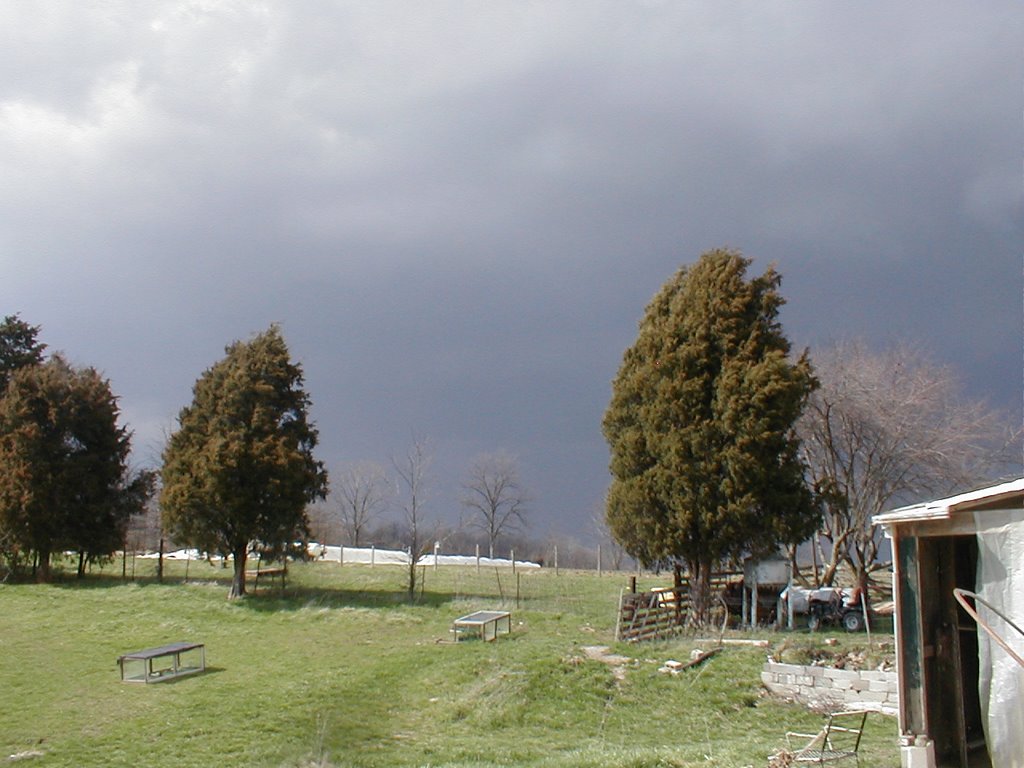
Storms rolling through Darke County to the north of us

We got a round of severe Thunderstorms on Friday afternoon.

The day dawned stormy (and we got .4" of rain) but cleared up by 8am and became quite warm and sunny. This allowed us to get quite a bit done-the zukes and cukes got transplanted (finally), the tomato house got set up and ready to receive the maters (which are close to being ready to get hardened off, just waiting for the weather to warm back up) which means the irrigation tapes and landscape fabric are down. Got more plowed beds ready for tilling. Found two toads in the garden beds (toads eat a lot of slugs and slug eggs among other pesky things)

But at 3:30pm work time was over and storms were rolling in. By 3:45 there were several tornado warnings to the south of us near Hamilton, OH. We still had sun over us at that point but to the north, south and west it was black and ominous. Quite beautiful with the contrasting lights. Around 4pm the storms started hitting us-we got some good wind gusts, than some heavy rain and finally pea sized hail for maybe 4 minutes and than it was over for us. We got maybe .01" of rain out of the event. But the storms were not over for places north, south, east and west of us. It was kinda weird that everything around us was getting rain, wind and hail and except for the one event we got nada (and we could use the rain, it is getting pretty dry). It did rain a few more times that afternoon on the farm but nothing extensive (as I said we got under .01" of rain out of the event).

But while the storm was pretty much a non event for us all hell was breaking loose to the south of us with reports of 70 mph wind gusts, golf ball sized hail and flash flooding. I hope my farming friends south of us in Butler and Union counties made it through with minimal damage to their crops and hoophouses. It really sucks when you get a lot of storm damage to your market garden, especially when it is so close to market time. A lot storm damage can set one's garden back 6 to 8 weeks if it is not properly protected.

Our hoophouses and the row cover we use are a huge help in protecting crops like lettuce from horrible damage. I was thinking this as I watched it hail. If our lettuce and other greens were not under cover they would have been ruined by that 4 minutes of pea sized hail. We probably could have salvaged some of the greens for our own use but little if any would have been salable and that would have meant we would have had little if anything to take to our first Tuesday farmers' market May 2nd.

We got lucky with this round of storms but I have a feeling that global climate change is going to bring us many many more rounds of severe weather before the summer solstice which will make for a dramatic spring season.

Saturday, April 08, 2006

How to Punish Drug Users: Poison Them!

I found this on Tom Harper's blog Who Hijacked My Country (a blog I discovered using Blog Explosion) This is a left of center political blog that has a lot of good ideas and news (well if you are a lefty). this is about the most dangerous idea the US House of representatives has had yet. As you surely know by now I am not an herbicide user and the biological agent proposed in this article is almost too scary for words. They want to spread a mold based herbicide that will kill anything it touches (including amimals such as humans), does not leave the soil for decades, rendering the soil unusable for farming food crops and it spreads beyond the area where it was sprayed. I thought chemical herbicides were bad but now they have created a true monster and if recent history is any indicator the GOP in the US house of reps likely will seriously try and pass a bill through allowing the use of this dangerous material.

If you want to take action simply click on the "Click here" link in the article and it will take you to a site where you can contact your US Reps.

How to Punish Drug Users: Poison Them!
by Tom Harper
4-6-06

The House of Representatives has decided that the best way to prevent drug use is to poison the crops. That’ll teach those lowly drug users a lesson. And for good measure let's poison everyone else in the community as well.

The House wants to authorize research into an herbicide that’s so dangerous, some governments have stockpiled it as a weapon. Even John Walters — our gung ho Drug Czar — is against using this herbicide because of the hazards.

The herbicide is a toxic, mold-like fungus which kills crops. These fungi — called mycoherbicides — have been heavily researched for the past thirty years. Practically everyone has agreed that this is not an option for controlling coca leaves or opium poppies. That is, everyone except for our House of Nazis Representatives.

These herbicides attack neighboring crops and orchards as well as the “drug” crops that are being targeted. They cause severe symptoms in any people or animals that come in contact with them. They also contaminate the soil so that nothing else will grow there.

Our government is ready to conduct “field studies” in Columbia and Afghanistan. Some governments might interpret this kind of “field study” as an act of war.

The Senate hasn’t yet voted on this bill. If you think this is the sickest wackiest law you’ve ever heard of, please tell your senators. Click here to e-mail your senators and ask them to vote AGAINST this madness.

Thursday, April 06, 2006

Our new salad bed


We just got done building raised beds for our spring mix. Being in a new place means our market garden beds will be weedy and one thing we cannot have in the spring mix beds is a lot of weeds. Been there, done that and got a lot of low quality salad that I had to spend a great deal of time picking out grass and other weedy material such as thistle.

I have been worried we would not be able to grow any spring mix this spring because of the weeds but I did not want to face several more months of no Boulder Belt spring mix. It is one of my favorite things to grow and eat. Oh sure I could go to the store and buy over priced tasteless organic mix but every time I do I go away terribly disappointed. I end up tossing out at least 1/3 of the bag and, as I already mentioned, compared to the stuff we grow it is tasteless greens.

So 3 days ago I was outside thinking about how to go about growing some salad and thought why not a couple of small raised beds filled with out soil block mix? I told Eugene my idea and at first he did not get what I was talking about-skinny beds filled with clean growing medium. he asked how he would till such narrow beds (they are 22" wide) beds and I said there would be no need to till them. We would build frames, line them with something to block weeds from coming up through the bottom of the beds and fill them with a clean growing medium. Once he understood what I was talking about he was on board.

We happen to have a pile of some very clean compost and a bale of peat moss as well as two huge bags of perlite for the growing medium. we also have a lot of junk lumber sitting around waiting to either rot or be burned. So at 11am this morning we started building the beds. We put together some old siding to make the sides of the beds, lined the beds with tar paper and filled them with compost peat, perlite and some minerals. At 5pm the beds were ready to be planted and I put in the brassica part of the mix. the lettuces will be planted in 4 or 5 days as they take less time to grow than the mizuna, tat soi, red mustard and arugula and we want all the greens to be ready to cut at the same time. Because we do not anticipate any weeds we scattered seed all over the bed so we will have a thick mat of greens covering the entire bed.

With a bit of luck we should be cutting our first salads the first week of May. I can hardly wait, we have not had any spring mix since last spring.

Sunday, April 02, 2006

Let's Talk CSA

Lemon cucumbers, one of the many heirloom veggies we offer our CSA members


No I am not referring to the Confederate States of America when I talk about CSA. I am talking about Community Supported Agriculture. Which is, in a nutshell, an investment in a local farm. You join the CSA farm which is essentially investing in the farm. And like the stock market there is risk in that the CSA members share the risk of farming with the farmers. in a good year your dividend is a weekly "share" of the harvest. In a bad year your dividend will also be a weekly share of the harvest but the share will not be as big or diverse as one from a great growing season. The other thing a CSA member gets is a unique experience in that they get the opportunity to visit and support a real working farm. This is something about 90% of the US population cannot do because fewer than 2% of the population farms in the US and even fewer of those farmers grow on a small human scale. There are far more people in US prisons than there are growing our food.

Now the Boulder Belt Eco-Farm CSA is going into its' 10th season with zero members. This is nothing new we have gone into the month of May before getting members but this does make me wonder if I should keep the CSA going any longer. I realize I have changed a lot of things about the CSA this year. I have pretty much done away with the conivence by charging for delivery (okay we still have conivence but it will cost). But I have done this because I feel if a person joins a CSA they should have regular contact with "their" farm and take the opportunity to learn about how food is grown and to see their food growing. I have found over the years that delivery pretty much prevents this from happening.

Folks, we do two farmers' markets a week in Oxford. OH. If you need our food but do not want to visit the farm to pick up your CSA share (though you may want to pay the membership fee so you can get the newsletter I publish weekly and also have the privilege of being allowed to tour the farm, getting invites to exciting and fun on-farm events such as farm tours, potluck dinners and the occasional bonfire by the pond). We also will be opening up a farm market in Mid May that will have for sale what we have harvested that day plus things other local farmers have grown (or that's the plan).

I was working on my Local Harvest listing to day and found that Local Harvest lists 103 CSA in Ohio alone. 10 years ago when I started my CSA I believe there were around 20 CSA in the state. So I can see this is an idea that is gaining steam and yet in the Preble county area I cannot seems to generate much interest in the CSA idea. I guess I am still ahead of my time with this idea. And I will probably keep on doing a CSA even if it means only 2 or 3 people become members this season.

The CSA is my labor of love so I guess it is not important that the CSA actually make the farm money (of course that sort of kills our economically sustainability now doesn't it?)

Friday, March 31, 2006

The Eco-Farm

After months and months of trying to figure out how to get across the idea that Boulder Belt Farm is an organic farm without breaking the law and using the term organic on our signage I have finally come up with THE term for us. A new name sort of.

Boulder Belt Eco-Farm

Eco-Farm is a term I have seen used for years but never thought to apply it to my own farm. Whatcha think?